What are the common questions about Simmental cattle farming?
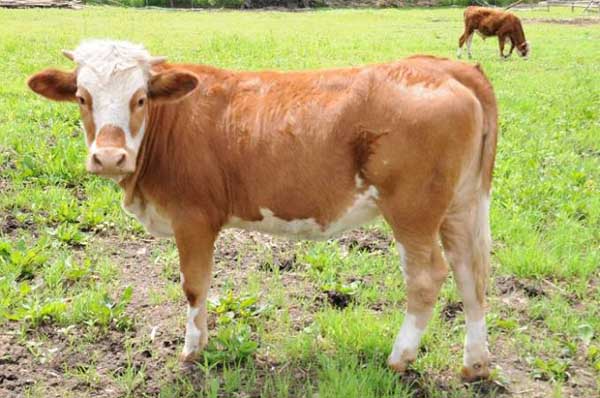
The purpose of my message here today is to share my more than ten years of farming experience with some fellow farmers. I don't expect to be able to help that many farmers, but I sincerely want to communicate with farmers. If you friends have any questions, we can study them together. How to raise cattle well is our ultimate goal. If there are any questions, let's all discuss them together.
1. Farmer friend: When did you start raising cattle, and in what region do you raise cattle?
Wang Yu of Jishun Cattle Farm: My family started raising fattening cattle in 2005, in Yitong, Jilin.
2. Farmer friend: In what form do you raise them?
Wang Yu of Jishun Cattle Farm: We use short-term fattening, raising them to a certain body weight and then selling them to a slaughterhouse.
3. Farmer friend: Why do you bring in breeding stock? Why not breed them yourself at home?
Wang Yu of Jishun Cattle Farm: If you breed them yourself, you first have to buy cows. The estrus period of a cow is generally around 15 months, and the breeding period should ideally be at 18 months of age. If bred too early, it may cause difficult calving. In addition, breeding requires very high-level skills. If you buy a 5- or 6-month-old cow at 300 jin of body weight, after buying it you have to raise it for 10 months to reach 1000 jin before it can be bred. After breeding, you still have to raise it for 10 months before it calves, and after calving the calf has to be raised for 5 or 6 months to reach 300 jin. Calculated this way, it takes about 2 years. Not counting the cow's growth period, counting from after breeding, feeding the cow for 10 months already requires a large cost, and after the calf is born it still has to continue being fed. The time needed to breed a calf is enough for a batch of fattening cattle to be finished and sold. In addition, adding breeding costs, vaccine costs, and feed costs, you can imagine how much more money it costs to buy calves, and how much money breeding can save. In short, I will not use cow breeding. My family has all bulls, which grow fast. So if you want to breed cattle, you first need to have natural conditions and resources, grassland or mountainous areas where grazing is possible, and the mountain slope cannot be too steep. Actually, breeding calves now is also quite good. At present in our northern region, hills are closed and grazing is restricted, and grazing is not allowed. Many people have switched to confined raising. Because the cost is high, they no longer do it. So if you have these conditions, you can absolutely breed calves. I am very optimistic about this market right now. You can see from the price of calves that the current number of domestic beef calves is far, far too insufficient.
4. Farmer friend: Then, as you said, breeding does not make money. If nobody breeds, where do the calves come from?
Wang Yu of Jishun Cattle Farm: It is not that it does not make money, but that the resources and conditions required are too harsh, and my type of farming model is not suitable for breeding calves, because I use confined raising, and confined raising has high costs, so it is not as profitable as fattening. In our northeast region there are also quite a lot of people who breed. They use free-range grazing, the cost is low, the amount of concentrate fed is small, and they rely on grazing for three seasons of the year. In addition, they rely on national subsidies.
5. Farmer friend: May I ask, what size calves do you buy, how big do you raise them to, and how long does it take?
Wang Yu of Jishun Cattle Farm: Generally we bring in 300-400 jin calves. For initial farming, you cannot raise calves that are too small, because if the calf is too small, its rumen has not fully developed. Considering adaptability, around 400 jin is relatively suitable at the initial stage, and the profit is higher than raising feeder cattle (500-800 jin are called feeder cattle). Raising a brought-in 300-400 jin calf to about 1400 jin takes 8-9 months with my family's current feeding method.
6. Farmer friend: How long does it take for feeder cattle to be finished and sold? How much profit is there?
Wang Yu of Jishun Cattle Farm: 500-800 jin are called feeder cattle. They are generally raised for 4-7 months, with a profit of 3000-4000 yuan. For raising feeder cattle, as long as market fluctuations are small and you avoid the seasonal period, the risk is relatively smaller, the profit is not high, and the upfront cost is very large. Now a 600 jin cow costs more than 7000-9000 yuan to buy. That works out to around 14 yuan per jin.
7. Farmer friend: Why is the profit from raising feeder cattle low?
Wang Yu of Jishun Cattle Farm: Generally there are more people in the north raising feeder cattle, because the weather is cold and young cattle adapt slowly, and most raise 600, 700, and 800 jin ones. The purchase price per jin is about 14 yuan (January 2013). If they are feeder cattle fed hormones, then they are not suited to long-distance transport, and the mortality rate is too high. Advantages: stronger disease resistance and adaptability, short cycle. Disadvantages: large upfront investment. If you are farming for the first time, and your sales channels and technology are not mature enough, it is not recommended to raise feeder cattle. If your sales channels are mature, as long as you choose a good cattle breed, generally there is no death. Choosing feeder cattle is still acceptable.
8. Farmer friend: For example, what is the purchase price of the 400-500 jin calves you mentioned?
Wang Yu of Jishun Cattle Farm: All the cattle my family raises now are Simmental cattle. At the end of February this year, the improved Simmental cattle we brought in at 400 jin had an average price of 5500 yuan, compared with 4300 yuan last year, 1200 yuan higher than last year.
9. Farmer friend: Now a 400 jin calf costs 5500 yuan. With the price so high, is there still profit to be made?
Wang Yu of Jishun Cattle Farm: I can say clearly that a 400 jin calf at 5500 yuan (February 2013 price) is not a high price. If you think it is high, it shows you do not understand the market. For a good breed, a good calf, a 400 jin improved Simmental, there is absolutely none below 5000 yuan. If you want to buy a good calf below 5000 yuan, you are dreaming.
At the beginning of 2010, the price of finished beef cattle was around 7.1 yuan, and calves were around 7.5 yuan. At that time, people who had never raised cattle thought the calf price was very high.
At the end of 2010, the price of finished beef cattle reached around 7.8 yuan.
At the beginning of 2011, calves reached around 8.3 yuan. At that time, people who had never raised cattle still thought the calf price was very high.
At the end of 2011, the price of finished beef cattle reached around 9.4 yuan.
At the beginning of 2012, calf prices reached 10.5-12 yuan. At that time, did you still think the calf price was very high?
At the beginning of 2012, finished adult cattle reached around 11 yuan. Some people have observed the cattle market for N years and still did not dare to raise them. Looking at it now, there is a very large gap in the number of domestic beef cattle. As long as beef cattle prices are not affected by grain prices, they definitely will not fall, and can only rise. People's consumption level is increasing. If every household is to be able to eat beef easily, it is estimated that with the current number, it would need to increase by several dozen times to meet demand, so pork prices and beef prices cannot be mentioned in the same breath.
10. Farmer friend: Why are the prices you mention so high? Online in Shandong, cattle are sold at only 2000 yuan for 300 jin, and just over 2800 yuan for 400 jin. Why is that?
Wang Yu of Jishun Cattle Farm: Calves are divided by breed and quality. Different breeds have different prices, and quality and price are also directly related. (Please remember one point: the price of calves is always higher than the price of adult cattle. This is 10000 percent certain.) How do you judge whether a calf's price is appropriate? Generally, if the market price of adult cattle is around 9.5 yuan, the calf price is basically above 10 yuan. If the market price of adult cattle is 9.5 yuan, then the calf price is definitely above 9.5 yuan. There are several hundred sellers of cattle online in Shandong. If you do not understand, you will be cheated. People all love to seek bargains. If you do not correct your mindset, the next person to be fooled may be you. The cattle in Shandong are not grown out of the ground either. Why would they be so cheap? Is it because the quantity is large? Or because there are subsidies? That is all nonsense. Slaughtering them for meat would fetch a higher price than selling to you, so why sell to you so cheaply? Are you relatives? Or close buddies? I just cannot stand those people who deceive farmer friends, burying their own conscience and cheating farmers out of their hard-earned money. Friends, pies do not fall from the sky... Be cautious. Only after being cheated do you realize you were a fool, and by then it is already too late.
11. Farmer friend: Then what is the calf price now in January 2013?
Wang Yu of Jishun Cattle Farm: Now 400 jin or so bull calves are at 14-17 yuan, depending on the cattle's quality. Also, different breeds have somewhat different prices, but the difference is not large. No matter what improved beef calf it is, each market jin absolutely will not be lower than 14 yuan.
12. Farmer friend: For the total cost per head of cattle, based on current prices, how much is the total investment per head?
Wang Yu of Jishun Cattle Farm: Based on the February 2013 calf market (300 jin), plus the money to buy the calf, plus feed, water and electricity, labor, vaccines... and all other expenses, the total investment per head is about 5000 yuan. The specific cost depends on the local feed price and feeding method.
13. Farmer friend: What breed should be chosen in what region?
Heilongjiang, Jilin, Liaoning, Inner Mongolia, **, Hebei, Tianjin, Beijing, Shandong, Shanxi, Henan, Jiangsu, Anhui, Shaanxi, Gansu, Qinghai, Tibet: in all the above regions, raising improved Simmental cattle is possible, and currently this breed has the largest farming numbers. Liaoning, Inner Mongolia, **, Hebei, Tianjin, Beijing, Shandong, Shanxi, Henan, Jiangsu, Anhui, Shaanxi, Gansu, Qinghai, Tibet and other regions: raising improved Charolais cattle is also possible. Guangdong, Guangxi, Yunnan, Fujian, Zhejiang, Hunan, Hubei, Chongqing, Sichuan: in the above regions, raising crossbred Simmental cattle, or improved yellow cattle, or Limousin cattle, is also possible. Some regions are still raising local yellow cattle. Yellow cattle that are basically not crossbred or improved have already been eliminated. Try not to raise local cattle anymore; their growth speed is too slow. It is recommended to change breeds; the effect is different. The above regions and breeds are for reference only.
14. Farmer friend: Over in Shandong they offer us free transport and cash on delivery. Is that credible?
Wang Yu of Jishun Cattle Farm: That is not credible. Do not think the websites online are very formal. Actually, if you look, those websites are basically all the same, and one person may even have several websites. In fact, if you really go to Shandong, you will know that there are no farms there at all, no livestock industry, no bases, just scammers. If you believe they will give you cash on delivery, you can go try. Do not think there is no scam in cash on delivery. There are tricks in this; it is just that you do not know how deep the water is. What do scammers do? As long as you walk into the circle they have drawn, generally you cannot escape. If you cannot find a suitable partner, I am willing to help with all my strength, at least so you will not be cheated.
15. Farmer friend: You mean the current calf price (400 jin) is at least, at the very least, 14 yuan, right?
Wang Yu of Jishun Cattle Farm: Yes, absolutely no breed of cattle is below 14 yuan (except trash cattle), and we also do not buy sick cattle.
16. Farmer friend: How do you judge calf quality? If I pay a good price but cannot buy good cattle, what should I do?
Wang Yu of Jishun Cattle Farm: Generally, choosing calves is very critical. Whether they are sick or not, and how their growth is, are key issues determining how much profit you make later. Without good calves and with poor growth, how can you guarantee your profit? If you have never raised them, you definitely will not understand. We cattle raisers can tell with our eyes which cattle grow fast and which cattle grow large.
First, look at the head: a big head and thick neck are good.
Second, look at the mouth: it must be big.
Third, look at the legs: they must be thick and strong.
Fourth, look at the gap between the front legs: it must be wide.
Fifth, look at the rump: it must be big.
Sixth, look at the body frame: high rump, wide body, and long body are preferable.
Seventh, look at the nose: do not buy one without water droplets, as it indicates disease.
17. Farmer friend: Then what is the price of adult cattle ready for sale?
Wang Yu of Jishun Cattle Farm: Most of the following prices come from quotes by friends across the country. The prices are comprehensive prices and are for reference only.
January 2013 finished cattle (live cattle)
Price 13-13.7 (market jin)
But many regions do not use the method of selling cattle on the scale. They look with their eyes, generally based on meat yield.
In addition, the price depends on the cattle's breed and body weight. Not every breed can sell for this price, and some breeds are also higher than the above prices. Prices change at any time and will be updated at any time.
18. Farmer friend: What risks exist in cattle farming?
Wang Yu of Jishun Cattle Farm: The risk is that you cannot buy a good breed, you pay an expensive price, you get cheated, you get fooled, the cattle you bring home grow slowly, or even die, have difficulty adapting, develop fever, and cost a lot of money for medication and treatment, increasing your investment. Also, feed may not be comprehensive enough and cannot meet the cattle's bodily needs.
Do not worry about the market. The market is very good. I feel beef cattle prices will still rise in the future. The potential is very large.
19. Farmer friend: Why do some cattle farmers lose money?
Wang Yu of Jishun Cattle Farm: First, improper breed selection. If the breed selection is poor, you want to make money? Dream on. With the same feeding method and the same feed, trash cattle just do not gain meat. What can you do?
Second, the chosen breed is not suited to the local climate. Adaptation is difficult, and if they cannot adapt, they are prone to illness. This also has a lot to do with routine prevention.
Third, disease appears, is difficult to treat, and finally leads to death, with the cause of death unknown. How can you not lose money?
Fourth, the partner you choose to buy calves from cheats you. Calves that are themselves low-priced are sold to you at a high price, leaving you no profit to make.
Fifth, feed mixing is unreasonable.
Sixth, management and technology are not up to standard.
Seventh, the selling price is too low.
20. Farmer friend: If you raise them in your way, what is the profit generally like?
Wang Yu of Jishun Cattle Farm: Profit is hard to say. It is related to market conditions, feed costs, selling price, and so on. Normally it is generally more than 4000 yuan in net profit. This year the net profit per head is close to 5000 yuan.
21. Farmer friend: Then what feed do you feed your cattle?
Wang Yu of Jishun Cattle Farm: Feed is divided into roughage and fine feed. Beef cattle mainly rely on roughage.
Roughage: distillers' grains, tofu residue, forage grass, corn stalks, wheat straw, rice straw, weeds can all be used as roughage. For roughage, it is best to choose two of them, or more than two, to achieve feed diversity.
Fine feed: bran (wheat bran), cornmeal, bean cake, soybean meal, cottonseed cake, rapeseed cake can all be used as concentrate.
For roughage, my family generally uses silaged corn stalks. In addition, we add distillers' grains (byproducts from the distillery). Fine feed: cornmeal, bran, soybean meal, additives, bone meal, salt, baking soda, trace elements. (Trace element additives generally cannot be mixed by yourself. They need to be purchased from regular manufacturers and used within the specified period according to the instructions. The use of "three-no" products is strictly prohibited.)
22. Farmer friend: If you use your ratio, how much does one cow cost per day?
Wang Yu of Jishun Cattle Farm: This is relatively hard to calculate, because intake differs at each stage. Generally, concentrate input is increased according to the cattle's body weight, divided into early, middle, and late stages. Normally concentrate input accounts for 0.8%-1.1% of the cattle's body weight. Feed less in the early stage, and add more during fattening in the late stage. Roughage input accounts for about 2.3% of the cattle's body weight. If you raise them to 900 jin, the feed cost is different. This cycle is short, the capital input is small, and the profit is relatively small too. The main feeds my family currently uses for cattle are: corn stalks, distillers' grains, soybean meal, bran, cornmeal, salt, bone meal, baking soda, additives... Combined with local feed, you can also choose according to price (sweet potato vines, peanut stalks, rice straw, wheat straw, soybean stalks, tofu residue, rapeseed cake, etc.). In this way you can calculate the daily cost. Generally, for my family to raise one cow to sale, the feed cost reaches 2000 yuan-3000 yuan. Specifically it depends on how big it is when you start raising it and how big it is when sold. Originally 4000 yuan could fatten one cow, and now it is almost 6000 yuan. Everything has gone up in price.
23. Farmer friend: Besides feed, what other expenses are needed?
Wang Yu of Jishun Cattle Farm: Labor costs (my family pays each person 1500 yuan per month), vaccine prevention and disease treatment costs (vaccines once every 4-6 months, about 50 yuan each time), water and electricity costs, and transport costs.
24. Farmer friend: How many cattle do you currently raise?
Wang Yu of Jishun Cattle Farm: Currently 300 head.
25. Farmer friend: For a number like yours, how many people are needed to manage them?
Wang Yu of Jishun Cattle Farm: I have hired 3 people, all relatives. Generally, with mechanized cattle farming, one person can raise hundreds of head. My uncle and I act as assistants. I am mainly responsible for procuring feed, understanding the market, and technical aspects.
26. Farmer friend: How many square meters does each head occupy?
Wang Yu of Jishun Cattle Farm: Normally each head needs at least more than 4 sq m of space. An activity area of 6-10 sq m is best.
27. Farmer friend: About how much does it cost to build each square meter of barn?
Wang Yu of Jishun Cattle Farm: This is hard to say. It depends on local prices, and also on what style it is. Now cattle barns come in all kinds. Generally there are brick-built ones (like a house) and steel-frame structures, which cost more. There are also plastic greenhouses and simple greenhouses. Building a cattle barn should depend on the region. The north should build enclosed ones, while the south can build simple ones, mainly to block the sun and prevent rain. In short, a formal standard cattle barn does not mean cattle farming will succeed; the relationship is very small.
28. Farmer friend: What should be noted when building a cattle barn, and what conditions should it have?
Wang Yu of Jishun Cattle Farm: First, it should be far from places where people live, because livestock farming fears disease transmission and environmental hygiene issues. The state has regulations on this, except for small-scale farmers. My family's cattle farm is 3 li from our village. Now in our area hills are closed and grazing is restricted. Do not blindly build on large areas of farmland. Illegal occupation of land is also not advisable. Or you can directly rent a factory and renovate the building, which can also serve as a cattle barn and save early-stage funds.
29. Farmer friend: Are there subsidies for farming now?
Wang Yu of Jishun Cattle Farm: This depends on the region. Now in Chongqing, generally small-scale farms also have subsidies, regardless of whether breeding or fattening, about 400 yuan per head. Harbin also has them, but it is stipulated that it must be cow breeding, with a subsidy of about 500 yuan per head. Shanxi, Shaanxi, Henan, Anhui all have subsidies. Specifically it depends on the local government. In my area there is no subsidy at all for breeding or fattening. For specifics you need to consult the local government or animal husbandry bureau.
30. Farmer friend: Generally, how big do your cattle get before you sell them?
Wang Yu of Jishun Cattle Farm: Normally they are raised to about 1400 jin. It also depends on the market price. If the price is good, maybe they are sold at 1400 jin, but they absolutely will not exceed 1500 jin. I have a few friends whose families raise them to at least 1500-1800 jin.
31. Farmer friend: Is the disease rate of cattle high? Is there a mortality rate?
Wang Yu of Jishun Cattle Farm: In livestock farming there are no animals that never get sick, including people; who has never been sick? But the disease rate of cattle is lower than that of people. In addition, it depends on your management, hygiene, and how well quarantine and vaccines are done. If done comprehensively, the disease rate can reach 1%. Mortality rate: in the 6 years my family has raised cattle, we lost 1 head in 2005, 1 head in 2008, and 3 head last year. Death is normal. To say something immoral, dead cattle just mean selling for a little less money.
32. Farmer friend: If I want to raise cattle, what conditions do I need? How many head is suitable for initial farming?
Wang Yu of Jishun Cattle Farm: Generally it depends on local resources. If your area has mountains with grass on them, or has grassland (not referring to planted forage grass), you can adopt an initial free-range method. After 600 jin, do not graze anymore; use confined raising for fattening. If there is no grassland, you can use straw farming. Corn stalks are best. Rice straw, wheat straw, and soybean straw have low utilization value, are hard and not easy to digest, and have little nutrition, unless they can be ammoniated (search "ammoniation technology" on Baidu) for treatment. If you do not even have straw, then you can adopt the method of planting forage grass. First you need farmland. Each mu of forage grass can be harvested as many as 7 or 8 times a year, and can supply the forage needed by 5 head of cattle, ensuring they eat fresh forage every day. Eating forage can reduce concentrate input and increase resistance. Harvest and feed at any time. This grass is not for letting cattle go in to eat; under confined raising, it is harvested manually and fed. If you have no mountains, no grassland, no straw, and no land, then buddy, you are not suited to raise cattle. Buying grass to raise them is a bit far-fetched. Look for another industry.
Wang Yu of Jishun Cattle Farm: Generally small-scale farmers should control it at around 20 head. If it is any fewer, there is basically no profit to speak of.
33. Farmer friend: Can I raise cattle without technology? What should I pay attention to when mixing feed?
Wang Yu of Jishun Cattle Farm: If you do not understand anything, how do you raise them? You need to understand something in whatever you do. If you do not understand and blindly do it, how can you guarantee success? At least you should understand the simple things. Read more materials, buy some books. More technical issues still need to be deepened through understanding during the farming process and gradually accumulated experience. It is not a problem that can be solved in a day or two. If you really want to raise cattle, you still have to go and raise them. Wanting to learn technology from others is hard. It is not that they do not teach, it is that they really do not want to teach. Even I, although I have said so much and a lot of nonsense, when it comes to the truly detailed technical aspects, I will not reveal them either. This is the market. This is competition.
34. Farmer friend: What should be paid attention to in the process of mixing feed?
Wang Yu of Jishun Cattle Farm: When preparing beef cattle concentrate, the following matters need attention: in the preparation of concentrate, the concentrate must include energy feed, protein feed, mineral feed, trace elements, and vitamins. Only with reasonable combination can the healthy growth of the cattle body be ensured.
35. Farmer friend: When the cattle are grown, where do you sell them?
Wang Yu of Jishun Cattle Farm: Almost all those farming are farmer friends, or friends who work in cities and want to return home to start businesses. They have no foresight in this area, but you must consider sales channels. You cannot wait until they are grown and then just sell them casually. If the price is low, our profit will be greatly reduced. If you sell each jin for 0.3 yuan less, for one head that is 3 or 4 hundred yuan of net profit. When the number is large, it is also quite considerable.
36. Farmer friend: Shandong cattle sellers say they sign repurchase contracts. Is that credible?
Wang Yu of Jishun Cattle Farm: I tell you clearly, do not even think about relying on repurchase. This is one of the scammers' tricks. I have more than 10 friends who bought cattle in Shandong. After raising them, they all found their own sales channels. The repurchase contracts they signed were like a blank sheet of paper. They are all cases of being cheated. Why did farming still lose money? It has a lot to do with being cheated. If you have no sales channels and still want to farm, I suggest you find a person with reliable reputation to bring in breeding stock. Without distant worries, there will be near troubles. In today's information age, you should also know that some products guarantee repurchase, but how many actually repurchase? Either this is not acceptable or that is not good; they simply do not want to repurchase your product. Besides, for beef cattle repurchase, do you know the cost of transport? Is this transport fee paid by you or by the supplier? You can imagine. Even if they repurchase, if they give you a low price, will you sell to them?
37. Farmer friend: Is it better to raise cattle or raise sheep?
Wang Yu of Jishun Cattle Farm: The cattle market is very, very stable. Although it does not have the large profit and high price of raising sheep, the beef cattle market is in large shortage. Many people are not suited to raising cattle. Why? Because they do not even have ordinary conditions. What conditions? They do not even have basic feed. No corn stalks, or no rice straw, no distillers' grains, no tofu residue. Then may I ask, without these, how do you raise them? Moreover, the cost of raising cattle is very large, with each head requiring 6000-7000 yuan of investment. Not everyone can afford to raise them. Add building a cattle barn, and 100,000 yuan cannot raise many head either. So in terms of capital input and profit, raising sheep is relatively easier. It is not that cattle have fewer diseases. No matter how big the cattle are, they also have disease and mortality rates. No one can avoid this. So according to your own funds and conditions, investigate the local market, and see what you can actually raise and what is more suitable to raise.
38. Farmer friend: Does cattle farming need any equipment?
Wang Yu of Jishun Cattle Farm: A straw chopper to crush stalks, a boiler for heating. The southern region does not need it. Solar energy can ensure the cattle drink warm boiled water in winter.
39. Farmer friend: How is cow manure handled?
Wang Yu of Jishun Cattle Farm: Those who buy cow manure are basically vegetable growers and greenhouse growers. I have seen cow manure used to raise earthworms, but I have not specifically studied it, or it is directly returned to the field to save chemical fertilizer.
40. Farmer friend: Please summarize cattle farming technology overall.
Wang Yu of Jishun Cattle Farm: The following points need attention: First, choose a good breed, choose improved crossbred beef cattle. Second, control disease, deworm and maintain health, and keep the cattle healthy. Third, reasonably combine feed, with an appropriate ratio of concentrate to roughage, comprehensive nutrition, suitable volume, and good palatability.
What farmer friends generally value is profit, but this profit is generated from many aspects.
1) Breed selection: First, according to the local climate and temperature, choose a breed suited to the local climate. Without a good breed, it is like planting crops without good seeds.
2) Feed combination: Feed combination, balanced nutrition, and diversity can ensure the nutrients the cattle body needs and ensure their growth speed.
3) Daily vaccine and hygiene management: Poor hygiene leads to a high disease rate. If vaccines are not done regularly, once disease occurs, you will know the seriousness of it. You spend money and also affect the cattle's growth.
4) Sales of beef cattle: Everyone is selling adult cattle. Through cattle dealers buying them, when the market price itself is 8 yuan, the cattle dealer gives you at most 7.8 yuan, so each head sells for 200 yuan less. This is net profit.
If you do the above points, success is not far from you.
The above are questions my friends often asked over the past 3 years. Today I publish them, first so friends can know whether they are suited to raising cattle or not, and second so everyone can save quite a lot of time. If you friends have any questions, we can study them together. How to raise cattle well is our ultimate goal. If there are any questions, let us communicate and exchange more.
Contact: Wang Yu Consultation phone: 15774404666