Succulent Plant Growing and Propagation Diary: Experiencing Firsthand How Difficult It Is to Grow Succulents
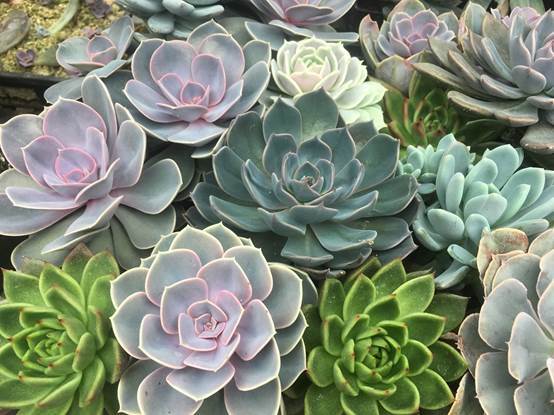
Succulent plants may be the easiest and most beloved plants we grow. They are now very popular at Western weddings, and the trend shows no sign of slowing down, so I have been spreading the word. When a leaf fell from my succulent and began to grow roots, I started propagating succulents almost by accident. "Wow," I thought, "it's cloning itself." So I bought some plants from florists and local nurseries, started pulling off their leaves, and sticking them into soil. Soon I had a greenhouse full of succulents. Apart from water, a little time and light, they need almost nothing to care for, and they are very well suited to flower arrangements, wedding gifts and wearable jewelry decorations.
Growth
I grow succulents in 5 cm seedling pots, and each standard tray can hold 32 of them. These pots are deep, and I have found that about half of the soil goes unused, because succulent roots are very shallow. So when I got new soil blockers, I started dividing them into blocks. I think they actually grow faster this way. According to the instructions on the label, I mix an all-purpose organic fertilizer into the soil before planting, but I have also planted them in plain soil when I had nothing else, and they grew perfectly well. I do not use a special fast-draining cactus soil, because in our very dry climate it is unnecessary - I just use a basic potting soil, so succulents are not as delicate as the legends say. If you live in a humid area, then fast-draining soil is essential!
Succulents grow happily in 5 cm soil blocks.
Succulent flowers are annoying because they drain the succulent's nutrients - but they are very beautiful.
It likes dry, warm, bright conditions, this succulent food. When I notice the plants are a bit soft and the leaves are not as firm as they should be, I water. I water my young plants much more often than my large plants; the large plants seem able to tolerate long periods without water, but I do not water on a fixed schedule, I just feel it out. I think I can wait 10-14 days. I only water from the bottom, because my water is very hard and the mineral spots left on the leaves will not come off, and I cannot put that on plants meant for weddings. About once a month, I add an organic liquid fertilizer to the water and let them take it up. I try to use a fertilizer high in nitrogen and low in potassium - I do not want the succulents to flower, because they produce large, long, fat stems that deform the perfect spiral shape. However, the flowers are stunning and lovely in appearance, and they can add a lot to boutonniere decorations.
If stretching occurs, I just cut off its head and replant it. I simply cut off the top, and it still looks like a rosette, then I put it in a container with fresh moist soil. It will begin to root and grow within a few weeks. Then I remove the remaining leaves on the stem, put it somewhere, and it starts producing new branches.
If I leave the beheaded stem in the soil, it will also start to sprout and shoot! Sometimes I find small nesting insects in the soil around my succulent roots, and some die from root worms, but not many. I will only notice one day that a plant is dying, and if I pull it up a little, it comes right out of the soil, because its stem has been eaten through. I just remove the contaminated soil, rinse the container, and start again. Some varieties seem more susceptible to this problem than others.
Oops. You can see the scars left by aphids on this one. Since using insecticidal soap, the center has turned green.
Aphids! At the same time, this also shows how the stump of a beheaded plant forms.
However, disaster struck! Recently, I have had a problem with aphids eating the newly grown plants - from the old plants to the newly grown shoots. This is bad! They are everywhere with sticky stuff (honeydew), which scars the leaves and stops the plants from growing. They are tiny blue-gray specks, and every time I think I have killed them, they come back. Unbearable. I have started using a Safer brand insecticide, and it does kill them, but they are so cunning that they hide inside the leaves, and some survive. Ladybugs may be next.
Apart from aphids, there is nothing to worry about with these tough, beautiful creatures, and they keep showing off their beauty.
Apart from aphids, there is nothing to worry about with these tough, beautiful creatures, and they keep showing off their beauty.
Some of my succulents are huge! These are about 3 years old, and they have been beheaded and replanted several times.
Propagation
Propagation
Succulent people just want to rule the world! It seems that every part of the plant will produce a new one if given the chance - all I do is create the right conditions to speed up the process. Depending on the variety, a leaf-propagated succulent takes 9 months to a year to reach 10-15 cm in diameter. I use three different strategies to propagate my succulents.
Leaf method: Starting with the mother plant, I choose a plump, healthy bottom leaf (or, I choose many plump bottom leaves at the same time). Larger leaves tend to produce larger, faster plants. I wiggle the leaf back and forth until it comes off the stem, without tearing the leaf or the stem. Sometimes I fail and damage the leaf or stem - some varieties are more cooperative than others. When I collect the leaves, I toss them into an empty room to give them a little light, although they do not need much. If I want to propagate a very satisfying or difficult-to-sprout variety, I will use rooting hormone according to the package instructions.
It takes at least two weeks for these leaves to start growing little red roots. Some plants start making new plants before they root, some plants never root at all, and some produce roots but never grow a new plant! Ideally, you want a leaf to start growing roots, and I put some moist soil into their "apartments," so that while I am waiting for them to grow a plant, their roots have something to grab onto. Then, when I see a leaf with lots of roots and a large plant, I stick it into the soil, burying the roots in the soil. I water these "apartments" well, until I can pull on the plant and feel resistance from the roots. After that, they are free!
Little red roots grow out of the beautiful leaves.
A small plant settles into a new soil block.
Stump method: I use this method to grow plants that are difficult to propagate from leaves - sometimes, they simply do not want to make roots or new plants. Sometimes after beheading a succulent, new shoots start emerging from around it. I just wait for these shoots to grow large enough, then cut them off and stick them into a new soil block. This method, like the next one, produces the fastest clones - they are already prepared to survive, and throughout their growth they have been supported by the mother plant, while a leaf has only a small part of her. To cut off a new plant, sterilize your cutting tool (I like needle-nose snips, or use very fine pointed scissors), and cut the plant close to the mother plant's stem. Make a loose hole in the soil block or other medium, gently place the stem in, and press the surrounding soil firmly for good contact.
These are some unclear plants that grew from the stump of a giant ravaged by mice.
Offset method: This is the easiest method and produces excellent clones. Most succulents, once they reach a certain size, will start producing offsets, sometimes from the main stem, but usually below the soil line. All you have to do is a little hunting - lift the lower leaves of your older succulents, and you may find some treasures under the skirt of their main stem, just waiting for a new home and their time in the sun. Cut them off and plant them in new soil. They will immediately start growing. Make sure you only plant rosettes, not stretched stems, because they have no roots to support any height. New succulent clones separated from leaves also often produce multiple plants, which can be divided to further increase your population. Wait until the plant has grown fairly large, then cut off the largest branch - she has lots of energy, and the other branch can still be supported by the roots she has already grown.
This little offset came out of the soil beneath her mother plant.
Often, new plants appear in pairs, trios or quartets. They can be divided.