Citizen catches a mini giant salamander, police warn it is poisonous and urge releasing it quickly
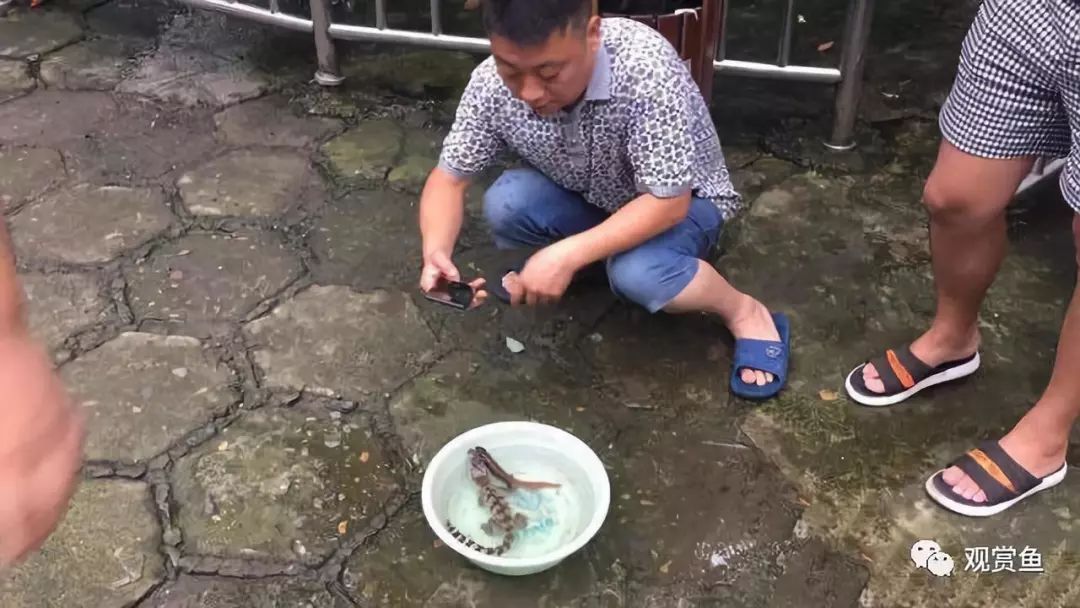
On July 4, after heavy rain, water levels rose in many parts of Yibin, bringing citizens cool weather as well as the fun of getting close to the water and splashing around. In a small stream near the urban area of Yibin, a citizen caught a small brown-and-tan four-legged animal and, suspecting it was a "giant salamander," called the police for help. After identification by forest police and fishery law enforcement officers from Cuiping District, the four-legged animal was found to be an exotic poisonous aquatic creature, a salamander (fire-bellied newt), rather than a "giant salamander," and citizens should not catch them casually.
According to Liu Xiaohuan, head of the Fishery Management Station of the Cuiping District Animal Husbandry and Aquatic Products Bureau, at around 11:30 a.m., they received a call from the Jiangbei Police Station of the Cuiping District Forest Public Security Sub-bureau, saying that a citizen had caught a small "giant salamander." Liu Xiaohuan and other law enforcement officers rushed to the police station and found that the creature, which the citizen had put in a transparent plastic bottle, did not look like a "giant salamander." After identification by experienced fishery staff on site, the creature was an exotic species - a salamander (newt). "Salamanders are poisonous and cannot be picked up directly with your hands," Liu Xiaohuan said.
Salamanders (newts) have short, small bodies, 4 legs, and moist skin, with a body length of about 10-15 cm. They are a type of tailed amphibian, similar in shape to lizards, but their skin surface has no scales. They are also good ornamental animals, and some are kept by people as pets.
Salamanders (newts) are very shy animals. They usually hide in damp places or underwater. Their skin is smooth and sticky, their tails are very long, and their heads are very round. Many species among them live in water all their lives, while others live entirely on land, and some even live entirely in damp, dark caves. Most salamanders (newts), whether they live on land or in water, must reproduce in water.
The series of neotenic developmental processes that salamanders (newts) go through is called metamorphosis. Terrestrial salamanders (newts) lay eggs on land, and larval development occurs within the eggs. When the young hatch, they look like miniature versions of the adults. Aquatic salamanders (newts) lay eggs in water, and after hatching they become tadpole-like larvae, and eventually they lose their gills. Some salamanders (newts) do not lay eggs and can give birth to fully formed young.
Most salamanders (newts) have bright and beautiful body colors, but they are poisonous. They use these dazzling colors to warn intruders, so those predatory animals ready to make a move will keep their distance. When a snake attacks a salamander (newt), the salamander's tail secretes a glue-like substance, and they use their tail to whip the snake's head fiercely and mercilessly until the snake's mouth is stuck shut by the secretion. Sometimes, a long snake is stuck into a ball by the salamander's mucus, unable to move.
The tiny glands of salamanders (newts) also contain a deadly bacterium, and they can use this bacterium to produce a toxin. This toxin is tetrodotoxin. When a salamander (newt) is attacked, it immediately secretes this deadly neurotoxin, leaving its opponent unable to get a bite and forced to retreat.
However, there are no salamanders (newts) distributed in the natural waters of Yibin, so it is suspected to be an exotic species.
"Although salamanders (newts) look gentle, they are actually harmful to the ecological environment," said Lu Guangming of the Jiangbei Police Station of the Cuiping District Forest Public Security Sub-bureau. If salamanders (newts) enter major rivers, they will eat small fry, and they are themselves poisonous, which will harm human health. "It is an aquatic organism, but it cannot be released into the Yangtze River like a 'giant salamander.'" Lu Guangming told reporters that this year more than 200,000 rare fish species endemic to the Yangtze River were stocked in the Yibin section of the Yangtze River, including fry, and these exotic organisms entering the Yangtze River will cause endless harm.
Mr. Hu, a fish-protection volunteer in Yibin, told reporters that in recent years the exotic species frequently appearing in the Yangtze River, such as alligator snapping turtles, gars, and piranhas, areoften bought by many citizens to keep as pets. "After keeping them for a while, they find it troublesome, but they have feelings for them and do not want to kill them, so they recklessly dump them into the Yangtze River." Mr. Hu said that if citizens do not exercise self-restraint in such situations, it will be difficult to stop it by relying only on law enforcement departments, and in the end it is humans themselves who suffer.
The above content comes from Chengdu Business Daily.