What Kind of Fish Is the Paddlefish? A Detailed Guide
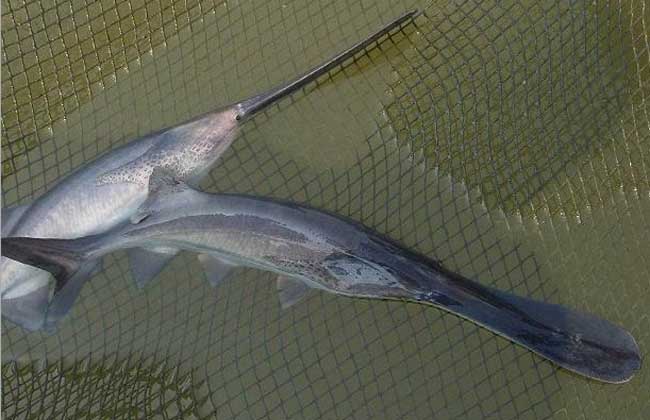
The paddlefish, scientific name Polyodon spathula, is native to the Mississippi River basin in the United States. It is a large freshwater commercial fish of the order Acipenseriformes and the family Polyodontidae. It is a rare sturgeon species that has lived on Earth and survived since 300 million years ago (that is, the dinosaur era), and it is also one of only two species in the family Polyodontidae in the world. Together with the Chinese sturgeon and the Yangtze paddlefish of the Yangtze River waters, it belongs to the order Acipenseriformes and the family Polyodontidae.
The paddlefish is a cartilaginous fish, with bare skin, glossy and scaleless, and a snout shaped like a spoon, resembling a duck bill, hence it is also called the duck-bill sturgeon. The snout is especially long, flat, and oar-like. The body surface is smooth and scaleless, and the back is blackish blue-gray, often with some spots interspersed among it. The sides have dotted ochre coloration, and the belly is white. The mouth is large and the eyes are small, and the forehead is higher than the mouth. The gill rakers are dense and slender, the operculum is large and extends backward to the pelvic fins, the caudal fin is forked, and the caudal peduncle is covered with jointed scale-like plates.
The paddlefish is a filter-feeding fish. Its main foods are zooplankton and cladocerans, and it especially likes to eat water fleas; it also occasionally feeds on small aquatic insects such as chironomid larvae. When the paddlefish is under 12 cm in body length, it can eat zooplankton one by one, and also eats small fish and small shrimp. When the fish exceeds 12 cm in body length, its feeding organs are fully developed and it switches to filter feeding, able to capture very fast-swimming copepods. As the paddlefish individual grows, it also feeds on pellet feed.
The paddlefish lives in the slow-flowing waters of the Mississippi River. It has strong adaptability to temperature changes and has been found in 22 states in the Mississippi River basin in the United States, including from the Missouri River to Montana, and in the Ohio River and its main tributary basins. The paddlefish spawns each spring on shoals in specific river basins, with the number of eggs ranging from 3 to 6 million. Males reach sexual maturity at 7 years, females at 9 years, and wild paddlefish can live up to 55 years, but usually only survive to 20-30 years.
The paddlefish is a valuable large freshwater commercial fish in North America. Its meat is delicious, and the snout is rich in collagen and highly nutritious, making it a fine banquet dish. Caviar is expensive on the international market, the skin can be made into high-quality leather, and each kilogram of finished fish is about 200 yuan. The paddlefish can also be sold as an ornamental fish, with each 15 cm-long individual priced at 30 yuan. The United States began artificial breeding in the 1960s, and China introduced it from the United States in 1988. It has now successfully carried out artificial seedling breeding and begun to promote production.