Is the rumor about how ocean sunfish die true?
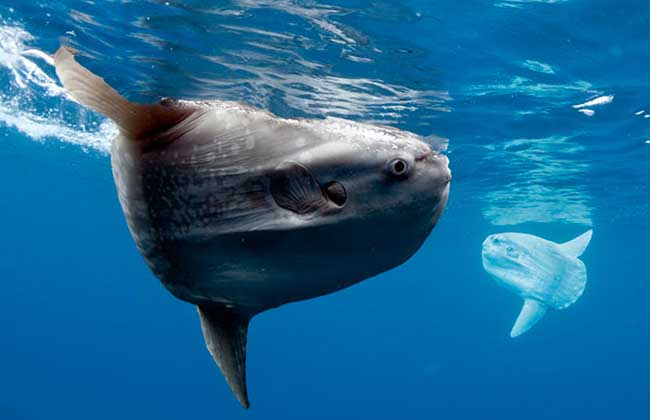
The ocean sunfish is the collective name for 3 species of oceanic fish in the family Molidae, order Tetraodontiformes, also known as sunfish, head fish, ocean sunfish, and so on. In Taiwan, China it was originally called "fan che yu" (flipping fish), because fishermen often saw it lying on its side at the surface as if sunbathing and used the name "flipping" to describe it. It is distributed in and inhabits tropical and subtropical oceans, and is found in coastal waters of China. Let us take a look below at whether the stories about how ocean sunfish die are true!
Is the story about how ocean sunfish die true?
The stories about how ocean sunfish die are false. As for the claims of dying from "excessive stress" and "too great a shock," there are no reports of this in the scientific community, and the ocean sunfish is a relatively long-lived fish. According to growth curves simulated by captive breeding research, it is estimated that they need at least 20 years to grow to 3 m long, so leaving aside whether an ocean sunfish can feel "emotional stress" and "too great a shock," for such a long-lived fish, a certain "psychological resilience" should still be expected. As for "bubbles entering the eyes," this is actually a problem that does not occur: when diving, the ocean sunfish's eyes are fully exposed to water, and while "sunbathing" one eye may be fully exposed to the air, and the ocean sunfish has no eyelids, so there is no space for bubbles to remain. As for the ocean sunfish's true cause of death, it may still be related to humans.
The growth process of the ocean sunfish
Unlike the "normal" and "sea monster" personas, the ocean sunfish's growth history is a bitter record of being bullied. When young, because of the lack of maternal care and their tiny size, even when gathered in groups they are often harassed by various predatory fish, and tuna, mahi-mahi, and others regard them as a fine meal. As adults, although they have a terrifying bulk, they lack sufficient self-defense ability and escape techniques, so large marine carnivores such as killer whales and sharks will not spare them either, and sea lions sometimes even hunt ocean sunfish for fun. Fortunately, those "two-legged terrestrial omnivores" have not developed much interest in these "sea monsters," so they can still live freely, basking in the sun.
The current population status of the ocean sunfish
The ocean sunfish is gentle by nature, so it is often attacked by humans, killer whales, and sea lions. In early summer, when large numbers of young ocean sunfish enter Monterey Bay with abundant food and warm ocean currents, California sea lions often attack them. Sea lions often bite the ocean sunfish's dorsal and pectoral fins and attack them toward the water's surface. If the sea lion cannot tear through the ocean sunfish's thick, hard skin, it throws the immobilized ocean sunfish toward the water's surface like a frisbee, making it a fine meal for vicious seagulls. This is how cruel the food chain arranged by nature is.
The breeding habits of the ocean sunfish
The ocean sunfish is both clumsy and poor at swimming, and is often eaten by other fish and marine mammals in the ocean, but the reason it has not gone extinct is its powerful reproductive capacity. One female can lay about 25 million to 300 million eggs at a time, but due to some natural factors, only about 30 survive to the breeding season, yet this does not prevent it from being called one of the fish that produce the most offspring in the ocean. The breeding process of the ocean sunfish is also very interesting. Whenever the breeding season arrives, the male chooses an ideal spot on the seabed, uses its pectoral fins and tail to dig open the sand and mud, and builds a concave "spawning bed," luring the female into the "spawning bed" to lay eggs. After the female lays the eggs, she leaves without looking back. At this point, the male quickly releases sperm over the eggs, and from then on takes on the duty of guarding the eggs and raising the young until the juvenile fish grow up.