What Is the Relationship Between Clownfish and Sea Anemones? A Guide to the Mutualistic Symbiosis
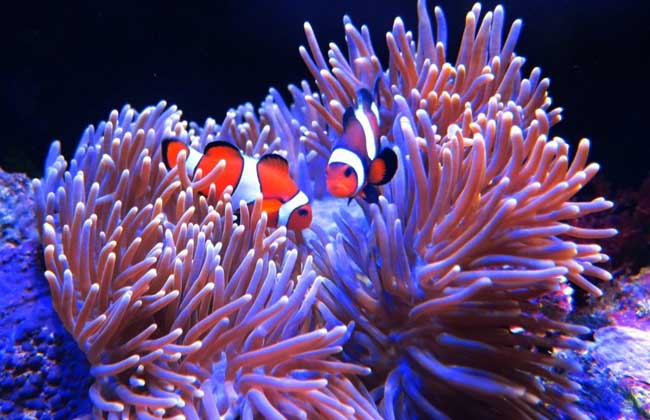
The clownfish, also known as the anemonefish, is the common name for fish of the subfamily Amphiprioninae in the family Pomacentridae. It gets its name from the one or two white stripes on its face that resemble the clown role in Peking opera. It shares an inseparable symbiotic relationship with sea anemones and lives among coral reefs and rocky reefs. Juveniles often live in symbiosis with large sea anemones, sea urchins or the tops of small corals. Let's take a look below at the relationship between clownfish and sea anemones!
The Relationship Between Clownfish and Sea Anemones
Clownfish and sea anemones have a symbiotic relationship. The clownfish's body surface has a special mucus that protects it from the sea anemone's sting, allowing it to live safely and comfortably among the tentacles. Thanks to the anemone's protection, the clownfish is safe from attacks by larger fish, and the anemone's leftover food can also feed the clownfish, while the clownfish can use the anemone's tentacle cluster to build a nest and spawn in peace. As for the sea anemone, the clownfish's free comings and goings can attract other fish to approach, increasing its chances of catching prey, and it can also remove the anemone's dead tissue and parasites, while the clownfish's swimming helps reduce debris settling into the anemone's cluster. The clownfish can also rub its body against the anemone's tentacles to remove parasites or mold from its body.
The Reproductive Characteristics of Clownfish
Clownfish are not the only hermaphroditic animals, but they are one of the few species in which a male can become female while a female cannot become male. Each clownfish population has one dominant female and several adult males, the latter being hermaphroditic during their juvenile stage. If the dominant female dies, one of the adult males will undergo hormonal changes and transform into the new female of the population. During the spawning season, the male and female fish exhibit territorial behavior in guarding the nest and eggs. One end of each egg is attached to a rock by a fine filament, and the eggs hatch in about a week. After floating in the water column for a period, the young fish settle onto symbiotic organisms such as sea anemones.
What Varieties of Clownfish Are There?
1. Ocellaris clownfish: The ocellaris clownfish is found in the reef waters of the South China Sea, the Philippines and the western Pacific. It has a body length of 10-12 cm and an oval shape. Its body is orange-red, with three silvery-white bands on the sides, located behind the eyes, at the center of the dorsal fin and at the caudal peduncle. The white band at the center of the dorsal fin forms a triangle on the side of the body, and all fins are orange-red with black edges. Its food includes brine shrimp, seaweed, chopped fish meat and pellet feed.
2. Red clownfish: The red clownfish's range includes the Gulf of Thailand to the southwestern Palau Islands, north to southern Japan, and south to the waters around Java, Indonesia. The adult fish has a black body, with the head, chest, abdomen and all fins red. Behind the eyes there is a broad white band edged in white that extends downward to the throat and isthmus. Sub-adult fish are uniformly orange-yellow, with a white vertical band behind the eyes.
3. Black two-band clownfish: The black two-band clownfish is found in the coral reef waters of the Indian Ocean. It has a body length of 10-15 cm and an oval shape. Its whole body is purplish-black, with three silvery-white vertical bands on the sides behind the eyes, at the middle of the dorsal fin and at the caudal peduncle. The mouth is silvery-white, and a black band runs through the eye. It requires clear water quality. Its food includes brine shrimp, fish worms, chopped fish and shrimp meat, and marine fish pellet feed. It likes to hide among flower-like sea anemone tentacles.
4. Tomato clownfish: The tomato clownfish is found in the coral reef waters of the Indian Ocean and the Pacific Ocean. It has a body length of 10-15 cm and an oval shape. Its whole body is purplish-black, all fins are purplish-red, and there are three silvery-white bands on the sides behind the eyes, at the middle of the dorsal fin and at the caudal peduncle. It is very beautiful. Its food includes marine algae, zooplankton and marine fish pellet feed.
5. Red two-band clownfish: The red two-band clownfish is found in the coral reef waters of the Indian Ocean and the Pacific Ocean, as well as in Taiwan, China, the South China Sea and the Philippines. It has a body length of 10-12 cm and an oval shape. Its whole body is bright red, with two silvery-white bands on the sides behind the eyes and at the middle of the dorsal fin. The body color of the two-band clownfish is variable, including bright red, purplish-red and purplish-black. Its food includes marine fish pellet feed, chopped fish meat and seaweed. It requires clear water quality and likes to hide among colorful sea anemones.
6. Cinnamon clownfish: The cinnamon clownfish is found in the coral reef waters of the Philippines, Taiwan, China and the Pacific Ocean. It has a body length of 5-8 cm and an oval shape. Its whole body is light brown, with a white band behind the eyes, like a silver ring around its neck. The mouth is silvery-white, and from the mouth along the back to the caudal peduncle, together with the dorsal fin, it is silvery-white. Its food includes algae, fish worms, brine shrimp and marine fish pellet feed, and it likes to live among sea anemones or coral clusters.