What is a clownfish? Getting to know this tropical saltwater ornamental fish
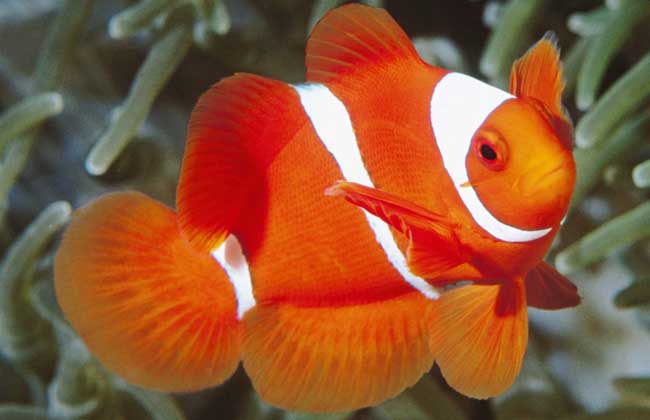
Clownfish is the common name for fish of the subfamily Amphiprioninae in the family Pomacentridae, named because each has one or two white stripes on its face resembling the clown role in Peking opera. There are 28 known species, one from the genus Premnas and the rest from the genus Amphiprion. They are native to the warmer waters of the Indian and Pacific Oceans, including the Great Barrier Reef and the Red Sea, and inhabit coral reefs and rocky reefs. Juveniles often live in symbiosis with large sea anemones, sea urchins, or the tops of small corals.
The clownfish is a tropical saltwater fish with a maximum body length of 11 cm. Total dorsal spines 10-12, total soft dorsal rays 4-16, total anal spines 2, total soft anal rays 14-15. Juveniles are entirely black with blue-centred scales, white patches on the forehead and upper sides, and all fins black except the transparent pectoral fins and the outer parts of the soft dorsal fin rays.
Each clownfish colony has one dominant female and several adult males, the latter being hermaphroditic in their youth. If the dominant female dies, one of the adult males will undergo hormonal changes and transform into the new female of the colony. During the spawning period, the male and female fish exhibit territorial behaviour, guarding the nest and the eggs. One end of each egg is attached to a rock by a fine filament, and hatching occurs in about a week. After the larvae drift in the water column for a period, they settle on symbiotic organisms such as sea anemones.
The clownfish has a special mucus on its body surface that protects it from the sea anemone, allowing it to live safely and comfortably among the tentacles. The sea anemone's protection shields the clownfish from attacks by other larger fish, while the anemone's leftover food can also feed the clownfish, and the clownfish can use the anemone's tentacle cluster to build its nest and spawn in safety. For the sea anemone, the clownfish's free movement in and out can attract other fish to approach, increasing the chance of catching prey, and can also remove the anemone's necrotic tissue and parasites, while the clownfish's swimming can reduce debris settling into the anemone's cluster.
Clownfish are highly territorial. Usually a pair of male and female fish will occupy one sea anemone and prevent other members of the same species from entering, though a large sea anemone may also allow some other juveniles to join in. In such a large family, the strongest in build is the female, who with her male mate occupies the dominant position, while the other members are all males and juveniles that have not yet developed their distinguishing features.