Do Angelfish Eat Small Fish? A Detailed Guide to Their Diet
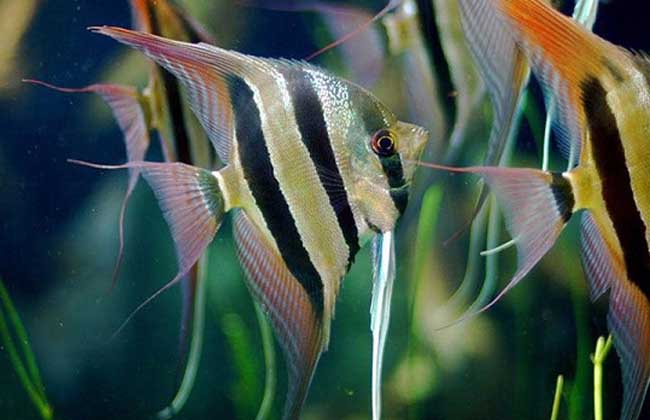
Angelfish is the collective name for Pterophyllum scalare, Pterophyllum leopoldi, and Pterophyllum altum under the genus Pterophyllum. They have an elegant bearing and graceful swimming posture. Although they lack brilliant colors, their popularity among aquarium enthusiasts is unmatched by any other tropical fish, and they are almost synonymous with tropical fish. Let us take a look below at whether angelfish eat small fish!
Do angelfish eat small fish?
Angelfish will attack other small fish, so it is best to avoid keeping them together. Angelfish are not exactly gentle in temperament, have a sense of territory, and have no special requirements for water quality. It is best not to keep them together with small fish. One thing to note is the tiger barb of the Cyprinidae family; this mischievous and lively small fish often likes to nibble on the anal and caudal fins of angelfish. Although it is not a fatal attack, in order to preserve the beautiful appearance of angelfish, it is still best to avoid keeping angelfish and these fish together.
What feed do angelfish eat?
Angelfish baits include fish worms, tubifex, ciliates, yellow mealworms, small live fish, pellet feed, and so on. Different varieties of angelfish also have different bait choices. Angelfish with a body length of 3 to 12 cm mainly feed on turtle worms, supplemented by tubifex, bloodworms, and yellow mealworms. For angelfish with a body length above 12 cm, turtle worms are too small and have poor palatability, so slightly larger baits should be chosen, mainly bloodworms, tubifex, yellow mealworms, small live fish, and so on. Most are mainly fed animal-based bait, and small varieties can also be trained to mainly eat pellet feed, while fish that mainly eat plant-based bait are very few.
What can angelfish be kept with?
1. Kissing gourami: The kissing gourami is native to Thailand, Indonesia, Sumatra, and other places. It is a common ornamental fish. Its wild body length is 20 to 33 cm, and in artificial breeding it is 3 to 5 cm. Among ornamental fish varieties, it belongs to the small ornamental fish category. It is named kissing gourami because two fish kiss each other, and it is loved by many fish keepers, implying that one's love will last long. In fact, kissing gourami perform the “kissing” action not only between opposite-sex fish but also between same-sex fish. The “kiss” is not an expression of friendship, but a kind of contest.
2. Catfish: Catfish, also known as bearded catfish, sticky fish, pond catfish, live-bearing fish, soil catfish, and so on, is a bottom-dwelling carnivorous fish. During the day it mostly hides in grass, under stones, or at the bottom of deep water, and generally forages frequently at night. Its prey is mostly small fish, such as Hemiculter leucisculus, crucian carp, gobies, topmouth gudgeon, carp, loach, and so on, and it also eats shrimp and aquatic insects. Catfish mainly swallow their food, and the role of their teeth is mainly to prevent food from escaping.
3. Red zebrafish: Red zebrafish are easy to raise. The suitable water temperature is 18 to 26°C, and they are not strict about water quality. The water quality is neutral. They are highly tolerant of heat and cold and can grow well in water above 10°C. They belong to the low-temperature, low-oxygen fish group. They like to eat bloodworms, red worms, and so on, and can also be fed with pellets. They are gentle in temperament, lively and delicate, and swim almost constantly in the water all day. They can be kept with other small fish and are the ideal fish species for beginners.
4. Pearl gourami: Pearl gourami originally lived in waters with abundant aquatic plants. Their suitable temperature range is 20 to 30°C, the optimal growth water temperature is 24 to 28°C, and the pH value is 6.5 to 8.5. They are gentle in temperament, especially the females. After mating, males tend to attack females, while at ordinary times there is rarely fighting among males. They cannot be kept with ferocious fish, otherwise they will become frightened, causing their body color to become dull and lusterless, and they may even stop eating. Adults also cannot be kept with very small characin fish, as they will also chase and swallow these small fish.
5. Corydoras: Corydoras are excellent mixed-keeping fish species in aquariums. Taxonomically, they belong to the order Siluriformes, subfamily Corydoradinae, genus Corydoras. So far, about 120 to 150 species have been discovered, but only about 80% have actually been named. Many individual Corydoras have confusing classifications and names. The optimal growth temperature is between 22 and 25 degrees. They are quite docile and can be kept with most fish.
6. Discus: Although discus are called angelfish, their kinship with angelfish is actually very distant. Angelfish is the collective name for Pterophyllum scalare, Pterophyllum leopoldi, and Pterophyllum altum under the genus Pterophyllum, while discus is the collective name for Symphysodon aequifasciatus, Symphysodon discus, and Symphysodon tarzoo under the genus Symphysodon. They are suitable for weakly acidic to neutral soft water with a pH value of about 6 to 7, but most artificially improved varieties can also adapt to weakly alkaline water with high hardness. Generally, the average aquarium water temperature only needs to be maintained between 26 and 28°C.