What fish are suitable for keeping with discus?
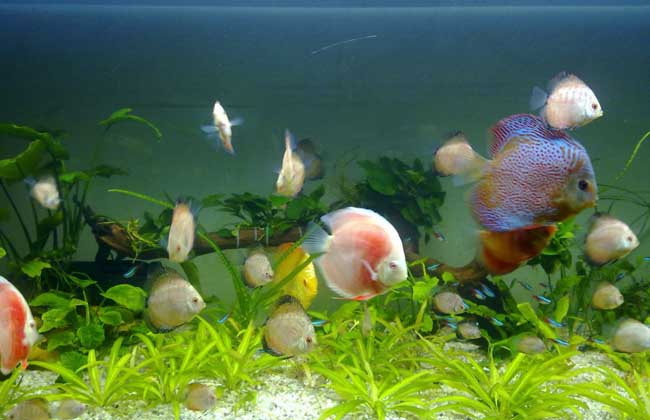
Although discus is called "discus" (a type of angelfish in Chinese naming), it is actually far removed in kinship from the angelfish (Pterophyllum). Its body colors are rich and varied: there is the red discus with red as the main tone, the brown discus with brown as the main tone, and the blue discus with blue as the main tone, accented with red, yellow, blue, green, black, brown, white, purple and so on. The varieties are numerous and simply beautiful to behold. Let's take a look below at what fish can be kept with discus!
Angelfish
The angelfish (Pterophyllum) has an elegant bearing and graceful swimming posture. Although it lacks brilliant colors, its popularity among aquarists is unmatched by any other tropical fish. It seems there is not a single case of an enthusiast who has kept tropical fish for many years without having kept angelfish; it is almost synonymous with tropical fish. All varieties of angelfish can be kept with discus, and the industry calls this combination a "match made in heaven."
Dutch rams
The Dutch ram is the name for the rainbow cichlid (Mikrogeophagus ramirezi) native to the Orinoco River system in Venezuela, improved and bred by Dutch and German breeders. It belongs to the same genus as the Bolivian ram, but its colors are more brilliant. Adults reach 6-9 cm in body length and bear patterns similar to those of the killifish family, glistening like gemstones. The male's fins have beautiful red edges, and the black spot on its back combined with red eyes makes it extraordinarily striking. When the male spreads the four black spiny rays on its dorsal fin, it is very beautiful.
Neon tetras
The neon tetra, scientifically named Paracheirodon innesi, is a fish of the genus Paracheirodon in the family Characidae. Its whole body is shrouded in a blue-green glow, with a bright blue-green band running from head to tail, and a short red band below the blue-green band on the rear half of the body. The belly is silvery white, and the red and blue bands run through the whole body, dazzling to the eye. Under different lighting or in different environments, the color of the bands varies from deep to light. Because of its extremely brilliant body color, it has the laudatory title of "queen" among tropical fish and is a highly beloved ornamental fish.
Cardinal tetras
The cardinal tetra, scientifically named Paracheirodon axelrodi, also known as the red neon tetra, new neon tetra, new red neon tetra and so on, is an important ornamental fish of the genus Paracheirodon in the family Characidae. Native to the Amazon River basin in South America, it is petite and slender, with a body length of about 4-5 cm. Its most obvious feature is a bright blue-green band on the upper half of the body and a red band on the lower half. The whole body has a metallic sheen and sparkles, and it is especially beautiful when swimming. It is gentle in temperament, best kept in groups, and swims in a lively and sprightly manner, making it very endearing.
Rummy-nose tetras
The rummy-nose tetra originates in Brazil, South America. Its body shape is similar to other species of the same genus. Its head is red, the snout is bright red, and the whole body is silvery white, nearly transparent. The caudal fin bears black-and-white stripes similar to those of the scissortail tetra. It reaches 50-60 mm in body length, is robust and easy to keep, and is gentle in temperament. It can be fed small fish food and is suitable for keeping in densely planted aquariums, and can be kept with other small fish.
Red-tailed black sharks
The red-tailed black shark, also known as the black shark minnow, red-tailed fish, fire-tailed fish and so on, comes from Thailand. Among tropical fish it is a medium-to-large variety, reaching up to 14 cm in body length. Its body is spindle-shaped, the caudal fin is forked, the whole body is ink black, and the caudal fin is golden red. Red and black together make for distinct, unique coloring. Another hallmark is its particularly broad dorsal fin and the two barbels on its mouth. It swims agilely and lively. Adults will attack other fish, especially loving to bite filamentous fin rays, so it is not suitable for keeping with fish that have filamentous fin rays.
Coffee Cory catfish
The coffee Cory is one of the most popular and also one of the most famous species among the Cory catfish. Its body color is a slightly green coffee brown, hence the common name "coffee Cory," and it has a black band in the center of the flank, hence also called "banded armored catfish." It is gentle in habit and can be kept mixed with other fish. It is also robust in constitution and is one of the famous "scavenger fish." Males and females are distinguished by the long, thick spines on the male's dorsal and anal fins, while the female's belly swells during the breeding season, which can be used for identification.
Upside-down catfish
The upside-down catfish belongs to the order Siluriformes and the family Mochokidae. It is a very amusing tropical ornamental fish. Neither its color nor its body shape is particularly beautiful, but what attracts people is its swimming posture. When they boldly swim agilely with their bellies facing upward, anyone who sees them will let out an amazed exclamation. This is also why the upside-down catfish has attracted many aquarists to keep them.
Scavenger fish
The scavenger fish is very simple to keep; almost any water will keep it alive. But to keep it well, it is best to provide slightly acidic soft water or neutral water quality, with a suitable water temperature above 20°C. It often attaches to aquarium walls or aquatic plants, licking off algae. Fights sometimes occur between individuals of the same species. It can be kept with large tropical fish. Distinguishing males from females is difficult; sexually mature females have a slightly more swollen belly than males.
Chinese high-fin banded shark
The Chinese high-fin banded shark, also known as yellow row, blood row, pink row, fire-burned bream, wood-leaf plate, red fish, purple bream, swallow fin fish, fire row, Chinese sailfin sucker and so on, grows in the Yangtze River system of China and is an egg-laying animal. It has not yet been successfully bred in aquarium environments. Its body shape is peculiar and its colors are vivid; the juveniles in particular have a unique body shape and brilliant colors and swim quietly, and people honor it as "smooth sailing," while in Southeast Asia it enjoys the laudatory title of "Asian mermaid." It is a rare freshwater species unique to China.
Note: Carnivorous medium and large fish such as arapaima and bichirs are not suitable for keeping with discus. Large catfish such as the red-tailed duckbill catfish, the Nile perch demon, or the silver arowana and other carnivorous species have peculiar feeding habits such as biting scales and fins, which will cause injuries to other fish species, making them less suitable for keeping with discus. In addition, slender species such as guppies or egg-laying species are also not suitable.