Can the pleco actually be kept together with koi?
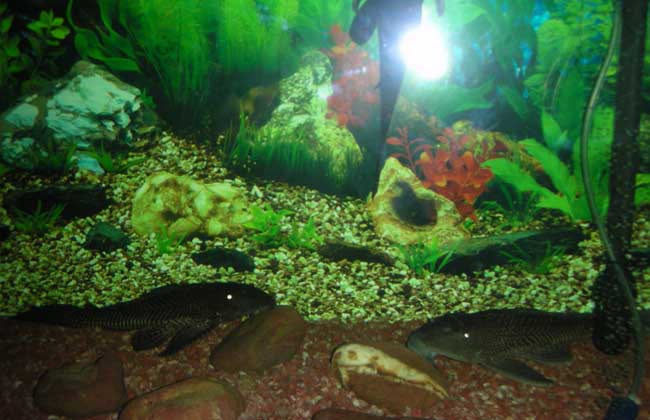
The pleco (sucker fish, algae eater, armoured catfish, etc.) - many people habitually put one in the tank when keeping fish. Juveniles are gentle, adults are rather aggressive. Juveniles mainly feed on algae attached to stones, while adults become omnivorous with a carnivorous bias and eat enormous amounts. Let's take a look below at whether plecos can be kept together with koi!
Can plecos be kept together with koi?
Keeping plecos together with koi is not recommended. Although in theory plecos and koi can be kept together, the temperature cannot be too low - too low and the pleco cannot stand it, too high and it is bad for the koi - and the cleaning effect is not very good either, as they only eat a bit of moss and also compete for fish food. At the same time, plecos will suck on the mucous membrane on koi's bodies and never reform, but if the size difference is too great, the koi will also bite the pleco.
What food do plecos eat?
The pleco is an omnivorous fish that feeds on algae, benthic animals and debris in the water, and can also swallow large quantities of fish eggs and fry. In aquariums it often attaches to stones and glass to stabilise its body and feed on algae, and also seeks out benthic animals (such as tubifex worms). For small pellet food floating on the surface, it will suck it up by pressing its belly against the water surface, its mouth like a vacuum cleaner, sucking fish faeces and green plants right into its stomach. It also holds a bubble in its mouth; this bubble contains oxygen, allowing it to stay underwater for a long time.
What can plecos be kept together with?
1. Rosy fish: Rosy fish are distributed in the coral reef waters of the Indian Ocean to the Pacific Ocean. They are carnivorous and can be fed animal bait as well as artificial feed. Once they have adapted to life in the aquarium, they will accept most live bait and dried feed, except they will not eat flake feed. Do not keep them together with agile, greedy fish, otherwise the rosy fish will not be able to grab food. Feeding time is best in the evening, which suits their nocturnal lifestyle and also helps them accept new food.
2. White cloud mountain minnow: The white cloud mountain minnow (also known as Baiyunshan fish, white cloud golden stripe, red-tailed fish, Tang fish, etc.) has a brilliant, colourful body when alive and is a famous ornamental fish. Generally the back is brown, the belly silvery white, with 1 golden-yellow or silvery-blue longitudinal stripe running along the middle of the flank, and several dark brown lines above and below the stripe. At the base of the caudal peduncle there is 1 red round spot, the iris is golden yellow, the base of the dorsal fin is red, and the other fins are yellow-green with transparent edges. Because this fish was first discovered in the streams of Baiyun Mountain on the outskirts of Guangzhou, China, its English name is white cloud mountain minnow.
3. Zebrafish: The zebrafish (also known as blue-striped fish, striped fish, blue zebrafish, Indian fish, Indian zebrafish, etc.) has an elongated, slightly spindle-shaped body, a small and somewhat pointed head, and a relatively short snout. Its whole body is covered with multiple dark blue longitudinal stripes resembling a zebra, arranged alternately with silvery-white or golden-yellow longitudinal stripes. When swimming in schools in an aquarium, it is like a herd of zebras galloping across the African savannah, hence the elegant name zebrafish. It is a relatively easy fish to keep.
4. Tiger barb: The tiger barb (scientific name four-banded barb, also known as four-striped fish, four-striped barb, etc.) originates from inland waters such as Malaysia and Sumatra Island and Kalimantan Island in Indonesia. It likes to live in groups, swims agilely and is lively. Adults will attack other fish, especially liking to bite filamentous fin rays. It should not be kept together with fish that have filamentous fin rays (such as angelfish), and is best kept in groups of its own kind.