Are Kissing Gouramis Easy to Keep? A Comprehensive Analysis of Keeping Difficulty
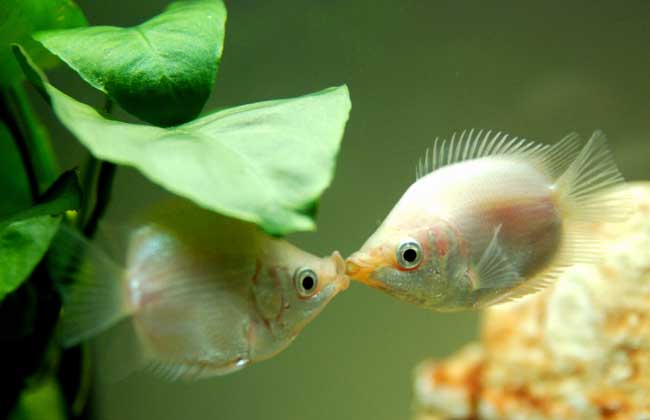
The kissing gourami is a fish of the genus Helostoma in the family Helostomatidae. It prefers to inhabit tropical rivers and was often used as a food fish in its native range. It is not demanding about water quality, does not show particularly obvious schooling behavior, and swims very slowly, appearing graceful and dignified, with captivating charm and ornamental value. Let's take a look below at whether kissing gouramis are easy to keep!
Are Kissing Gouramis Easy to Keep?
Kissing gouramis are easy to keep. The kissing gourami is a tropical fish native to Java and Borneo in Southeast Asia. Local residents are very fond of kissing gouramis and often keep them in fish tanks to watch their "kissing" performances. Later, the kissing gourami became a world-famous ornamental fish, and its market price soared all the way up, with each fish selling for around 100 US dollars.
What Food Do Kissing Gouramis Eat?
Kissing gouramis are gentle in temperament, move in groups through all water layers, and can be kept mixed with other fish. They are omnivorous and not picky at all: breadworms, chopped earthworms, and artificial feed are all fine. They eat whatever their owner feeds them. Not only do they grow quickly, but their disease resistance is also good, and they rarely get sick, multiplying and producing many offspring. Under artificial keeping conditions, kissing gouramis have no fixed breeding season, and breeding is relatively simple. It is best to keep them in pairs and feed them heavily to encourage breeding.
How Should Kissing Gouramis Be Kept Properly?
1. Fish tank: We all know that adult kissing gouramis can reach 20-30 cm in body length, and smaller kissing gouramis can also exceed 10 cm. Calculating by a tank-to-fish-body-length ratio of 3:1, the tank should be at least 90 cm. However, most kissing gouramis people buy are around 10 cm, so a tank 40-60 cm long is enough.
2. Water temperature: Kissing gouramis can live in water temperatures of 18-30°C, with above 22°C generally being suitable. If keeping them in winter, you may not need to install a heater if your home has heating. Installing a thermometer lets you observe the water temperature at any time. If the water temperature cannot be maintained at around 25°C, you need to buy a thermostat. In addition, keeping kissing gouramis has no strict requirements for water quality; they like weakly acidic soft water.
3. Feed: Kissing gouramis are easy to keep precisely because they are not picky eaters. They eat both animal-based and plant-based feed, like red fish worms (bloodworms) best, and love eating aquatic plants and algae.
4. Tankmates: Kissing gouramis swim relatively slowly and are not suitable for being kept with aggressive fish species, such as piranhas, flowerhorn cichlids, three-spot cichlids, and so on. It is best to keep fish species that are smaller than kissing gouramis and gentle in temperament.
5. Male and female: Male and female kissing gouramis are not easy to distinguish, and juveniles are almost impossible to identify by sex. In adults, the male's anal fin is generally broad and long, and the body appears somewhat slender; the female's anal fin is narrow, the body is broad and thick, and the abdomen bulges slightly.
6. Breeding: Kissing gouramis directly lay floating eggs that float on the water surface. The eggs are amber-colored; if they turn white, it means the eggs are unfertilized. After spawning is complete, the parent fish can be removed, and the eggs can be artificially incubated. Larvae hatch in 20-24 hours. After 2-3 days, when the larvae can swim, they must be fed large amounts of gray water (infusoria), otherwise they will starve to death. After another 2-3 days, feed small red worms for 3-4 days, then larger worms can be fed. At 15-20 days, the rapidly growing larvae should be divided into two or three tanks to ensure a higher survival rate. Sometimes a single brood of larvae can yield more than 9,000 survivors.