What are the common varieties of feng shui fish?
Keeping fish at home is the most beneficial for feng shui. Feng shui fish help a household prosper and avert misfortune, but because it seems simple, people assume that just keeping fish will be effective. In reality, there are quite a few things to pay attention to when keeping fish, and since different types of feng shui fish have different functions, you must first understand the types of feng shui fish before keeping them. Below, let's take a look at the common types of feng shui fish!
Koi
Koi have been kept in China for even longer than goldfish, but it was in Japan that koi truly flourished as a major ornamental fish and feng shui fish. They have always been regarded as fish with spiritual nature that can make a family's fortune flourish. However, due to space constraints, not many households keep koi as feng shui fish; they are mainly kept by businesses and institutions.
Goldfish
Goldfish are an ornamental fish species continuously improved from carp during China's Song Dynasty, and are also called national treasure fish. To this day, there are quite a lot of goldfish varieties, and the lineage is so extensive that it is hard to trace. Taking the varieties displayed at the Goldfish House of Ocean Park in Hong Kong, China as an example, there are as many as over a hundred. The more common varieties mainly include bubble eye, red peony, black pearl, teapot, and so on. They symbolize bringing in wealth and treasure and both fortune and longevity, and are very popular among fish lovers. The biggest problem is that they are prone to diseases of the scales, so special attention is needed.
Dragon spitting pearl fish
The body of the dragon spitting pearl fish looks like a sharp blade, and the fish is rather fierce by nature. It is generally used facing the sha direction to take on the role of blocking sha. In addition, the dragon spitting pearl fish is quite effective at strengthening wealth luck. Because of its fierce nature, it is generally considered beneficial for windfall wealth. Many so-called "side-door" industries with high risk but thick profits, such as mahjong parlors and nightclubs, like to keep it.
Red arowana
The red arowana is the finest among feng shui fish. In Chinese communities, this fish native to Indonesia is believed to have the benefit of averting disaster and misfortune and seeking good fortune and avoiding evil, and can even take on disaster with its own body in place of its owner, sparing the owner from bad luck. In the early period in Indonesia, because its numbers were quite large, it was once used by locals as a food fish. Later, it became famous for being a feng shui fish, but because of this it was also severely overfished. It is now regarded as a protected animal, and public buying, selling, and keeping are already prohibited. At present, because Singapore and Indonesia have cooperated and developed artificial breeding and keeping methods, fry can be purchased at a high price under a controlled and registered system.
Silver arowana
The silver arowana mainly inhabits pools in tributaries of the Amazon River and submerged shrubs along the banks, and even floating-grass water meadows on the water are their habitat, but they rarely appear in the main stream of the Amazon River. If you cannot afford the expensive red arowana, the silver arowana is another alternative choice. A pair of fry costs about eight thousand yuan. Because its whole body is covered in silver, it is regarded as a symbol of wealth, and its swimming posture is as imposing as that of the red arowana, making it very popular among people in business circles.
Blood parrot
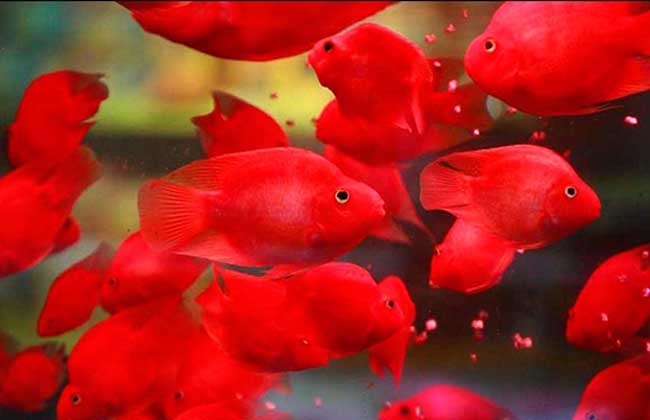
The blood parrot is a kind of yin-yang fish, like the so-called liger or mule, and has no ability to reproduce the next generation. If you see it laying eggs, do not get excited, because there is absolutely no chance of hatching. This is a new fish produced in Taiwan, China by crossbreeding the red devil fish introduced from South America with the purple-red firemouth cichlid. Foreign countries still cannot fully master this breeding technique, and only Taiwan, China can cultivate such a fish species. Because of its flame-like appearance, bright red color, and elegant posture, it quickly became the number one brand of feng shui fish kept in Taiwan, China. Its average lifespan is about seven years, and it can grow to about 20 cm. The biggest drawback is that it is afraid of cold, so a constant-temperature controller must be installed in the fish tank to maintain the temperature at 28 to 30 degrees Celsius.
Betta
The betta is also called iron fish, black wife, moon fish, Chinese fighting fish, paradise fish, bodhisattva fish, flower handkerchief, and so on. It is native to Thailand. Kept in small bottles, bettas are regarded as having the function of supplementing the five elements because of their bright and varied colors. They belong to omnivorous fish that lean toward carnivorous feeding. When keeping them, you can feed a variety of bait, and try not to let the betta's diet be too monotonous.
Crown six-bar
The crown six-bar is a cichlid. The breeding tank is best arranged with coral rock and coral sand, which helps maintain the water quality most suitable for its life. It can be mixed with other African cichlids or kept in groups of the same species, but the density must not be too high and the sizes must not differ too greatly. The ideal feed is frozen bloodworms, and other small invertebrates are also acceptable. After acclimation, it can adapt to dried shrimp or pellet feed. Feed twice a day.
Redtail catfish
The redtail catfish has a relatively graceful appearance, with an elongated, wide, and flat body. On the upper and lower parts of the mouth there are a total of 6 pairs of noble snow-white barbels, one pair of which is longer and often extends forward. Its body color is basically three colors: gray-black on the back, snow-white on the belly, and orange-red on the caudal fin. The boundaries are extremely distinct. The head and snout are very large, and a white line extends from the snout all the way to the tail. The tail and dorsal fin are rouge red, while the other fins are blue-black, and its posture is elegant. The upper half of the eye socket is white, forming a half-circle white ring. Adults reach 70 to 100 cm in body length.
Discus
The discus has a body length of 20 cm, is nearly round, laterally compressed, with an extremely short caudal peduncle, and symmetrical dorsal and anal fins. The body is brilliant blue, or dark green or brownish, and from the gill cover to the caudal peduncle there are 8 evenly spaced brownish-red horizontal stripes. The body color changes under the influence of light: when the light is dim, the body color is dark and dull; when the light is bright, the colors are gorgeous and rich and the stripes cover the whole body. From a distance, the head, body, and fins are hard to distinguish, resembling a discus on a track and field field, hence the English name "discus."