What Do Kingfishers Eat? A Complete Guide to the Kingfisher's Diet
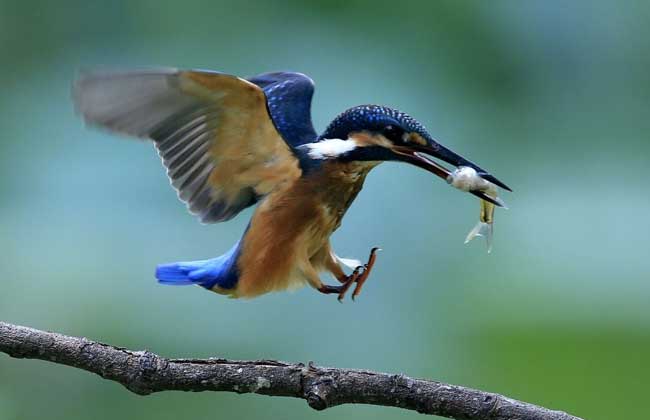
Kingfisher is the collective name for birds of the genus Alcedo in the family Alcedinidae. They are medium-sized water birds, named for the brilliant turquoise-blue sheen of the feathers on their backs and faces. There are 15 species and 48 subspecies worldwide. In China there are 3 species: the Blyth's kingfisher, the blue-eared kingfisher and the common kingfisher, with the common kingfisher being the most common and also the most widely distributed. Now let's take a look at what kingfishers eat!
What do kingfishers eat?
Kingfishers inhabit waters such as small rivers, streams, lakes and irrigation canals with shrubs or sparse woods and clear, slow-flowing water. They are solitary by nature, usually perching alone on branches or rocks near the water to wait for prey. Their food is mainly small fish, along with crustaceans and various aquatic insects and their larvae; they also peck at small frogs and a small amount of aquatic plants. After diving into the water, a kingfisher can still maintain excellent vision, because once its eyes enter the water they can quickly adjust to the contrast in viewing angle caused by the light in the water, so its fish-catching ability is very strong.
Kingfisher breeding habits
The kingfisher can use its thick, strong bill to dig a burrow in an earthen cliff as a nest, and it also nests in tunnels in field embankments. The bottom of the hole is generally not lined with anything, and the eggs are laid directly on the ground of the nest cavity. Each clutch contains 6 to 7 eggs. The eggs are pure white, glossy, with slight speckles, and measure about 28×18 mm. There are 1 to 2 clutches per year. The incubation period is about 21 days; both male and female incubate the eggs, but only the female feeds the chicks. In southern China, the kingfisher's breeding season is from April to July each year.
Common species of kingfisher
1. Blyth's kingfisher: The upperparts of Blyth's kingfisher are mainly dark brown tinged with blue-green, with a bright green longitudinal line in the center of the back, blue ear coverts, chestnut breast and belly, and a black head and neck. It inhabits the banks of forest rivers in low hills and foothill plains below 1200 m in elevation. It usually perches alone on branches or rocks near the water to wait for prey. Its food is mainly small fish, along with crustaceans and various aquatic insects and their larvae, and sometimes some plant food as well.
2. Common kingfisher: The common kingfisher has a body length of 16 to 17 cm, a wingspan of 24 to 26 cm, a weight of 40 to 45 g, and a lifespan of 15 years. Its appearance is similar to that of Blyth's kingfisher, but it is smaller. It moves alone or in pairs and is solitary by nature, usually perching alone on branches or rocks near the water to wait for prey. Its food is mainly small fish, along with crustaceans and various aquatic insects and their larvae; it also pecks at small frogs and a small amount of aquatic plants.
3. Blue-eared kingfisher: The blue-eared kingfisher has a total length of about 15 cm, a black crown and nape with blue-purple transverse bars, purple-blue ear coverts, a pale brown throat, and a yellowish-white spot on each side of the neck. There are two major types, forest-dwelling and aquatic. The forest-dwelling blue-eared kingfisher stays far from water and feeds mainly on insects. The aquatic type lives mainly in freshwater bodies in various places, likes to live and forage in ponds, swamps and by streams, and feeds mainly on fish, shrimp and insects. It often perches quietly on floating leaves in the water or on branches on rocks by the water. It is a national second-class protected animal in China.