What Do Scarab Beetles Eat? Understanding Scarab Beetle Feeding Habits in One Article
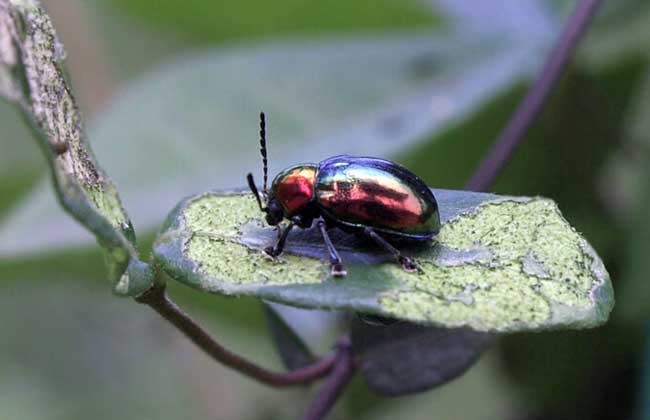
The scarab beetle is an omnivorous pest and the collective name for insects in the family Scarabaeidae. Besides damaging fruit trees such as pear, peach, plum, grape, apple and citrus, it also damages forest trees such as willow, mulberry, camphor and privet. Common species include the copper-green scarab beetle, the Korean black scarab beetle, the tea-colored scarab beetle and the dark black scarab beetle. Let us take a look below at what scarab beetles eat!
What do scarab beetles eat?
Scarab beetles gnaw on underground parts of plants such as roots, tubers and seedlings, making them major underground pests. They also damage above-ground parts of plants including leaves, flowers, buds and fruits. Adults bite the leaves into net-like holes and notches, and in severe cases only the main veins remain; the damage is even worse when they gather in groups, and they feed most heavily from dusk until 10 p.m. Adult scarab beetles vary in feeding habits: some feed on plant roots, stems and leaves, some feed on decaying organic matter, and some feed on dung. The larvae mostly live in the soil and feed on organic matter in the soil.
Are scarab beetles pests?
Scarab beetles are pests. Scarab beetles have a long life cycle. Apart from the adults, which spend part of their time above ground, all other stages live underground. In China, completing one generation generally takes 1 to 2 years, or 3 to 6 years, and they overwinter as larvae and adults. There are two types, night-active and day-active: night-active ones feed and cause damage at night and mostly show varying degrees of phototaxis, while day-active ones are active and feed during the day. Scarab beetles undergo complete metamorphosis. There are about 30,000 species worldwide, and about 1,300 species in China. Common ones include the black velvet scarab, the northeastern large black chafer, the copper-green shining scarab and the copper flower chafer, which is active during the day, damaging crops such as soybean, peanut, sugar beet, wheat, millet and tuber crops.
Common species of scarab beetles
1. Copper-green scarab beetle: The adult copper-green scarab beetle is 18 to 21 mm long and 8 to 10 mm wide. The back is copper-green with a metallic sheen, and the sides of the pronotum are yellow. The elytra have a chestnut-colored reflection and 3 raised longitudinal stripes. The ventral side of the male is dark brown, while the ventral side of the female is light yellowish brown. The eggs are round and milky white. The larvae, called white grubs, are milky white and plump, bending toward the ventral side into a “C” shape, with 3 pairs of thoracic legs and a brown head.
2. Korean black scarab beetle: The adult Korean black scarab beetle is 20 to 25 mm long and 8 to 11 mm wide. It is dark brown with a metallic sheen. The elytra are dark brown, and where the two elytra meet there is a raised longitudinal line; each elytron has 3 raised longitudinal lines. The middle of the ventral side of the male's last segment is sunken, with a relatively deep transverse groove in front, while in the female the middle is raised and the transverse groove is not obvious.
3. Dark black scarab beetle: The adult dark black scarab beetle is 18 to 22 mm long and 8 to 9 mm wide, dark brownish black and without a metallic sheen. There are 3 raised longitudinal lines on the elytra. There are short, small blue-gray hairs on the wings and abdomen, and there are 4 indistinct longitudinal lines on the elytra.
4. Tea-colored scarab beetle: The adult tea-colored scarab beetle is about 10 mm long and 4 to 5 mm wide. It is tea-brown and densely covered with short yellowish brown hairs. There are 4 indistinct longitudinal lines on the elytra.