Key Technical Points and Feeding Management Methods for Guanzhong Horse Breeding
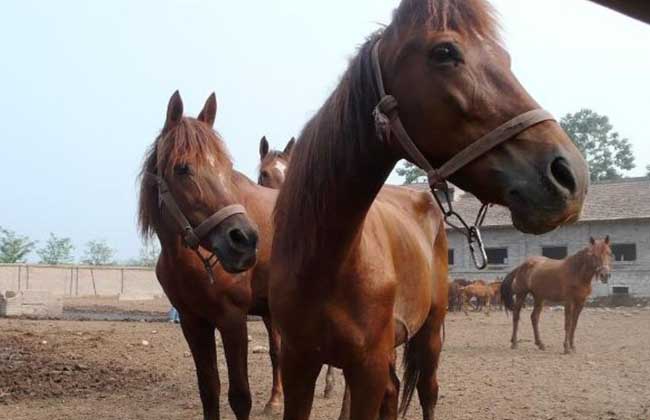
The Guanzhong horse was formerly known as the "Guanzhong draft horse", and the name "Guanzhong horse" was adopted after 1976. In October 1982, the Shaanxi Provincial Department of Agriculture and the Baoji City Animal Husbandry Bureau organized an on-site appraisal, which concluded that it met the breeding indicators and possessed the predetermined characteristics, confirming it as a new breed and officially naming it the "Guanzhong horse". Now let us take a look at Guanzhong horse breeding techniques together!
Breeding Characteristics of the Guanzhong Horse
The average body height, body length, chest circumference and cannon circumference of adult Guanzhong stallions are 153.77±4.36 cm, 160.64±4.62 cm, 196.36±10.70 cm and 21.5±1.0 cm respectively, while those of adult mares are 147.83±3.58 cm, 155.59±4.42 cm, 179.67±7.94 cm and 19.6±0.7 cm respectively. They have relatively good draft power, move briskly and are full of endurance. They are a dual-purpose draft and riding breed developed in China, with distinct type, a basically uniform population, strong adaptability, and characteristics such as being easy to raise and combining strength with speed.
Stable Design for Guanzhong Horses
1. Stable floor: The floor of the stable is very important and is required to be slip-resistant, moisture-proof and durable. Cement flooring is usually used, as it is sturdy, durable, economical and convenient, and facilitates sanitation, disinfection and epidemic prevention.
2. Stable doors and windows: The size and height of the doors and windows are directly related to the ventilation and lighting of the stable. The size of the windows should be in a certain proportion to the floor area, generally 1:10 is preferable, with a window height of about 1.5-1.8 m. The door is about 2.5 m high and about 1.2 m wide.
3. Fixtures: The fixtures in the stable include feed troughs, hay racks and water troughs. The feed trough should be located in the corner beside the door. The feed trough and water trough should be separate; a bucket is generally used as the water trough, and the bucket holder can be fixed in a corner of the wall to prevent it from being knocked over by the horse. Hay racks are used to feed hay to the horses. The feed trough, hay rack and bucket holder should be designed without sharp corners to avoid injuring the horses.
4. Ancillary buildings: The saddle room should be dry and moisture-proof, and its size should be able to hold the required horse tack, with fixed saddle racks needed. Horses are good at running, so a relatively large exercise yard is needed; the area of the exercise yard should be based on the management capacity of the breeder, and the larger the better. The ground of the horse exercise yard is generally a mixed surface of soil and sand, which reduces wear on the horses' hooves and protects them. Some palatable green grass can also be planted in the exercise yard for the horses to eat while walking.
Selection of Breeding Stock for Guanzhong Horses
1. Look at appearance: Looking at appearance includes the horse's external form, the sturdiness of its body and its sensitivity to the outside world. The horse's head should be moderate in size and square-round in shape. Neck requirements: slender and full of muscle. A horse with a long neck tends to shift its center of gravity forward, and the neck swings with a large range, which is conducive to exerting speed. The back and loins should be broad and straight with strong, solid muscle, which is conducive to carrying weight and exerting speed. As the saying goes, "a good horse is found in its legs", which shows the importance of the limbs. The forelimbs support body weight, so large shoulders are required, thick at the top and tapering downward.
2. Look at gait: When selecting a horse, attention should also be paid to its gait. Looking at gait means examining the horse's limb stance and hoof shape, which can be checked while the horse walks at a slow pace, and if necessary, it can be made to walk at a fast pace. Generally, a horse with correct limb stance and hoof shape keeps its forelimbs and hindlimbs on the same vertical plane when moving.
3. Look at coat color: Recognizing a horse's coat color is basic knowledge in horse raising. Looking at coat color is also an important step and basis for selecting a horse. Horse coat colors can be divided into two major categories: single coat colors and compound coat colors. A body coat of only one color is a single coat color, while a coat made up of two or more colors is a compound coat color, such as gray, roan, piebald, spotted, etc. For example, the broad masses of farmers and herders all like dark-colored horses, and the requirements for military horses are even stricter; generally white, piebald and spotted horses are not allowed to enlist.
4. Look at age: The natural lifespan of a horse is generally 25-30 years. Working ability is strongest between 4 and 15 years of age. The old or young age of a horse can be roughly determined from its appearance. For example, a young horse has tight, elastic skin, full muscles, a glossy coat, a short body and long legs, while an old horse has drooping lips, many wrinkles, sunken eye sockets, inelastic skin and inflexible movements. As age changes, the growth, replacement and wear of a horse's teeth all undergo regular changes, so we can determine a horse's age based on the changes in its teeth. For example: at 3 years of age, the permanent central incisors are fully grown; at 4 years of age, the permanent intermediate incisors are fully grown; at 5 years of age, all the corner incisors are fully grown, commonly known as "complete mouth".
5. Look at constitution: Constitution is the comprehensive manifestation of a horse's external form and physiological functions, that is, its degree of sturdiness. Horse constitution is generally divided into five types: moist type, dry type, fine type, coarse type and sturdy type. However, in practice, horses of a single constitution type are rarely seen; they are generally mixed types dominated by a certain type. Temperament refers to the horse's character and is a manifestation of the horse's sensitivity to the outside world; in horse husbandry it is called "hanwei" (spirit), and can usually be divided into four types: fierce, high, medium and low.
Feeding and Management of Foals
After birth, foals have relatively poor adaptability to the outside world, and their development is closely related to the production performance of the adult horse later on. Therefore, attention must be paid to the feeding and management of foals. The entire foal period is 6 months. Within 3 days after birth, if the weather is good, the foal can be allowed to exercise outdoors with the mare. At 10-15 days, the foal begins to eat grass on its own, and at one month it begins supplemental feeding. Prepare easily digestible bran and rolled barley, oats, etc., add an appropriate amount of soybean cake, add water when feeding, soak and mix well, starting with 50 grams per day fed in two portions, then gradually increasing the feeding frequency to three times per day.
Feeding and Management of Growing Horses
When a foal reaches 6 months of age, it can be transferred from the foal barn to the growing horse barn and enter the growing horse stage, which lasts from 6 to 30 months of age. This stage is a period of comprehensive growth and development for the foal, and nutrients such as muscle and bone growth agents and milk powder should be supplemented. What has been introduced above is differentiated feeding based on physiological characteristics. In addition, in the practical use of horses, exercise intensity is a very important indicator, so individualized feeding should also be combined with different degrees of exercise intensity for the horse.
Feeding and Management of Breeding Stallions
In terms of feeding, the nutritional needs of breeding stallions must first be ensured. The roughage is mainly a mixture of high-quality dried alfalfa and Leymus chinensis. In addition to feeding concentrate and roughage, it is best to supplement some vitamins for "special care". During the non-breeding period, the reference formula for concentrate is oats 50%, soybeans 10%, black beans 10%, bran 10%, corn 10%, sunflower seeds 8%, minerals 2%, among which the minerals include salt, calcium powder, etc. In addition, soybeans should be soaked thoroughly in water, and black beans should be cooked. During the breeding period, the proportion of oats can be reduced by 5%, and nutrient feeds such as eggs, yogurt and red rice can be added.
Feeding and Management of Broodmares
1. Non-pregnant period: During the non-pregnant period, mares lose weight relatively quickly and need increased nutrition to promote estrus. The roughage is 8-12 kg/day, and the concentrate is 3-4 kg/day. The roughage can be high-quality alfalfa and Leymus chinensis. The reference formula for the concentrate is: oats 35%, soybeans 15%, black beans 12%, bran 10%, corn 15%, sunflower seeds 10%, minerals 3%.
2. Gestation period: The feeding and management of pregnant mares must not only meet the mare's own nutritional needs, but also ensure the normal development of the fetus and the needs of postpartum lactation, so the diet of a pregnant mare must contain rich nutrition. During gestation, foods rich in calcium, phosphorus and vitamins should be added. The feeding and management in the last 1-2 months of gestation are very important for increasing milk yield, and feeding should be strengthened, but 2-3 weeks before foaling the feed should be appropriately reduced, giving feed of excellent quality that is soft and easily digestible.