How are Guanzhong donkeys raised? A detailed explanation of key breeding technology points
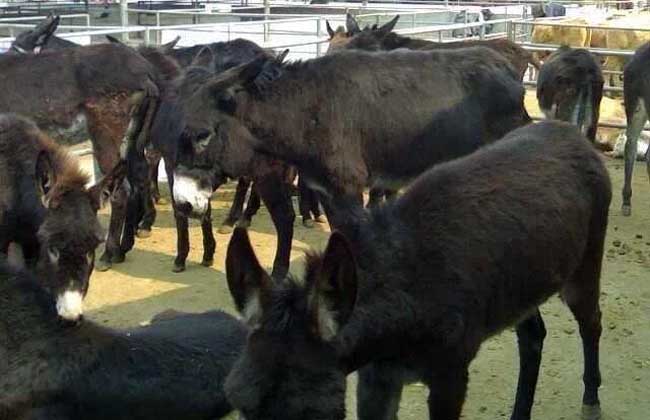
The Guanzhong donkey is produced in the Guanzhong Plain of Shaanxi Province. It is a draft livestock breed introduced from the Western Regions during the Western Han Dynasty. After long-term domestication, it has now become one of the excellent large donkey breeds in China. It is docile and lively, with a coat that is mostly black, a tall and large frame, good structure, a head and neck held high, strong joints, and solid hooves. Let us take a look at Guanzhong donkey breeding technology together below!
Barn planning
For intensive Guanzhong donkey fattening, pen and barn raising is better. A general pen or barn only needs to block rain from above and shelter from wind below. Feeding troughs for food should be set up inside the pen. Each donkey should be allotted 60-80 cm of feeding space. Between adult donkeys, sturdy fences should be set up as barriers according to the distance of the feeding spaces to prevent them from disturbing each other (this is even more important in pens where males and females are raised together).
Feed feeding
Donkeys are herbivorous animals, and when eating grass, dry, hard, and crisp crop straws are especially good, such as corn, millet, bean vines, and other relatively hard-textured straws, cut into 3-4 cm short sections with a chaff cutter, while also supplementing with concentrates such as peas, corn, fried cottonseed, or wheat bran. Feed once each in the morning, at noon, and in the evening, with evening feeding as the main one. During each feeding, add single grass first and let them eat until mostly full, then feed mixed grass to stimulate their appetite. When they show signs of stopping eating, then feed mixed grass with concentrate to induce them to reach their maximum feed intake.
Breeding technology
The intensive breeding of Guanzhong donkeys is still in its initial stage, so meat-type donkeys produced through artificial breeding have not yet been promoted. For raising, it is better to choose donkey breeds that are relatively large in body size, tolerant of roughage, strong in disease resistance, good in adaptability, good in reproductive performance, and also high in feed conversion efficiency. Guanzhong donkeys are mostly bred by mating with the same breed, and can also be crossbred with horses. For intensive breeding, artificial insemination can be used. Collecting semen from improved breeds is conducive to large-scale breeding and accelerates the promotion and cultivation of improved breeds.
Breeding management
1. In terms of habits, Guanzhong donkeys are more tolerant of roughage than horses, cattle, and other livestock, and also have relatively strong disease resistance, but this does not mean they will not get sick. Especially under intensive breeding conditions, the policy of "combining prevention and treatment, with prevention first" must be strictly implemented, and more attention must be paid to environmental hygiene to prevent the occurrence of epidemics. When leaving the pen after feeding, they should be allowed to drink enough clean water. Drinking polluted water or dirty water is strictly prohibited.
2. Do a good job of feeding and housing hygiene. Do not leave overnight manure in the pen or barn, and clean and disinfect feeding troughs and water vats regularly. Pens and barns should be built in places far from villages to avoid infection from epidemics. Every time Guanzhong donkeys enter or leave the pen, especially after finishing work, let them roll a few times to their heart's content and brush each one individually. Doing so is not only beneficial for skin cleanliness, but can also promote blood circulation, strengthen physiological functions, improve physical health, and eliminate fatigue.
3. Observe frequently during feeding. Once Guanzhong donkeys are found to be unwell or show reduced eating, a veterinarian must be called immediately for treatment. Never be careless and delay the timing. In pens where males and females are raised together, pay attention to disturbances, because disturbances can not only cause miscarriage in female animals, but also cause accidental injuries due to mutual biting and collisions, and even induce tetanus. Therefore, when setting up feeding-space partition fences, the sturdier the better, as this is beneficial for large-scale breeding.