Key Technical Points and Feeding Management Methods for Dezhou Donkey Farming
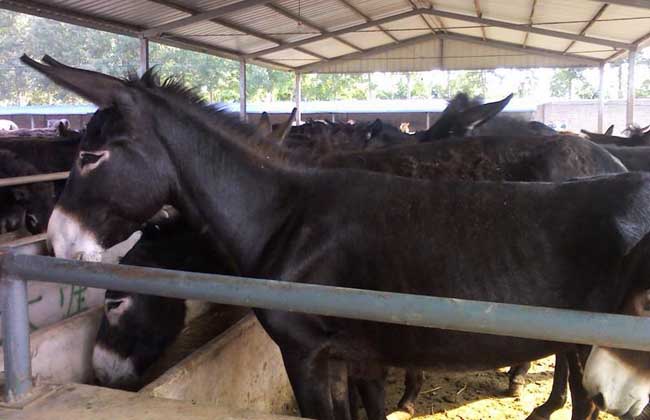
The Dezhou donkey is one of China's five excellent donkey breeds, also known as the Bohai black donkey, Wudi donkey, etc. China's five excellent donkey breeds are the Guanzhong donkey, Dezhou donkey, Guangling donkey, Biyang donkey, and ** donkey. It was introduced from the western region during the Song Dynasty and, through long-term selective breeding, became a breed renowned at home and abroad. Let us now take a look at Dezhou donkey farming techniques!
Production Performance of the Dezhou Donkey
The Dezhou donkey grows and develops quickly, reaching sexual maturity at 12-15 months of age and beginning mating at 2.5 years. At 1 year of age, the foal's body height and body length are over 85% of those of an adult donkey. Mares generally come into estrus very regularly and can produce about 10 foals over their lifetime; even at 25 years of age, good mares still produce foals. Stallions have strong libido; under normal circumstances, semen volume is 70 milliliters, sometimes reaching 180 milliliters, and semen quality is good. When raised as a meat donkey, the slaughter rate can reach as high as 54%, with a relatively high meat yield. It is an excellent sire breed for improving small-sized donkeys. A single donkey pulling a cart can carry 750 kilograms, travel 40-45 kilometers per day, and can do so for many consecutive days. Its maximum pulling force accounts for 75% of its body weight.
Economic Benefits of Dezhou Donkey Farming
The Dezhou donkey is a herbivorous livestock animal, tolerant of coarse feed, with good adaptability, strong disease resistance, easy to manage, easy to breed, and short in growing time. It can be raised by grazing or in pens, making it very suitable for farmers to raise. The feed sources used for raising donkeys are widely available and extremely low in price; even when pasture grass is insufficient, crop straw, grain by-products, and other materials can be fully utilized as feed. Donkeys are divided into three types: meat donkeys, breeding donkeys, and draft donkeys. Donkey meat sells well year-round in domestic markets such as Beijing, Tianjin, Shanghai, Taiyuan, Shijiazhuang, Jinzhou, Harbin, Shenyang, and Dalian, while foreign trade exports have also remained promising.
Fattening of Adult Dezhou Donkeys
1. For newly purchased Dezhou donkeys, on the 1st day provide only drinking water; on the 2nd day provide drinking water plus green grass or dry grass; on the 3rd day provide drinking water plus free access to green grass or dry grass, and add 0.5 kilograms of wheat bran; on the 4th-6th days do the same as above, and add 1 kilogram of corn.
2. After a 6-day transition period, Dezhou donkeys can enter the fattening period. Coarse feed such as millet straw, cottonseed hulls, soybean stalks, and corn stalks is provided for free access; mixed concentrate is fed at 3.5-4 kilograms per head per day, composed of 50% cottonseed cake or soybean meal and peanut cake, 29% cornmeal, 20% wheat bran, and 1% salt; additionally, add 20 grams of sodium bicarbonate per head per day.
3. During the fattening period, Dezhou donkeys should have their exercise restricted, be supplied with clean drinking water, have their bodies brushed daily, and be kept in pens and surrounding environments that are dry and hygienic. They can be slaughtered after 60-70 days of fattening.
Fattening of Young Dezhou Donkeys
1. Newly purchased donkeys should first be dewormed, not castrated, and raised in separate troughs according to sex and body weight.
2. Newborn donkeys drink colostrum for 6 days, then nurse on breast milk after 7 days. At 15 days of age, train them to eat thin porridge made by boiling equal portions of corn, wheat, and millet mixed evenly, with a little sugar added, to entice them to eat, feeding 15-20 grams per day.
3. After 22 days of age, feed 80-100 grams of mixed concentrate, with a formula of 50% soybean meal plus cottonseed meal, 29% cornmeal, 20% wheat bran, and 1% salt. At 1 month of age, feed 100-200 grams per donkey per day; at 2 months of age, feed 500-1000 grams per day; after 9 months of age, feed 3.5 kilograms per day. The entire fattening period consumes a total of 500 kilograms of concentrate. If cottonseed is fried until yellow or boiled until it swells and cracks open, feeding 1 kilogram per donkey per day gives even better fattening results.
4. Coarse feed is provided for free access; choose millet straw, soybean stalks, peanut vines, sweet potato vines, ear-bearing silage corn, and high-quality forage grass, and cut them short.
5. Feed 4 times a day: morning, noon, evening, and night. The farming proverb says, "A horse cannot grow fat without night feed," and the same applies to donkeys; emphasis is placed on mixing in night feed. The farming proverb says, "Grass for fat, grain for strength, water for spirit," meaning that eating more grass is what puts on fat.
6. When feeding, pay attention to feeding small amounts frequently, mixing feed into all four corners of the trough, providing enough clean water, and supplementing salt in appropriate amounts.
7. Form groups of 20-25 donkeys each, allowing free movement, free access to coarse feed, free access to drinking water, and free access to salt.
8. Brush the donkeys' bodies daily, remove manure and urine, and clean the feed troughs.