What do tadpoles eat? A detailed explanation of tadpole food types
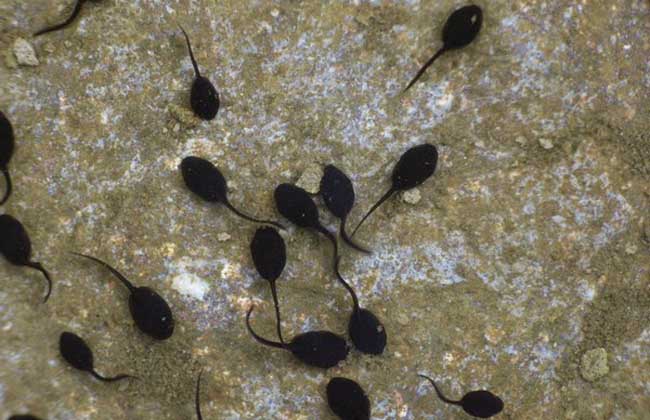
Tadpoles are the larvae of amphibians such as frogs, toads, salamanders and giant salamanders, also known as geniu, toad eggs and so on. Newly hatched tadpoles attach themselves to aquatic plants and rely on the remaining yolk inside their bodies for nutrition. They are mainly social creatures, and once mature they begin metamorphosis and gradually grow limbs. Let us take a look below at what tadpoles eat!
What do tadpoles eat?
Most tadpoles use rows of keratinized teeth in their mouths to scrape and eat algae, but if there happen to be small animal carcasses such as earthworms or beetles in the water, they will also gnaw on them in groups. Some kinds of tadpoles have no keratinized teeth, such as the ornate narrow-mouthed frog and the black-spotted narrow-mouthed frog, and these feed by filtering plankton from the water. In addition, the tadpoles of the emerald tree frog are egg-eating, and the mother frog returns regularly to lay eggs to feed the tadpoles. When food is insufficient, larger tadpoles eating smaller tadpoles, a form of cannibalism, can also occur. If you are raising them yourself, then feed them bread crumbs. If they are in a natural pond, they generally eat mosquito larvae, plankton, fish worms and so on in the water.
Rearing and management of tadpoles
Tadpoles should be reared in grades. Tadpoles of the same age in days should be graded according to differences in individual size, once a month, to facilitate uniform feeding management. Reasonably control the rearing density. During the grading process, divide and regroup them, and rear them in separate ponds at an appropriate density for individuals of the same grade. The feed should be diverse in variety and high in quality, and a reasonable feeding amount should be correctly controlled, neither too little nor too much. Feed once a day at a fixed time, with a balanced amount each time, gradually and appropriately increasing as the age in days grows. During the peak feeding season of tadpoles or around metamorphosis, feeding management should be carried out more strictly to prevent the occurrence of various diseases or unnecessary losses caused by unsuitable environmental conditions.
The growth stages of tadpoles
1. Early growth stage (1-10 days): Within three days after hatching, tadpoles do not seek food and rely on the nutrition brought from the yolk to sustain life; feeding too early will instead cause their death. After three days, the activity level of the tadpoles increases markedly, and when the two opercula are completely formed they begin to seek food. Feed at fixed times according to the standard of one egg yolk per ten thousand tadpoles, and appropriately add some natural plankton from the water, such as water fleas and algae.
2. Early growth period (10-20 days): After 10 days, small tadpoles increase their food intake, their growth and development speed up, and they begin to look for new food, but their digestive function is still not strong. At this time, the quality of rearing directly affects the survival rate of the tadpoles. Therefore, in rearing, bait must be supplemented to meet the needs of their growth and development, mainly nutrient-rich paste bait such as egg yolk, corn flour and No. 4 flour, supplemented with tender algae and plants.
3. Mid growth period (20-50 days): In the mid growth period, the digestive function of tadpoles continuously strengthens. To promote the development of the tadpole digestive tract as quickly as possible and adapt to the “herbivorous” biological characteristic of a certain specific tadpole stage of amphibians, after 20 days of age, in addition to feeding paste bait, tadpoles should be fed plant-based feed and algae, such as duckweed.
4. Late growth period (50-78 days): The late growth period is the key period when tadpoles transform into young frogs. During this period, tadpoles must grow their hind limbs and forelimbs and transform from aquatic to amphibious. In rearing during this period, in addition to feeding enough feed, a small amount of live animal bait feed should also be added.