What kind of animal is the mandarin duck? Get to know this waterfowl
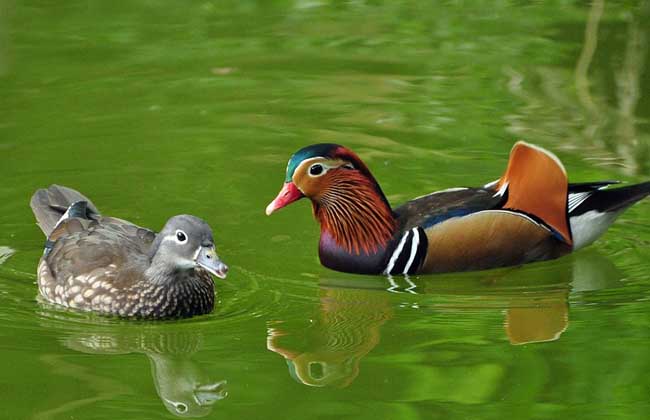
The mandarin duck is also known as Wurenhaqin, official duck, paired bird, Dengmu bird, and so on. It is a famous ornamental bird of the genus Aix in the family Anatidae. "Yuan" refers to the male bird and "yang" to the female bird. It is regarded as a symbol of love because the mandarin ducks people see always appear in pairs. As a bird that frequently appears in ancient Han myths, legends and literary works, the mandarin duck is often used as a metaphor for love between men and women.
The mandarin duck is intermediate in size between the mallard and the Eurasian teal, with a body length of 38-45 cm and a weight of about 0.5 kg. The sexes differ in color. The male has a red bill, orange-yellow feet, and bright and gorgeous plumage, with splendid crest feathers on the head, a broad white eyebrow stripe behind the eye, and a pair of chestnut-yellow fan-shaped upright feathers on the wings that stand on the back like sails, very peculiar and eye-catching, and extremely easy to identify in the wild. The female has a black bill, orange-yellow feet, a grayish-brown head and entire upperparts, white around the eyes, followed by a thin white eyebrow stripe, also very eye-catching and distinctive.
Mandarin ducks often arrive at the breeding grounds in flocks. When they have just migrated to the breeding grounds, they are active in ponds and streams in open low-mountain areas; when resting, they gather in flocks by the water or on unmelted ice. Apart from the breeding season, they often move in flocks, especially during the migration season and in winter, with flocks of as many as 50-60, sometimes nearly a hundred. They are good at swimming and diving, and also walk well on the ground. Besides activity on water, they often come to land to move about and forage. They are alert by nature and take off immediately when encountering people or other disturbances, uttering a thin, sharp "oh-er" call.
During the breeding season, mandarin ducks mainly inhabit rivers, lakes, ponds, reed marshes and rice fields in mountain forests, while in winter they mostly inhabit large open lakes, rivers and marsh areas. Every day, before the morning mist has fully dispersed, they fly out from the thickets where they roost at night and gather by the ponds, floating and feeding on the water surface with shade or reeds, then fly into the woods to forage. After about one or two hours, they return one after another to rest on branches or rocks near the riverbank or pond.
The mandarin duck is omnivorous, and the types of food often vary with season and habitat. In spring and winter, it mainly feeds on plant foods such as green grass, grass leaves, tree leaves, grass roots, grass seeds and mosses, and also eats crops such as corn and rice as well as plant fruits and seeds such as honeysuckle and acorns. In the breeding season, it mainly feeds on animal foods, such as ants, stoneflies, katydids, locusts, mosquitoes, beetles and other insects and insect larvae, and also eats crayfish, shrimp, snails, spiders, and small fish and frogs and other animal foods.
Mandarin ducks mostly breed in northern Northeast China and Inner Mongolia, and winter in the southeastern provinces as well as Fujian and Guangdong, while a small number are resident birds in Taiwan, China, Yunnan, Guizhou and other places. In Pingnan County, Fujian Province, there is an 11-kilometer-long Baiyan Stream, with deep and beautiful water and quiet forested hills on both banks, where thousands of mandarin ducks winter each year, so it is also called Mandarin Duck Stream and is China's first mandarin duck nature reserve. Mandarin Duck Lake in Wuyuan County, Shangrao City, Jiangxi Province, is the largest wintering habitat for wild mandarin ducks in Asia and even the world.
The mandarin duck is one of China's traditional export birds and once had a very large population in China. Every year, large numbers of live birds were hunted to supply domestic zoos and for export. Before 1975, whether in spring in the Changbai Mountains or in winter in the southern wintering grounds, large flocks of 40-50 could often be encountered, but such spectacular scenes are now rarely seen. The main reason is that deforestation and hunting have caused the population to decline day by day. According to surveys, the breeding population in China is 1500-2000 pairs, and it has been listed in the world's endangered bird directory.