How strong is the venom of the banded krait, and does it belong to the highly venomous snake category?
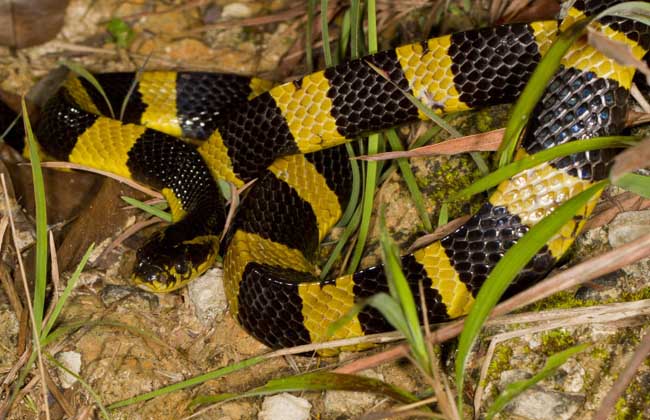
The banded krait, also known as the yellow-banded snake, golden armor belt, Buddha snake, golden armor and so on, is a highly venomous snake of the genus Bungarus in the family Elapidae. Like other snakes of the genus Bungarus, it moves slowly and is not fond of attacking humans, feeding mainly on small vertebrates. Its venom is weaker than that of its close relative the many-banded krait, but it is still a highly venomous snake, and its numbers are also greater than those of the many-banded krait. Let us take a look below at whether the banded krait's venom is strong!
Is the banded krait's venom strong?
The banded krait's venom is strong. The banded krait is one of the ten most famous venomous snakes in China, and its venom is weaker than that of its close relative the many-banded krait. The toxin is a neurotoxin, and just as with the many-banded krait, if a person is bitten by a banded krait, if it happens while they are asleep, it likewise amounts to a “mercy killing”, dying from the poison in their sleep. Of course, if a banded krait bite is treated promptly with early detoxification, suppressing the spread of the snake venom and its absorption by the body, good results come quickly; it is best to promptly inject bivalent antivenom against the many-banded krait, and then there is no danger, and after the bite is cured there are no after-effects, much better than with the cobra or the five-step snake.
What food does the banded krait eat?
The banded krait inhabits plains or low mountain areas at altitudes of 180 to 1014 m with fairly good vegetation cover and near water. It fears light, and during the day it often coils up motionless with its head hidden beneath its belly, but at night it is very active, preying on lizards, fish, frogs, rodents and so on, and it can also swallow other snakes and snake eggs. It is docile in temperament and slow-moving, and its venom is extremely potent, but it does not actively bite people.
China's ten most famous venomous snakes
1. Bamboo pit viper: The bamboo pit viper is mainly green all over, and is distributed in the southern Yangtze River basin of China. When alarmed it flees. The symptoms of its bite are relatively mild, and two small needle-tip-like fang marks are often seen. Within minutes after being bitten the wound becomes red and swollen, the wound burns unbearably, and bloody blisters can be seen nearby; in more severe cases ecchymosis can be seen on the upper part of the affected limb, and the victim has reactions such as headache, dizziness, blurred vision, drowsiness, nausea, vomiting, chest pain, abdominal distension and loss of appetite.
2. White-browed pit viper: The white-browed pit viper is mainly brown all over, with a linear white stripe behind the eye, resembling an eyebrow. Its head is large and triangular, and it is distributed throughout the country, even living on snowy mountains at an altitude of 4000 m. When alarmed it mostly flees and does not actively attack. After a bite the symptoms come on fiercely, with bleeding all over the body, severe pain at the wound and tissue necrosis. The bite symptoms include two deep and clear fang marks; the wound has a stinging and numb sensation, the surrounding swelling is obvious, and there is local tenderness that worsens with movement. The swelling and pain are worst at 2 to 4 days; the wound does not bleed much, but yellow mucus exudation is commonly seen, and ecchymosis and water and blood blisters can be seen locally. Systemic symptoms mostly appear 1 to 6 hours after the bite; ptosis, blurred vision and double vision are one of the features of early poisoning from a pit viper bite.
3. Grey-blue sea krait: The grey-blue sea krait is mainly distributed in the sea areas from the Indian Ocean to the Pacific, along the coasts from the Bay of Bengal to the Malay Peninsula, Papua New Guinea, Australia, the Philippines, Fiji, Tonga, southern China, the coasts of Japan, and the coasts of Taiwan, China and other places. It possesses a strong neurotoxin, but because its mouth is small and it is less aggressive, its threat to humans is not especially serious.
4. Sharp-nosed pit viper: The sharp-nosed pit viper, commonly known as the five-step fall, is mainly brown all over, with a large triangular head and an upturned nose (it looks as if it is holding a cigarette butt in its mouth). It is fierce and actively attacks people, and the symptoms come on fiercely, with bleeding all over the body, severe pain at the wound and tissue necrosis. The bite symptoms are more severe than those of a pit viper bite: the fang marks are larger, deeper and wider apart, and are often accompanied by bleeding; severe burning pain at the wound and local swelling are a major feature of this snake's bite. The wound is red, swollen and spreads outward, and can extend to the trunk. Larger water and blood blisters form near the wound, and there is relatively large and deep local tissue ulceration and necrosis, which appears relatively quickly and comes on fiercely. General malaise, aversion to cold, fever, palpitations, chest tightness, shortness of breath and blurred vision are common.
5. Banded krait: The banded krait is black on its back with many yellow crossbands, and is distributed south of the Yangtze River. When alarmed it flees, but if you get too close to it, it will open its mouth and bite. Bites are commonly seen; the wound does not swell or hurt, and after several hours the whole body is paralysed and breathing stops. Under normal circumstances, within 30 minutes of being bitten, two relatively small needle-tip-sized fang marks can be seen at the bite site, with very little bleeding; the wound is painless or slightly painful and numb, and this gradually spreads toward the proximal end. The wound may show limited slight redness and swelling, presenting a “lychee skin” appearance. Systemic symptoms generally appear only 1 to 4 hours after the bite, including dizziness and blurred vision, headache, chest tightness and shortness of breath, nausea, abdominal pain, throat discomfort, generalized muscle pain, weakness of the limbs, poor tongue movement and difficulty opening the mouth. If treatment is delayed, most people's condition will rapidly worsen.
6. King cobra: The king cobra is mainly blackish-brown all over, with its head raised and its neck flattened. It is distributed in southern China and is fierce in temperament. It is the largest in body size among venomous snakes and will actively attack people, biting and not letting go. After a bite, two relatively large and deep fang marks can be seen, and the distance between the fang marks is often greater than 1.8 cm. First, severe pain is felt locally, and acute inflammation such as redness and swelling gradually develops. The poisoning develops rapidly, and systemic poisoning symptoms appear before the local symptoms are fully manifested. Within half an hour after being bitten, the person feels dizziness, headache, weakness of the limbs and drowsiness, followed by salivation, vomiting and speech impairment.
7. Many-banded krait: The many-banded krait is black on its back with many white crossbands, and is distributed south of the Yangtze River. When alarmed it flees, but if you get too close to it, it will open its mouth and bite. Bites are commonly seen; the wound does not swell or hurt, and after several hours the whole body is paralysed and breathing stops. Under normal circumstances, within 30 minutes of being bitten, two relatively small needle-tip-sized fang marks can be seen at the bite site, with very little bleeding; the wound is painless or slightly painful and numb, and this gradually spreads toward the proximal end. The wound is locally neither red nor swollen, and if no one pays attention to it, diagnosis and treatment are easily delayed. Systemic symptoms generally appear only 1 to 4 hours after the bite, including dizziness and blurred vision, headache, chest tightness and shortness of breath, nausea, abdominal pain, throat discomfort, generalized muscle pain, weakness of the limbs, poor tongue movement and difficulty opening the mouth. If treatment is delayed, most people's condition will rapidly worsen.
8. Pointed-scaled pit viper: The pointed-scaled pit viper has a long triangular head, with the head length about 1.5 times its width, a slender neck, and many fine scales on the top of the head. Its snout is relatively narrow, the internasal scales are relatively small, separated by several even smaller scales, and between the upper eye scales on the left and right there are 14 to 16 small scales in a horizontal row. Between the nasal scale and the front edge of the loreal pit scale there are several small scales. Its body length is about 1 m, the color of its back is brown, and on both sides of the midline of the back there are parallel dark brown markings that connect left and right into a chain-like pattern. Its belly is greyish-brown with many spots. It is nocturnal.
9. Russell's viper: Russell's viper is mainly brown all over, with a slightly elongated triangular head. When alarmed it can face off against an opponent for a long time, and the bite symptoms resemble those of the sharp-nosed pit viper. The bite symptoms include two large fang marks, swelling and pain at the wound, bleeding, and subcutaneous hemorrhage forming ecchymosis. Some patients have blood and blisters at the wound, and local tissue necrosis and ulceration often occur, even involving the bone. After being bitten, the onset is acute, the symptoms are severe and it comes on fiercely. In the initial stage it causes the blood to clot rapidly in large amounts, consuming large quantities of clotting factors in the blood, after which the blood loses its ability to clot.
10. Zhoushan cobra: The Zhoushan cobra is mainly black all over, with its head raised and its neck flattened. It is distributed south of the Yangtze River in China and is fierce in temperament. It can face off against an opponent for a long time and spray venom, but it does not actively attack people. After being bitten by a cobra, the wound immediately feels painful and the pain gradually intensifies, with the area rapidly expanding. Two fang marks are commonly seen locally, the wound does not bleed much and quickly closes and turns black, and the surrounding skin becomes red and swollen. There is a numb sensation at the center of the wound, which spreads toward the proximal end. Locally there are often blisters and tissue necrosis that are difficult to heal. Generally about 2 to 6 hours after the bite, the patient feels drowsy, has chest tightness and distension, palpitations, nausea, vomiting, general malaise, aversion to cold and fever.