Does the Galapagos giant centipede actually have venom?
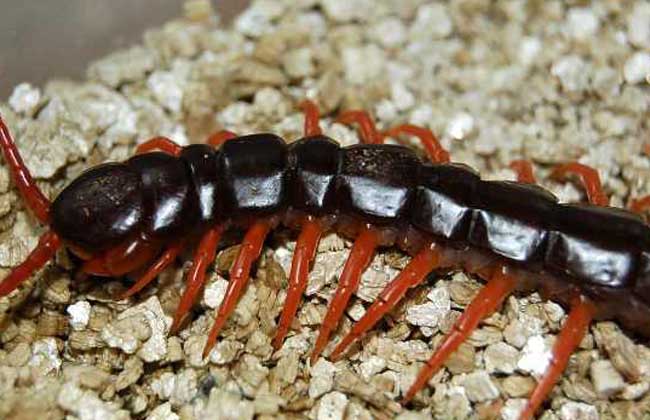
The Galapagos giant centipede, also known simply as "Gala", has an average body length of 25-26 cm; the longest Galapagos giant centipedes can even grow to over 30 cm, and there are unconfirmed reports of an individual measuring 62 cm having been captured. The Galapagos giant centipede looks very similar to the Hainan spirobolid centipede, with a pure black body color and an extremely stout build, and it is distributed on Santa Cruz Island in the Galapagos Islands, coastal areas of Ecuador, southern Peru, the Cook Islands and other places.
Is the Galapagos giant centipede venomous?
The Galapagos giant centipede is venomous. Centipede venom is a toxin released when centipedes sting humans and livestock; similar to snake venom, it is mainly composed of proteins. At the sting site it can cause redness, swelling and burning pain, and it also produces lymphangitis, but the systemic reaction is relatively mild, and there may be chills, fever, headache, nausea, vomiting, increased pulse rate, delirium and convulsions, and in severe cases it can even lead to death.
How much does the Galapagos giant centipede cost?
The Galapagos giant centipede is extremely rare, and at present it has a market but no price. First, on Santa Cruz Island in the Galapagos Islands, ordinary people are not allowed to go ashore, and scientific research organizations must also pass strict approval before they can land on the island. Second, it is also very difficult to capture, so from the very source the possibility of ordinary people owning this black giant has been cut off. At present, an extremely small number of Galapagos giant centipedes exist in research institutes and some large zoos, with strict rearing conditions; each one must be reported, and after death it must also be used for scientific research, so "Gala" cannot be bought on the black market either.
Extended: A grand review of the world's giant centipedes
1. Vietnamese giant centipede: The Vietnamese giant centipede is the largest centipede in Asia, with a body length reaching over 30 cm. It is fairly venomous, fierce by nature and sensitive, and under normal circumstances it will actively attack other arthropods near it. It is mainly distributed in Thailand, Vietnam, Malaysia and other places in Asia, and mainly has a black body with yellow (red, orange) legs.
2. Peruvian giant centipede: The Peruvian giant centipede reaches a maximum of 41-42 cm, and is distributed on Trinidad Island in the Caribbean Sea and in the Amazon River basin of Peru, Ecuador, Brazil and other South American countries. Before the Galapagos giant centipede, the Peruvian giant centipede was generally considered the world's largest species, and it is divided into a yellow-legged form and an orange-legged form. For the yellow-legged form, a wild individual as long as 41-42 cm was once found on the island of Curacao in the Netherlands Antilles.
3. Amazonian giant centipede: The Amazonian giant centipede is distributed in the Amazon River basin of Brazil, Ecuador, Peru and other countries. Its body color is generally red. As for black individuals, one explanation is that the color change is caused by individual variation, and another explanation is that black individuals are actually the Galapagos giant centipede. This is because the individual in one of the most convincing and most widely circulated photos is 44 cm long, far exceeding the average body length of the Amazonian giant centipede (25-30 cm).
4. North American giant centipede: The North American giant centipede is the largest species in North America, with a body length of 18-20 cm. It feeds on insects such as crickets. It is not only relatively large in size, but also has a "fierce beyond measure" temperament, and coupled with its relatively high ornamental value, it is a very popular species among enthusiasts.
5. Puerto Rican giant centipede: The Puerto Rican giant centipede is a centipede species mainly distributed in Puerto Rico, Haiti and other countries and regions in the Caribbean Sea, with a body length of 20-25 cm. It reproduces by laying eggs and feeds on insects such as crickets.