Can You Make Money Farming Centipedes? Farming Prospects and Profit Analysis
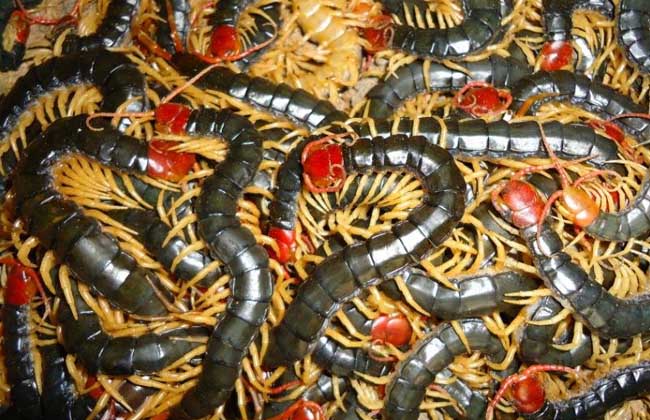
The centipede is also known as Tianlong, Baijiao, Wugong, and so on. Its body is made up of many segments, each bearing a pair of legs. Common centipedes come in three types: red-headed, green-headed, and black-headed. They have venom glands that secrete venom, and they can be used as medicine themselves, giving them extremely high medicinal value. In recent years, deep-fried centipedes have gradually become accepted by some people, and they are very suitable for artificial breeding. Let us take a look below at whether farming centipedes is profitable!
Can You Make Money Farming Centipedes?
At present, centipede farming prospects can still be profitable. As a medicinal animal, the price of processed and prepared centipedes is as follows: large centipedes up to 12 cm long sell for 1.8-1.9 yuan each at the Bozhou medicine market, medium ones (10-12 cm long) for 1.2-1.3 yuan each, and small ones (6.7-10 cm long) for 0.6-0.7 yuan each. Please note that these are prices for processed dried centipedes. Moreover, deep-fried centipedes have gradually become accepted by some people, and it is said the selling price reaches 3 yuan each. In the past, centipedes were mostly caught in the wild. In recent years, with worsening environmental pollution, people's reckless catching, and the continuous expansion of application scope, wild centipede resources have become increasingly depleted, and supply appears very short. From this perspective, farming centipedes is a good path to wealth.
Centipede Farming Costs
Centipede farming feed is very wide-ranging. Generally, animal offal, green vegetables, melons and fruit, and scraps from markets, restaurants, and kitchens can all be used, so costs are low. Now, calculating based on feeding yellow mealworms: 3 kg of rice bran raises 1 kg of yellow mealworms, rice bran costs 1.2 yuan per kg, so 3 kg costs 3.6 yuan. 600 breeder centipedes eat an average of 60 g of yellow mealworms per day, totaling 0.216 yuan. The cost of raising breeders per batch is 0.216 yuan × 90 days = 19.44 yuan. The feed cost for 36,000 larvae (the total feed intake of larvae is less than 1/2 that of breeders) is 19.44 yuan × 60 times × 0.5 = 583.2 yuan. Labor cost (1 hour of work per day) is 10 yuan per workday-hour × 90 days = 900 yuan. The average seed introduction fee is 1,200 yuan, farming construction costs are 500 yuan, and disinfection medicine costs are 50 yuan. Total cost is 19.44 + 583.2 + 900 + 1,200 + 500 + 50 = 3,252.64 (yuan).
Centipede Farming Profit
When selling centipedes at 1.5 yuan each, the sale price of 36,000 centipedes is 54,000 yuan, and the profit is 54,000 - 3,252.64 = 50,747.36 (yuan). The above profit calculation is per batch. If calculated based on 4 indoor breeding cycles per year per batch, the annual profit is 68,747.36 yuan × 4 = 202,989.44 yuan.
Centipede Farming Risks
1. Constrained by pharmaceutical companies: Demand for centipedes mainly comes from pharmaceutical factories, with little use elsewhere. Although over-catching in previous years consumed a lot of wild centipede resources, it also increased pharmaceutical factories' inventory. Many pharmaceutical factories' demand for centipedes is basically saturated, and this situation will continue for some time, so farming centipedes at this time may not be very profitable.
2. Farming technology is difficult: When farming centipedes, there are certain requirements for temperature, humidity, and farming facilities. Moreover, centipedes with high medicinal value grow slowly and have long farming cycles. Investors must know the centipede's habits, mating, and egg-laying times like the back of their hand. All of this requires certain professional knowledge and practical experience, and any mistake in any step can ruin the earlier investment.
3. Centipedes are relatively difficult to preserve: Usually the centipedes needed by pharmaceutical factories are bundled dried centipedes, which investors need to dry well before selling. During this period, dead centipedes are very prone to insect infestation, and insect-infested centipedes fetch low prices, which undoubtedly further squeezes investors' profit margins in centipede farming.
Summary: Although farming centipedes can make money, you must be very cautious when developing centipede farming. Without accumulated technical experience, investing heavily in centipede farming projects carries relatively high risk.