Why do crocodiles shed tears? Read on and you will understand
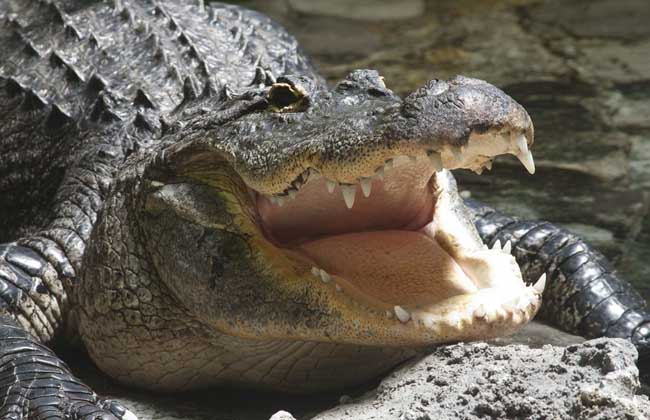
Crocodiles really do shed tears, but it is not because they are sad. For a long time, people believed that crocodiles were excreting excess salt from their bodies. In sea turtles, sea snakes, marine iguanas and some other marine reptiles, as well as some seabirds, salt glands are located near the eye sockets. Salt glands allow these animals to remove excess salt from seawater and thus obtain fresh water, so salt glands are their natural "seawater desalination devices." People therefore believed that crocodile tears were shed for this reason too. The excretory function of a crocodile's kidneys is very imperfect, and excess salt in the body must be excreted by a special salt gland, which happens to be located near the eyes. But this was only a guess.
It was not until 1970 that biologists tested the composition of crocodile tears. They found that after saltwater crocodiles had lived in seawater for some time, the salt content of their tears increased. This seemed to prove that crocodiles have salt glands around their eye sockets just like sea turtles, and so it was written into zoology monographs and textbooks. On the other hand, however, this experiment showed that the salt content of crocodile tears was clearly lower than that of the salt-gland secretions of sea turtles, sea snakes and other marine reptiles, indicating that the metabolic function of crocodiles is far more complete than that of other animals. Therefore, some biologists (including the person who conducted the experiment) believed that the hypothesis that crocodiles have salt glands around their eye sockets could not be disproved.
The debate ended in 1981, when Taplin and Grigg of the University of Sydney in Australia noticed that a clear liquid flowed from the surface of the saltwater crocodile's tongue. They suspected that this, rather than tears, was the secretion of the crocodile's salt gland, but the liquid was secreted too slowly to be collected and analyzed, and their attempt to stimulate salt-gland secretion by injecting the crocodiles with saline also failed. In the end, the method they adopted was to inject the crocodiles with methacholine chloride - earlier experiments had shown that injecting other marine reptiles with methacholine chloride could stimulate salt-gland secretion.
Sure enough, liquid was continuously secreted from the crocodile's tongue. It could be collected with a syringe to analyze the content of sodium, chloride and potassium ions and to measure osmotic pressure. They also collected crocodile tears for comparison. The results showed that the salt content of these secretions was much higher than that of blood salt, about 3 to 6 times as high, and that their osmotic pressure was 3.5 times that of blood, comparable to the osmotic pressure of seawater. The salt content of the tears, although also elevated, was only about 2 times that of blood salt. They then dissected the crocodile's tongue and found salt glands on the tongue mucosa, whose structure was very similar to the salt glands of other marine reptiles, especially the sublingual salt glands of sea snakes. Afterward, other researchers' studies also confirmed this discovery.
It seems, then, that crocodiles excrete salt through secretions from the tongue rather than through tears. So what role do crocodile tears play? Crocodiles usually begin to secrete tears only after having spent a relatively long time on land, and the tears come out from behind the nictitating membrane. The nictitating membrane is a transparent eyelid; when a crocodile dives into the water, it closes the nictitating membrane, which both allows it to see clearly underwater and protects its eyes. Another function of the nictitating membrane is to moisten the eyes, and this requires tears for lubrication.
In 2007, zoologist Kent Vliet of the University of Florida observed and filmed 4 caimans and 3 alligators eating on land at a crocodile farm. He found that 5 of them did indeed shed tears while eating, and some even had bubbles forming in their eyes. They were eating processed food like dog food, so there was certainly no reason to cry over such food. Vliet speculated that this was because crocodiles blow air while eating, which presses air in the sinuses out mixed with tears. The claim that crocodiles shed tears to excrete salt still has a very scientific and rigorous rationale in textbooks, popular science books and knowledge quizzes.