What Kind of Animal Is a Crocodile? Crocodile Classification and Habits
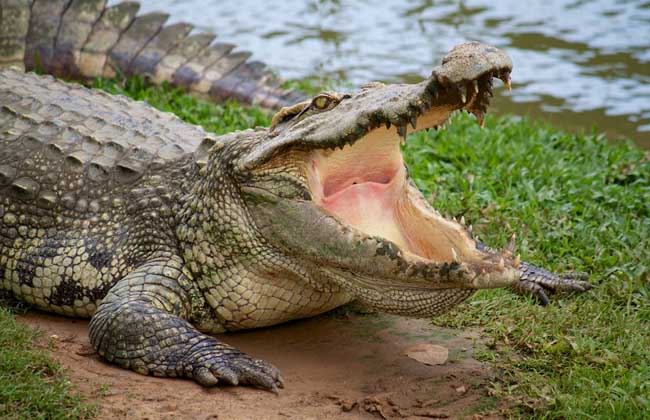
A crocodile is not a fish, but a cold-blooded, egg-laying reptile of the families Alligatoridae, Crocodylidae, and Gavialidae. Its name may come from the way it frolics in the water like a fish, and it is one of the earliest and most primitive animals found alive to date, appearing in the Mesozoic era from the Triassic to the Cretaceous (about 200 million years ago), in the same era as the dinosaurs. The crocodile is a wild animal with extremely high ecological, scientific, and economic value, so some countries around the world actively develop crocodile farming.
According to archaeological findings, the largest crocodile reached a body length of 15 m and a weight of nearly 1.5 tons, but among existing large species the average body length is more than 3 m and the weight is about 100 kg or more. The jaws are strong and powerful, with many conical teeth; the legs are short, with claws and webbed toes; the tail is long and heavy, and the skin is thick with scales and armor. In people's minds the crocodile is a "vicious fish"; at the mention of a crocodile, one immediately thinks of a bloody gaping mouth, densely packed sharp teeth, hard armor covering the whole body, and a look ready at any moment to eat a person.
Crocodiles live in fresh water. Apart from a few that live in temperate regions, most live in rivers, lakes, and watery swamps in tropical and subtropical regions, and some live in shallows near the coast. They mainly feed on fish, waterfowl, hares, deer, frogs, and so on, and are carnivorous animals. In fact, crocodiles are very agile animals, and their agility even exceeds human imagination, and saltwater crocodiles are more dangerous than their close relatives, the freshwater crocodiles.
Crocodiles build nests on shaded hills by freshwater rivers, sweeping out a 7-8 m platform with their tails, on which a nest 3 m in diameter is built to hold crocodile eggs. The nest is about 4 m from the river, formed by shade from clumps of leaves, and each nest holds about 50 white hard-shelled eggs, about 80×55 mm in size. The mother crocodile keeps watch beside the nest, constantly swinging her tail to sprinkle water and wet the nest, maintaining a temperature of 30-33°C, with hatching in 75-90 days. Hatchlings are 240 mm long when they emerge, can grow to 480 mm in 1 year, and can reach 1156 mm in 3 years, weighing 5.2 kg.
The Chinese alligator, Chinese and American alligators, South American alligator, Amazon caiman, narrow-snouted crocodile, sharp-snouted crocodile, intermediate crocodile, Philippine crocodile, Peten crocodile, Nile crocodile, gharial, saltwater crocodile, rhombic-marked crocodile, Siamese crocodile, alligator, false gharial, fish-eating crocodile, and others are endangered wild fauna and flora species. They are internationally important protected species, listed in Appendix I of CITES (the Convention on International Trade in Endangered Species of Wild Fauna and Flora), which prohibits their international trade.