What bait is good for catching soft-shelled turtles? Bait selection tips explained in one article
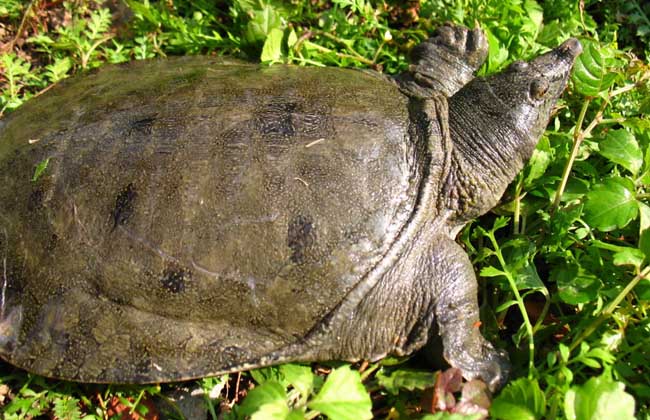
The soft-shelled turtle is a cold-blooded amphibious animal that likes to live in rivers, lakes, and ponds. It often floats to the water surface and extends the tip of its snout to breathe, and also frequently moves about on land to bask its shell. It is very sensitive to changes in outside temperature. At 10-12°C it enters hibernation, and when the water temperature rises to around 15°C it gradually wakes from hibernation and begins to feed. Now let us take a look at what bait to use for catching soft-shelled turtles!
What bait to use for catching soft-shelled turtles?
For catching soft-shelled turtles, meat bait is generally better. Earthworms, silkworm pupae, grasshoppers, and the like can all be used as feed, but the best is none other than pork liver or sheep liver. Among plant baits, fresh tender corn kernels are also a very good bait. As an attractant, a soft-shelled turtle attractant can be used; if this attractant is dipped onto pork liver as bait, the effect is even better. One of the simplest soft-shelled turtle baits is recommended: live loach, which is available in supermarkets and vegetable markets. Before fishing, cut off the head and tail of the loach, mix in sesame oil and shanai powder evenly, then insert a needle from the middle section of the loach until the needle is fully buried in the loach's belly, and it is ready for fishing.
Fishing tackle combination for soft-shelled turtles
The rod for catching soft-shelled turtles does not need to be too long; about 1 m is best. It is best to use a one-piece rod or a multi-piece hard elastic rod. The fishing line should be multi-strand opaque thick nylon line, such as 0.3-0.5 mm nylon line, so that it will not be bitten off by the soft-shelled turtle. The line length is about 4 m. The hooks should be large, such as crane-beak type No. 115-116, ring type No. 415-416, turtle type No. 815-816, etc. Straight hooks can also be used. The method for making a straight hook is to use 1 mm diameter stainless steel wire or a sewing machine needle, take a length of 25-30 mm, sharpen both ends into a date-pit shape, grind a groove at 1/3 of the way to tie the fishing line, load the bait from the short end, and make the long end face upward (absolutely do not install it upside down). Straight hooks can also be used to catch crucian carp, eel, and so on. This kind of fishing tackle for soft-shelled turtles usually needs to be used in large numbers, ranging from several dozen to over a hundred, and can be set according to need.
How is the best way to catch soft-shelled turtles?
1. Time: The early fishing time for soft-shelled turtles is from dawn to around 9 a.m., and evening fishing is from 5 p.m. to dark. When fishing for soft-shelled turtles during the day, choose a secluded flowing spot to cast. The fishing line should be long, 10 m or more or even longer. Cast the hook into the pond 10 m from the bank or farther, because during the day there is more noise and the soft-shelled turtle does not come near the bank, mostly moving about in the middle of the pond.
2. Bait: The bait is still fresh raw pork liver, chunks of fish meat, frog meat, or other chunks of meat, etc. Use an ordinary bamboo fishing rod (it should not be too long; 3-4 m is enough) as the turtle-fishing rod. Placing three or four fishing rods in one pond is enough. After the hooks are cast into the pond, you can sit and wait for a bite. Although the soft-shelled turtle is a cold-blooded animal, it requires a relatively high temperature when feeding. The minimum temperature must also be above 15°C. At 40°C or a little higher, the soft-shelled turtle is still very active, so catching soft-shelled turtles is highly seasonal. After the Beginning of Summer, soft-shelled turtles begin to bite; from Lesser Fullness to the Beginning of Autumn they are most active; after Cold Dew they can no longer be caught.
3. Casting: Summer and autumn are the best times to catch soft-shelled turtles. When it is hot, soft-shelled turtles often crawl out of the water and go to sunny spots by rivers and ponds to bask. They like to rest by riverbanks with sand or at bends in the river. When catching soft-shelled turtles, you can observe carefully along the bank and cast where there are traces of soft-shelled turtles crawling.
4. Taking the hook: After a soft-shelled turtle finds food, it is always cautious and first smells and nudges it, then bites lightly, and only swallows it for real when there is no movement. Therefore, it is better to lift the rod late rather than early. The float usually bobs first, then moves slowly up and down, and if this continues, you can lift the rod. After being hooked, it often grips the ground with all four claws, as if snagged on the bottom. At this time, do not pull hard. When it moves on its own, you can follow its movement and lift it out of the water.
5. Removing the hook: Once the soft-shelled turtle leaves the water, it loses its ability to struggle, but removing the hook is rather troublesome. Generally, if it has not swallowed the hook deeply, you can put it on the ground, press down on its back, and pull the hook out, or use a tree branch, bamboo stick, or the like to lure it into opening its mouth, then thrust it into the mouth while taking advantage of the moment, push the fishhook downward, and pull it out accordingly. When a soft-shelled turtle encounters something probing into its mouth, it often bites down hard and will not let go. Experienced anglers often make use of the soft-shelled turtle's habit of turning over and first extending its neck: turn the soft-shelled turtle over so its back faces the ground, and when it is about to turn over and extends its neck, quickly pinch its neck, step on its belly, pull out the neck, and then remove the hook. But this must be done skillfully and without hesitation, otherwise it is very hard to pinch it, and you may be scratched by its front claws. If it really cannot be done, then you have no choice but to cut the fishing line short and deal with it when slaughtering it at home.