What Animal Is the Tibetan Antelope? Getting to Know This Rare Plateau Animal
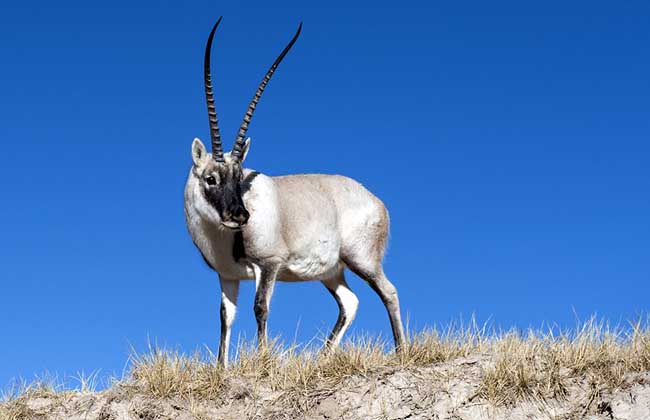
The Tibetan antelope, also known as the chiru or long-horned antelope, is an animal of the genus Pantholops in the family Bovidae, order Artiodactyla. It mostly lives on the Qinghai-Tibet Plateau in China (Tibet, Qinghai, Gansu, **), with a small number distributed in the Ladakh region of India. It is called the "pride of Hoh Xil", is a national first-class protected animal, and is also an endangered animal listed in the Convention on International Trade in Endangered Species of Wild Fauna and Flora, with trade strictly prohibited.
The Tibetan antelope has well-proportioned, strong limbs, a short tail with a pointed tip, and a body covered in thick, dense, fine fur with straight hair. Each nostril also contains a small sac, which helps it breathe in the thin air of the plateau. In males, the head, neck and upper parts are light brownish, darker in summer and lighter in winter, the belly is white, and there are striking black markings on the forehead and all four legs; females are pure yellowish brown with a white belly. Adult males have long, straight horns with slightly inward-curving tips, 50-60 cm long, while females have no horns. Males generally live no more than 8 years, females generally no more than 12 years, and in captivity they can live nearly 10 years.
The Tibetan antelope's habitat altitude is 3500-5200 m, and it is especially common in the uninhabited plateau areas at 4000-5000 m. It usually lives in the ecological environments of alpine meadow, alpine steppe, alpine steppe desert and alpine desert. It is mainly distributed across most of Tibet and Qinghai as well as the southern edge of **, the two northwestern corners of Sichuan and parts of southwestern Gansu, with a total distribution area of about 88.5 sq km, between latitude 37 degrees 17 minutes north and longitude 80 degrees 10 minutes to 99 degrees 50 minutes east, with a small number distributed in northern India and Nepal.
The movements of Tibetan antelopes are very complex; some Tibetan antelopes stay in one place for a long time, while others have migratory habits. The activity patterns of females and males differ; adult female Tibetan antelopes and their female offspring migrate 300 km each year from the winter mating grounds to the summer calving grounds. Young male Tibetan antelopes leave the group and gather with other young or adult males, eventually forming a mixed group.
The Tibetan antelope's main instinct for defending against enemies is running. Thanks to its strong, well-proportioned limbs, it has the advantage of being especially good at running, with a running speed of up to 70 km per hour. Even pregnant females about to give birth will run quickly, which is rarely seen among other herbivores. Wolves are the main natural enemy of the Tibetan antelope, often hunting them by chasing them relentlessly; young, old and injured Tibetan antelopes often end up in the belly of wolves. In addition, birds of prey such as vultures pose a great threat to Tibetan antelopes, especially newborn ones.
The Tibetan antelope was listed as a vulnerable species by the International Union for Conservation of Nature in 1996, as an endangered species in 2000, and was included in CITES Appendix I in 1979. It is also under first-class key protection under China's Wildlife Protection Law, and hunting and trade are prohibited without a permit. In India, apart from special circumstances in the Zhaomo and Kashmir regions, trade in Tibetan antelopes is also explicitly prohibited under the Indian Wild Life (Protection) Act.