What Kind of Bird Is the Red Turtle Dove? A Guide to Getting to Know This Bird
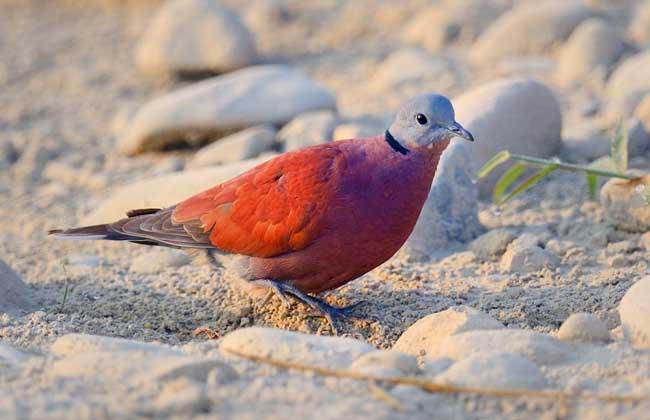
The Red Turtle Dove, also known as the red dove, red-spotted dove, spotted turtle dove, red ka zhui, and fire turtledove, is a bird of the genus Streptopelia in the family Columbidae. It inhabits tropical regions of southern Asia and is commonly seen foraging in flocks on plains and grasslands. It is distributed in India, Nepal, Bhutan, Bangladesh, Myanmar, Indochina, the Philippines, and across mainland China from north China southward, west to Sichuan and Tibet, and throughout the areas north of the Yangtze River. It mainly inhabits open fields and areas near villages.
The Red Turtle Dove is one of the smaller species in the family Columbidae, with adults measuring about 23 cm in length. The male's forehead, crown, and nape are blue-gray, and the sides of the head and neck are also blue-gray but slightly paler. The chin and upper throat are white or blue-grayish white. A black collar band crosses the base of the hindneck and extends to both sides of the neck. The back, shoulders, upper wing coverts, and tertials are grape-red; the rump, uppertail coverts, and central tail feathers are dark blue-gray; the remaining tail feathers are grayish black with broad white terminal spots. The outer webs of the outermost tail feathers are white, and the flight feathers are dark brown. From the throat to the belly, the plumage is pale grape-red, and the undertail coverts are white. The flanks, feathered tarsi, area around the vent, underwing coverts, and axillaries are all blue-gray.
The female Red Turtle Dove has a pale brownish forehead and crown tinged with gray. The black collar band at the base of the hindneck is narrower and less obvious than in the male, and the outer edge of the black neck ring is bordered with white. The rest of the upperparts are dark earth-brown, with the rump tinged with blue-gray. The underparts are light earth-brown with a slightly pinkish hue. The chin and throat are white or nearly white. The lower belly, area around the vent, and undertail coverts are pale gray or blue-white. The iris is dark brown, the bill is black with a paler base, the legs are brownish red, and the claws are blackish brown.
The Red Turtle Dove mainly feeds on plant berries, seeds, and fruits, and also eats the seeds of crops such as rice, corn, buckwheat, wheat, sorghum, and rapeseed. It sometimes also eats animal matter such as termites, pupae, and insects. It often moves in pairs or flocks, and sometimes mixes with Oriental Turtle Doves and Spotted Doves. It likes to perch on power lines or tall dead branches. It flies very fast and often produces a 'whirring' sound with its wings.
The breeding season of the Red Turtle Dove is from February to August, mainly from May to July in the north. It nests and breeds in pairs, usually building its nest in trees in forests and open woodlands on low mountains or at the foot of mountains, with the nest mostly placed on well-concealed low branches. The nest is saucer-shaped, relatively simple and rough in structure, and mainly made of a few dead twigs piled together in a crisscross pattern. It lays 2 eggs per clutch. The eggs are oval and white, measuring 23-29.5 mm × 20-22.7 mm, with an average of 26.9 mm × 20.9 mm.
The Red Turtle Dove is a "Three-Haves Protected Animal" and has been included in the List of Terrestrial Wild Animals Under State Protection That Are Beneficial or of Important Economic or Scientific Research Value, issued by China's State Forestry Administration on August 1, 2000. Its protection level on the International Union for Conservation of Nature (IUCN) Red List is Least Concern ver 3.1.