Pistachio is also called anacardia, one of the world's four major nut tree species, and its kernel is a highly nutritious food.
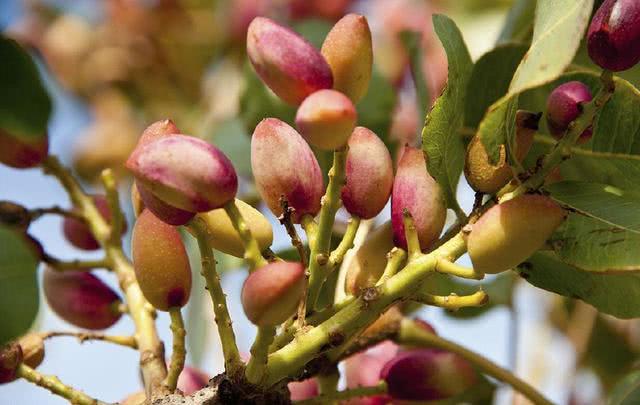
Pistachio tree
The pistachio tree (Pistacia vera), also called anacardia, is a small deciduous tree.
The tree is about 10 m tall, with odd-pinnate compound leaves, a long lifespan, and slow growth. Counting from the first year of planting the seed, a seedling grown from seed needs at least six years to bear fruit, and the fruiting rate increases year by year. The fruit is relatively large, oblong, about 2 cm long and about 1 cm wide, and turns yellow-green or pink when ripe.
It is native to Syria, Iraq, Iran, southwestern part of the former Soviet Union and southern Europe, and was later introduced to remote areas of China.
Morphological characteristics
The tree is about 10 m tall, with odd-pinnate compound leaves and 3-5 leaflets, but often 3.
The leaflets are ovate or broadly elliptical, 4-10 cm long and 2.5-6.5 cm wide, with entire margins.
The panicle is 4-10 cm long.
It is dioecious. Male flowers have 3-5 tepals of unequal size. Female flowers have 3-5 membranous tepals.
The ovary is ovate. The fruit is relatively large, oblong, about 2 cm long and about 1 cm wide.
The apex is acute, and the fruit turns yellow-green or pink when ripe.
Species culture
Legend has it that in the 3rd century BC, when Alexander's expedition reached an uninhabited region, the army's provisions became a major problem.
But there is always a way out. The soldiers found that a valley was full of a kind of tree laden with fruit. They tried gathering this fruit to satisfy their hunger, and found that this fruit was not only edible but also had a fragrance, and after eating it people became energetic, physically strong, and more capable;
It is also said that in the 5th century BC, during the Greco-Persian Wars, the Persians relied entirely on eating anacardia to keep their army energetic and win victories repeatedly.
At that time, when Persian herders migrated, they had to carry enough anacardia with them before undertaking longer migratory lives.
Distribution range
Because the pistachio tree (anacardia) is not a native seedling in China and was introduced into China only in remote areas, the pistachio tree is very commonly planted in countries such as Syria.
Growing environment
1. Soil requirements and adaptation
The pistachio tree is highly adaptable to soil and can grow in almost all types of soil, especially preferring deep, thick, light, or dry calcareous sandy loam and yellow loam, and also growing in clay loam, gravelly soil, shallow chestnut soil, light loam, mildly salinized soil, and so on.
Soil pH 7.7-8.0. It can also grow and bear fruit on gravelly barren mountain land and semi-desert land. Growth requires trace elements such as potassium and iron. Pistachio is not tolerant of saline-alkali conditions, and cannot grow in places that are too damp and waterlogged.
2. Water requirements and adaptation
In suitable planting areas for the pistachio tree, the annual precipitation is generally in the range of 200-400 mm, where it grows well and bears abundantly;
In areas with annual precipitation below 80 mm, it can still grow, flower and bear fruit tenaciously, but a lack of water during the sensitive water-demand period in summer can lead to a total loss of the fruit crop.
Iran's best pistachio orchards are on plateaus at an altitude of 4,000 ft, considered the world's worst desert, with average annual rainfall of 10-15 in, less than 5 ft in the southern and eastern regions, and summer temperatures in the northern part of the plateau reaching as high as 100 degrees Fahrenheit.
Annual sunshine of 2,500-3,000 hours is best. It does not require high air humidity, and the water table is best below 3 m.
3. Heat requirements and adaptation
Pistachio is drought-tolerant, light-loving, intolerant of shade, afraid of moisture, afraid of summer waterlogging, and extremely strong in drought resistance. Its main root penetrates 7-8 m into the soil layer, and its horizontal roots are well developed and can extend beyond 10 m. It is one of the world's most drought-resistant fruit trees and an excellent tree species for soil and water conservation.
Pistachio has strong adaptability to temperature. In Shufu County, Xinjiang, it can withstand high temperatures of 42 degrees Celsius and low temperatures of -26 degrees Celsius. In Sicily (Bronte), a summer temperature of 73.4 degrees Fahrenheit, an average temperature of 46 degrees Fahrenheit, and a low temperature of 26.6 degrees Fahrenheit cause no damage to the tree;
In Arizona, USA, it can endure low temperatures of 6 degrees Fahrenheit, while in Iran from 15 degrees Fahrenheit to 108 degrees Fahrenheit, and in some areas of the former Soviet Union it can endure subzero Fahrenheit temperatures. Kerman, Iran, is the most suitable growing place for pistachio. Over 7 years, the average January temperature variance is 4.4 degrees F, and the average temperature is 44.9 degrees F. The pistachio tree needs a sufficiently cool winter to break bud dormancy and a long, hot, dry summer to ripen the fruit.
The fruiting period requires a large day-night temperature difference.
With regional temperatures within the range of a maximum of 43.8 degrees Celsius and a minimum of -32.8 degrees Celsius, the fruit grows well.
4. The Northern Shaanxi Loess Plateau is a suitable growing area
On the Northern Shaanxi Loess Plateau, south of Yan'an, the annual rainfall is mostly above 450 mm, belonging to a semi-humid region.
North of Yan'an, the annual rainfall is mostly below 450 mm, belonging to a semi-arid region. From south to north, the vegetation is successively deciduous broad-leaved forest, forest steppe and semi-arid steppe.
This area is rich in light energy resources, with cold winters, hot summers, a short frost-free period, concentrated precipitation, and frequent rainstorms.
Annual total radiation is 120-130 kcal/cm. per year, and annual sunshine is about 2,500 hours.
The annual average temperature is 8-10 degrees Celsius in the north and 7-9 degrees Celsius in the south; the temperature in the coldest month is -5 degrees Celsius to -8 degrees Celsius;
In the hottest month, except for the western mountainous areas, it generally reaches above 22 degrees Celsius.
The extreme minimum temperature is between -22 and -26 degrees Celsius, and -23 degrees Celsius in the south.
The extreme maximum temperature is 39 in the north.
7 degrees Celsius, 39 degrees Celsius in the south. Except for the Suide area, the annual temperature range is 3-4 degrees Celsius lower than along the Great Wall, and the accumulated temperature of ≥10 degrees Celsius is 2,800-3,500 degrees Celsius.
The accumulated temperature of ≥5 degrees Celsius is 3,800-4,200 degrees Celsius.
The frost-free period is 160-190 days. Annual precipitation is 480-560 mm in the north and about 600 mm in the south;
Precipitation is concentrated in summer, accounting for 57% of precipitation. Adding that of September, precipitation accounts for about 70% of annual precipitation. The relative variability of annual precipitation is 18-24%. The late frost period is short in duration.
The soils are mainly dark loessial soil and partly mountain brown soil. Before the 1980s, dark loessial soil was rich in a dark brown or black-brown humus layer and was a soil developed from loess parent material.
The humus layer is deep, reaching 120-220 cm.
There is leaching and deposition of carbonates in the soil, pH 7.5-8.5, with more pores and microaggregate capacity.
However, due to climate change and human activities, the soil in this area has been severely degraded, and soil erosion and desertification are becoming increasingly serious.
In summary, pistachio is a suitable tree species for the Northern Shaanxi Loess Plateau region, and planting pistachio can reverse the current ecological and environmental situation.
Main value
Economic value of the fruit
The pistachio tree is a plant with a long lifespan and slow growth.
Counting from the first year of planting the seed, a seedling grown from seed needs at least six years to bear fruit, and the fruiting rate increases year by year.
From the 14th to the 70th year after planting is the full fruiting period.
Grafted seedlings begin to bear fruit in the third year, and can enter the full fruiting period in the sixth year.
A robust and healthy pistachio tree begins to bear fruit six years after planting.
Each tree can harvest 100-200 kg of fresh fruit per year, and an ordinary pistachio tree produces 70-130 kg of fresh fruit per plant per year. The dried fruit rate (commercial product) of fresh fruit is 30%, that is, 100-200 kg of fresh pistachios forms 30-60 kg of commercial product (dried fruit). For nearly a hundred years.
The value of pistachio ranks first among dried fruits.
Pistachio commercial products are divided into four grades. In China, the retail price of first-grade pistachios is 75 yuan per kg, second-grade 65 yuan, third-grade 50 yuan, and fourth-grade 40 yuan.
Ecological value
At the same time, pistachio is a deep-rooted drought-tolerant tree species. Its main root can penetrate up to 7 m into the soil layer, its horizontal lateral roots can reach 10-15 m, and the tree can live as long as 300 years. Therefore, it can serve as an excellent tree species for soil and water conservation and promote a virtuous cycle of the ecosystem.