What kind of bird is the laughing dove? Let us get to know this dove
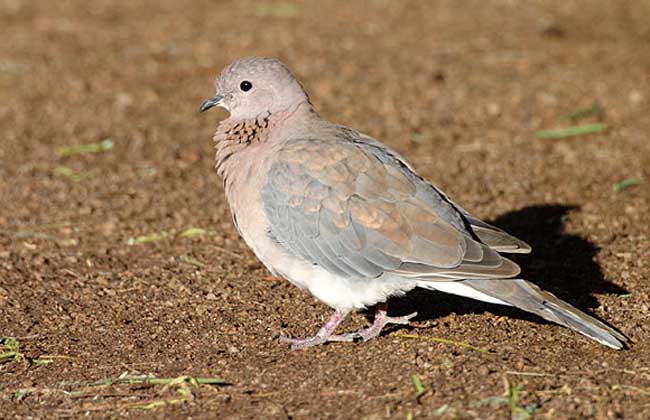
The laughing dove is a bird of the genus Streptopelia in the family Columbidae, also known as the blue-shouldered dove. It is distributed across Africa, the Arabian Peninsula, Iran, the former Soviet Union, Afghanistan, Pakistan, India, Nepal, possibly introduced artificially to Turkey, Palestine, Syria, Australia, as well as ** and other places in mainland China. It generally inhabits deserts, semi-deserts, and places with oases and low thickets.
The laughing dove is small, about 25 cm, with a long tail and short wings. It differs from the Eurasian collared dove in being smaller, lacking a black neck ring, and having darker coloration, more resembling the European turtle dove. It lacks the neck and wing markings of the European turtle dove, but has a brown neck band with black spots. The outer tail feathers have white tips, and it has a distinctive blue-gray wing patch. The iris is brown, the bill is gray, and the feet are pink.
The laughing dove inhabits oases and thickets in desert and semi-desert regions, as well as near villages and small towns. It usually forages on the ground for plant seeds, fruits, and shoots, and is also fond of eating grain. It usually lays 2 to 3 clutches of eggs per year, nesting in various trees, shrubs, thorn bushes, forests, or cactus thickets, and often also nests on balconies, walls, or under the eaves of houses.
The main threats to the laughing dove come from people hunting and killing them and destroying nests to take eggs, followed by the unreasonable use of chemical pesticides. It has now been included in the "List of Terrestrial Wild Animals Protected by the State or of Important Economic or Scientific Research Value" issued by China's State Forestry Administration on August 1, 2000.