What kind of snake is the Chinese cobra? Get to know this venomous snake
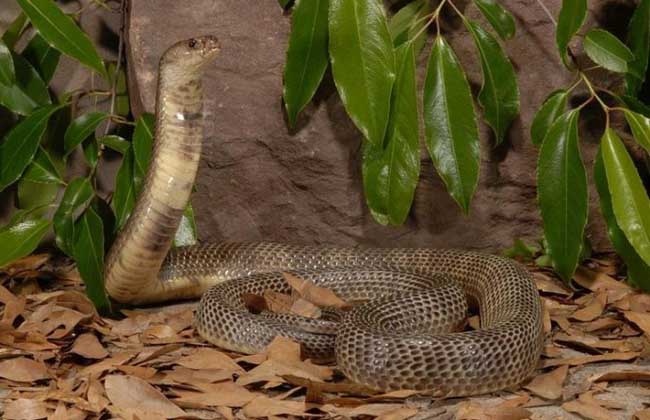
The Chinese cobra is also known as the Zhoushan cobra, white-necked black snake, Baohu, bat snake, flat-necked snake, flat-headed snake, and so on. In Guangdong, Guangxi and Hong Kong, China it is commonly called fanchan tou, while in Taiwan, China it is called fanshi qian, fanshi chong and pengjing she. It belongs to the genus Naja in the family Elapidae, and is distributed in southern China, Taiwan, China and the low- and mid-altitude areas of the Indochinese Peninsula.
The Chinese cobra is medium to large in size, with adults reaching a total length of 1.5-2 m. It has no cheek scales, 1 preocular scale, 2 postocular scales, and temporal scales 2+2. There are 7 upper labial scales, the 3rd being the largest, preceded by the nasal scale and followed by the eye; there are 8 lower labial scales, with the front 4 or 3 touching the anterior chin shields. The dorsal scales are smooth and keelless; ventral scales number 158-193 in males and 160-196 in females; the anal scale is entire or divided. Subcaudal scales number 39-54 pairs in males and 38-53 pairs in females. The dorsal surface is black or dark brown, with spectacle-like markings on the nape, and thin white rings throughout the body, especially obvious in young individuals, while in old individuals they are blurred and indistinct.
The Chinese cobra has a wide diet, feeding mainly on frogs and snakes, secondarily on birds and rodents, and also eating lizards, loaches, eels and other small fish. In Taiwan, China this snake has been observed to feed mainly on birds and rodents, and it also goes to the water's edge to eat water snakes and loaches. It emerges from hibernation around May each year and enters winter dormancy in November.
Many zoos keep a small number of Chinese cobras for display, but most cannot survive the winter, and the next year more are captured from the wild. Some snake farms also raise them, but few can successfully breed the next generation, and generally they buy those captured from the wild for use. It is oviparous, mating in May-June and laying 7-19 eggs in July-August; the eggs are 42-54 mm in long diameter and 26-31 mm in short diameter, the incubation period is 1.5-2 months, and newly hatched young snakes have a total length of about 200 mm.
The Chinese cobra inhabits plains, hills and low mountains, and is found in cultivated areas, roadsides, near ponds and in residential courtyards. It is mostly active by day, with a vertical distribution of 70-1630 m. It is distributed in Anhui, Chongqing, Fujian, Guangdong, Guangxi, Guizhou, Hainan, Hubei, Hunan, Jiangxi, Zhejiang, Hong Kong, China, Macao, China and Taiwan, China, as well as the Lao People's Democratic Republic and Vietnam.
The Chinese cobra is a rear-fanged venomous snake that secretes a mixed neurotoxic and hemotoxic venom, with a large venom yield, strong toxicity, a wide range of injuries and serious harm; if bitten and not treated promptly, it can be life-threatening. Its venom can be made into freeze-dried products and snake venom enzymes, and the medicinal three-snake wine made with the banded krait and the oriental ratsnake has the medicinal effects of clearing meridians and dispelling rheumatism.