What Kind of Snake Is the King Cobra? A Detailed Guide to Its Characteristics and Habits
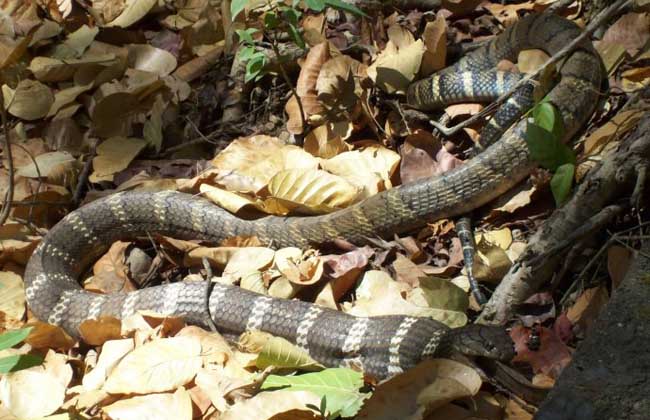
The king cobra is also known by other names such as mountain ten-thousand snake, ridge-crosser, large flat-necked snake, large cobra, large flat-headed wind snake, flat-necked snake, large swollen neck, blowing-wind snake, and ridge-crosser marker, among others. Although it is called the "king cobra," this species is different from true cobras and is not a member of the genus Naja, but belongs to the independent genus Ophiophagus. Compared with other cobras, it has a fiercer temperament, extremely agile reactions, a flexible rotating head and neck, and a large venom output, making it one of the most dangerous snake species in the world. It is often found in southwestern and southern China, usually inhabiting grasslands, open slopes, and forests. Its main food is its close relatives -- other snakes -- so in the territory of the king cobra, it is very difficult to see other kinds of snakes. Its venom is extremely potent.
The king cobra is a large snake. The maximum total length recorded is 3806 mm in China and 5580 mm outside China. It has 1 preocular scale, 3 postocular scales, smooth dorsal scales without ridges and with a metallic sheen arranged in oblique rows, an entire anal scale, and subcaudal scales in a single row or double row. It has anterior grooved fangs, followed by 3 small teeth. In life, the dorsal surface of the body is dark brown, and the back of the neck has a yellow-white "∧"-shaped marking, without spectacle-shaped markings. The dorsal surface of the trunk and tail has narrow white crossbands edged in black. The lower jaw is earth-yellow, and the ventral surface of the body is grayish-brown with black linear markings. The markings of young snakes differ from those of adults, mainly in having yellow-white transverse stripes on the top of the snout and in front of the eyes, a black body, and more than 35 pale yellow or white transverse stripes. It generally weighs 6 kg, and its lifespan is about 20 years.
The king cobra likes to live alone, coming out during the day to hunt and hiding at night in rock crevices or tree holes to rest. Like other cobras, when in danger it raises the front third of its body, then opens its mouth, reveals its fangs, and stares at its opponent while keeping watch on the surrounding environment. Once the king cobra believes it is in danger, it will attack without hesitation. It mainly preys on snakes and lizards, and also eats birds, bird eggs, and rodents.
The king cobra's food is usually other snakes. It has anti-venom serum in its body, so when other venomous snakes bite the king cobra, the king cobra usually remains unharmed. Its food includes pythons of suitable size, other kinds of venomous and non-venomous snakes such as cobras, banded kraits, many-banded kraits, and rat snakes, and when food is insufficient it will even eat other members of its own species, which is why the king cobra is also called the "nemesis of snakes."
The king cobra is a highly intelligent snake. It hunts other snakes and can distinguish whether the other party is venomous. When preying on non-venomous snakes, the king cobra does not readily use venom; it will casually bite once and hold on, letting the prey struggle and resist until it dies before slowly swallowing it. When preying on venomous snakes, it does not act rashly, but keeps provoking them. When the opponent is finally enraged and attacks it, it dodges alertly. Finally, when the prey is exhausted both physically and mentally and no longer wants to fight, it seizes the opportunity, bites the prey's head and neck in one bite, and releases venom to kill it.
The king cobra moves agilely, and its head can rotate flexibly. It can not only attack forward, backward, left, and right, but can also lunge vertically to attack objects above its head. After biting something, it often does not let go easily. The dry venom in its venom is about 100 mg, while the average lethal dose is 12 mg. A bitten person will experience swelling, nausea, abdominal pain, respiratory paralysis, speech impairment, coma, and other symptoms within a few minutes. If a person does not receive timely medical treatment within half an hour after being bitten, death is certain.
The king cobra is a special economic animal with high economic value. Its skin, meat, blood, gallbladder, and venom each have different medicinal value. In particular, snake venom is an animal-derived medicinal material in extremely short supply on the international market. It is hailed as "liquid gold" on the international market, and its price is dozens of times that of gold, with demand exceeding supply.