What are the characteristics of the rattlesnake's living habits?
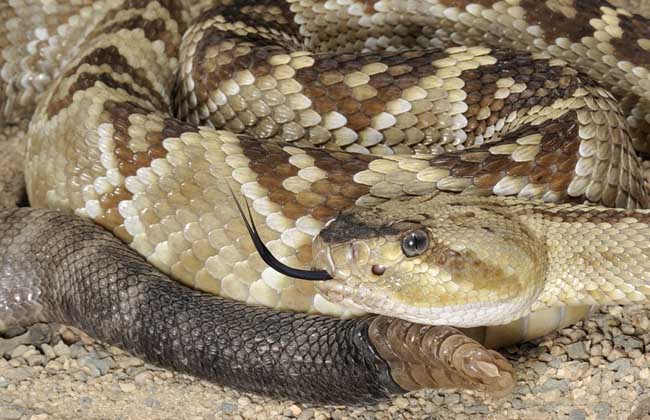
The rattlesnake is a type of fanged venomous snake in the family Viperidae, class Reptilia. Its venom is a hemotoxin. It generally has a body length of about 1.5 to 2 m, is yellow-green in color, has diamond-shaped dark brown spots on its back, and has a series of keratinous rings at the end of its tail that can vibrate and produce a loud sound for a long time, causing enemies to dare not approach or to be frightened away. Let us take a look below at the living habits of rattlesnakes!
The distribution range of rattlesnakes
Rattlesnakes are distributed in arid regions from Canada to South America. Their body lengths vary greatly. For example, several smaller species in Mexico are only about 30 cm, while the eastern diamondback rattlesnake can reach about 2.5 m. There are two genera, the dwarf rattlesnakes and the rattlesnakes. Dwarf rattlesnakes are small in body size and have 9 large scales on top of the head. Rattlesnakes vary in body size depending on the species, but the scales on top of the head are all very small. The most common in North America are the timber rattlesnake in the eastern and central United States, the prairie rattlesnake in several western states, and the eastern diamondback rattlesnake and western diamondback rattlesnake. The latter two are the largest among rattlesnakes.
The feeding habits of rattlesnakes
Rattlesnakes are carnivores and eat rodents and other small animals (such as rabbits, mice, etc.). Young snakes mainly feed on lizards. They use venom to quickly subdue prey rather than constriction. These toxins can cause the prey to become immediately paralyzed or die, and they will track prey that has not been subdued by the venom and tries to escape. Their strike distance can reach two-thirds of their body length.
The reproductive habits of rattlesnakes
Most rattlesnakes mate in spring and are ovoviviparous. After birth, the young snakes are already able to be independent, so the mother snake will not stay by the side of the young. According to a report in the British magazine New Scientist, the outstanding family planning award in the animal world should be given to the eastern diamondback rattlesnake. Females of this rattlesnake can store sperm in their bodies for at least 5 years before reproducing offspring.
The heat-eye system of rattlesnakes
The “heat eyes” of rattlesnakes and pit vipers are located in the pit organ between the eyes and nostrils. The pit organ is generally 5 mm deep and only one cm long. This pit organ is trumpet-shaped, with the opening angled forward, and is divided by a membrane into inner and outer parts. The inner part has a thin tube connected to the outside, so the temperature inside is the same as the temperature of the surrounding environment where the snake is. The outer part, however, is a heat collector. If there is a warm object in the direction faced by the trumpet opening of the rattlesnake's heat eye, infrared radiation passes through here and shines onto the outer side of the membrane. Obviously, this is higher in temperature than the inner side of the membrane. The nerve endings spread across the membrane sense the temperature difference and generate a bioelectric current, which is transmitted to the snake's brain.