Where are rattlesnakes mainly distributed?
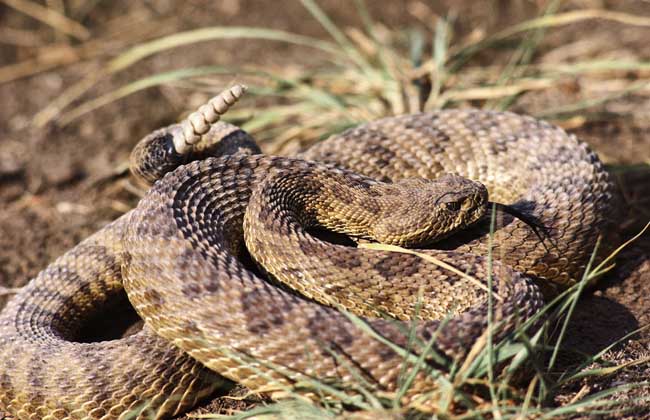
The rattlesnake is a type of venomous snake with solenoglyphous fangs. At the end of its tail is a string of keratinous rings, which are the remnants left after multiple molts. When it encounters an enemy or makes sudden movements, it rapidly shakes the tail rings, vibrating them 40 to 60 times per second, and can produce a loud sound for a long time, causing enemies to dare not approach or to be frightened away. Hence it is called the rattlesnake. Now let us take a look at where rattlesnakes are distributed!
Where are rattlesnakes distributed?
Rattlesnakes are distributed in the arid regions stretching from Canada to South America. Their body lengths vary greatly; for example, several smaller species in Mexico are only about 30 cm, while the eastern diamondback rattlesnake can reach about 2.5 m. There are two genera: the pygmy rattlesnakes and the rattlesnakes. The pygmy rattlesnakes are small in size and have 9 large scales on top of the head. The genus Crotalus varies in size depending on the species, but the scales on top of the head are all very small. The most common rattlesnakes in North America are the timber rattlesnake of the eastern and central United States, the prairie rattlesnake of several western U.S. states, and the eastern diamondback rattlesnake and western diamondback rattlesnake, with the latter two being the largest among rattlesnakes.
What do rattlesnakes eat?
Rattlesnakes are carnivores and eat rodents and other small animals (such as rabbits and mice). Young snakes mainly feed on lizards. They use venom to quickly subdue prey rather than constriction. These venoms can immediately paralyze or kill the prey, and they will track prey that has not been subdued by the venom and tries to escape. Their strike distance can reach two-thirds of their body length.
What types of rattlesnakes are there?
1. Pygmy rattlesnake: The pygmy rattlesnake is a venomous snake in the subfamily Crotalinae of the family Viperidae, order Serpentes, distributed in Canada, the United States, and Mexico. It is noticeably smaller than rattlesnakes, has nine relatively large frontal scales on the head, and possesses a tail that can produce sound, though it can make sounds that are higher in both frequency and pitch and more rapid than those of ordinary rattlesnakes. Although the venom of the pygmy rattlesnake is generally considered to be relatively low-risk, any venomous snake bite must nonetheless be handled with caution and receive relevant treatment immediately; that is the most correct attitude.
2. Eastern diamondback rattlesnake: The eastern diamondback rattlesnake is the largest rattlesnake in the world. In the United States it is becoming increasingly rare, often killed by cars or captured during rattlesnake roundups. Its venom is very toxic and abundant. This is not surprising, because it is very large. Today in the United States, only one or two people die each year from rattlesnake bites. But because of its astonishing size and its venom, it occupies third place on snake catcher Nigel Marven's list of the ten deadliest venomous snakes in the United States.
3. Sidewinder: The sidewinder, also known as the sidewinding snake, is a small nocturnal snake of the family Viperidae, found in the sandy deserts of Mexico and the southwestern United States. Its body length is about 45 to 75 cm. It has a horn-like scale above each eye, is pale yellow, pink, or gray, and has inconspicuous spots on the back and sides of the body. It moves sideways in coils across the desert, leaving distinctive J-shaped tracks. It is venomous, but a bite generally does not kill a person.
4. South American rattlesnake: The South American rattlesnake is a rattlesnake distributed in South America. It can reach 1.8 m in length and has two distinct black lines from the neck to the head. The venom of the South American rattlesnake is like playing Russian roulette. The venom of adult rattlesnakes only destroys blood cells and tissues, but young rattlesnakes do not yet have a rattle and cannot yet give a warning, so their venom also causes muscles to contract and climb stems, and attacks the respiratory system, leading to respiratory failure. The stronger venom can compensate for the young rattlesnake's inability to give a warning.
5. Santa Catalina rattlesnake: The Santa Catalina rattlesnake is a venomous snake species in the family Viperidae, order Serpentes, mainly distributed in northwestern Mexico and adjacent coasts and islands. At present, three subspecies have been confirmed. The Santa Catalina rattlesnake prefers to live in desert areas, but in northwestern Mexico they can also be found in some scrublands, because the local forests have the characteristics of pine-oak mixed forest and short-term tropical features, making them suitable for the Santa Catalina rattlesnake to live in. It also inhabits rocky areas or sand dunes, and is sometimes attracted to and appears around physiological waste left behind by human settlements.
6. Twin-spotted rattlesnake: The twin-spotted rattlesnake, also known as the double-spotted rattlesnake, is a venomous rattlesnake in the genus Crotalus, subfamily Crotalinae, family Viperidae, order Serpentes, mainly distributed in the United States and Mexico. Adult twin-spotted rattlesnakes usually do not exceed 50 to 60 cm in length, and the current longest recorded specimen is 66 cm. In color, they are mostly based on gray or brownish gray (sometimes leaning toward brownish red), with many small brown spots. The dorsal scale pattern is spot-like, divided into two rows on the left and right with the midline of the ridge as the boundary, and there are about 39 to 64 pairs of such markings.
7. Tiger rattlesnake: The tiger rattlesnake has many longitudinal stripes on its back resembling tiger stripes. Few adults reach 100 cm, and the largest specimen had a length of 88.5 cm. Its head is very small while its back is large. It is distributed in Arizona in the southeastern United States and the Sonora region of northwestern Mexico. The tiger rattlesnake's venom is the most potent of all rattlesnakes. Despite the high toxicity, it appears not to have caused severe local or systemic symptoms in humans.