Why does a rattlesnake's tail make a rattling sound?
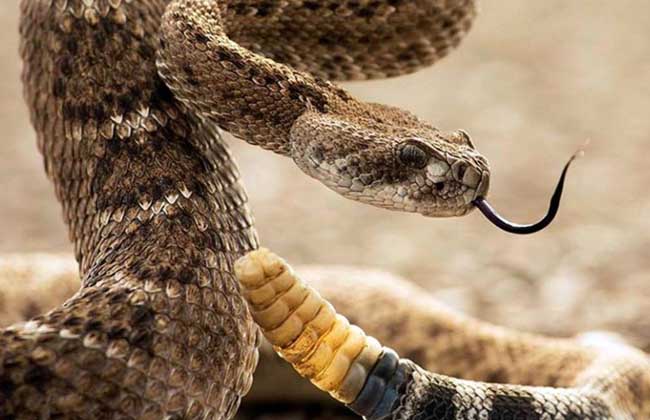
Rattlesnakes generally measure about 1.5 to 2 m in body length, are yellow-green in color, have diamond-shaped dark brown markings on their backs, and a series of keratinous rings at the tip of the tail, which are the remnants left after multiple molts. When encountering an enemy or moving rapidly, they swing the tail rings quickly and can produce a loud sound for a long time, making enemies dare not approach or scaring them away. Now let us take a look at why a rattlesnake's tail rattles!
Why does a rattlesnake's tail rattle?
At the tip of a rattlesnake's tail grows a kind of keratinous chain-like ring, forming a hollow cavity, and a keratinous membrane divides the cavity into two ring-shaped vacuoles, as if they were two air oscillators. When the rattlesnake keeps shaking its tail, a flow of air forms inside the vacuoles, oscillating back and forth as it enters and exits, and the vacuoles produce a “clack-clack” sound.
What is the function of a rattlesnake's tail?
The typical feature of a rattlesnake is the rattle at the tail. The rattle is like a string of dry hollow beads; when shaken, the rings rub against each other and vibrate the air, producing a hissing sound to warn intruders that being bitten by it will cause poisoning. The longer the rattle string, the louder the sound it produces, which also indicates that the rattlesnake is older. Young rattlesnakes that do not yet have a rattle cannot produce a warning sound, so when they encounter intruders they launch attacks without any warning. At the same time, a rattlesnake's tail can mimic the sound of flowing water, attracting thirsty small animals in the desert.
What are the common species of rattlesnakes?
1. Pygmy rattlesnake: The pygmy rattlesnake is a venomous snake in the subfamily Crotalinae of the family Viperidae, order Serpentes, distributed in Canada, the United States and Mexico. It is noticeably smaller than other rattlesnakes, has nine relatively large frontal scales on the head, and possesses a tail that can produce sound, though it can make a higher and denser sound than ordinary rattlesnakes in both frequency and tone. Although the venom of the pygmy rattlesnake is generally considered to be a relatively low-risk toxin, in any case any venomous snake bite must be handled carefully and receive relevant treatment immediately, which is the most correct attitude.
2. Eastern diamondback rattlesnake: The eastern diamondback rattlesnake is the largest rattlesnake in the world, and it is becoming increasingly rare in the United States, often being run over by cars or captured during rattlesnake roundups. Its venom is highly toxic and plentiful, which is not surprising because of its large size. Today in the United States, only one or two people die each year from rattlesnake bites. But because of its astonishing size and its venom, it occupies third place on snake catcher Nigel Marvin's list of the ten deadliest venomous snakes of the United States.
3. Sidewinder: The sidewinder, also known as the side-moving snake, is a small nocturnal snake of the family Viperidae, found in the sandy deserts of Mexico and the southwestern United States. Its body length is about 45 to 75 cm. It has a horn-like scale above each eye, is pale yellow, pink or gray, with inconspicuous spots on the back and sides of the body, and moves sideways in a looping motion on the desert sand, leaving a distinctive j-shaped track. It is venomous, and its bite generally does not kill a person.
4. South American rattlesnake: The South American rattlesnake is a rattlesnake distributed in South America, can reach up to 1.8 m in length, and has two distinct black lines from the neck to the head. The toxin of the South American rattlesnake is like playing Russian roulette: the toxin of adult rattlesnakes only destroys blood cells and tissues, but young rattlesnakes do not yet have a rattle and cannot produce a warning, so their toxin also causes muscles to contract and climb stems, and attacks the respiratory system, causing respiratory failure. The stronger toxin compensates for the young rattlesnake's inability to produce a warning.
5. Twin-spotted rattlesnake: The twin-spotted rattlesnake, also known as the double-spotted rattlesnake, is a venomous rattlesnake of the genus Crotalus in the subfamily Crotalinae of the family Viperidae, order Serpentes, mainly distributed in the United States and Mexico. Adult twin-spotted rattlesnakes usually do not exceed 50 to 60 cm in body length, and the longest record so far is 66 cm. In color, they are mostly based on gray and brownish-gray (sometimes leaning toward brownish-red), and are covered with many small brown spots. The dorsal scale pattern is spot-like, divided into two rows on the left and right with the mid-dorsal axis as the boundary, and there are about 39 to 64 pairs of such markings.
6. Tiger rattlesnake: The tiger rattlesnake has many longitudinal stripes on its back like tiger stripes. Few adults reach 100 cm, and the largest specimen was 88.5 cm in length. It has a very small head and a large back, and is distributed in Arizona in the southeastern United States and the Sonora region of northwestern Mexico. The venom of the tiger rattlesnake is the most potent of all rattlesnakes. Despite its high toxicity, it seems to have never caused severe local or systemic symptoms in humans.