What animals are the natural predators of rattlesnakes in the wild?
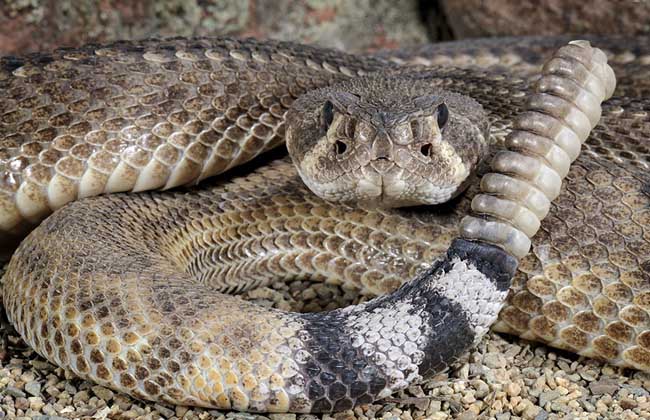
The rattlesnake gets its name from the string of horny rings at the end of its tail, whose vibration can produce a loud sound for a long time, causing enemies to dare not approach or to be scared away. It is extremely venomous, enough to put a bitten person to death, and a rattlesnake already has sharp fangs capable of injecting venom at birth. However, it also has many major natural predators in the wild. Below, let us take a look together at what the natural predators of rattlesnakes are!
Kingsnake
The kingsnake, also called the emperor snake, is a snake of the genus Lampropeltis in the family Colubridae, suborder Serpentes, and gets its name from feeding on other snakes. The kingsnake's food includes rattlesnakes and copperheads, and it is immune to the venom of rattlesnakes and copperheads; sometimes individuals of the same species may even kill and eat one another. The scarlet kingsnake is a small species from the southeastern United States, feeding mainly on lizards. Stronger wild desert kingsnakes will also devour rattlesnakes of the same snake family.
Roadrunner
The roadrunner is a bird of the family Cuculidae, order Cuculiformes, and often holds its tail up. It is unprepossessing in appearance but very comical. Although it is a bird, it can only glide short distances and is very good at running fast. It runs across the wilderness of Texas and New Mexico in the United States at very high speed, able to run more than 500 m per minute. The roadrunner has a large appetite and mainly catches and eats insects, lizards, and even rattlesnakes.
Crested serpent eagle
The crested serpent eagle, also called the large-crested eagle, snake hawk, snake eagle, white-bellied serpent eagle, crowned serpent eagle, and crested snake-catching eagle, is a medium-to-large eagle. It inhabits high, tall dense forests in deep mountains, likes to be active in woodlands and forest edges, and circles and flies high in the sky, giving calls resembling whistles. It feeds on snakes, frogs, lizards, and the like, and also eats rodents, birds, crabs, and other crustaceans.
Mongooses
Mongooses are animals with long bodies, long tails, and short limbs, and are the general name for animals of the family Herpestidae. They mainly eat snakes, and also prey on frogs, fish, birds, rodents, crabs, lizards, insects, and other small mammals. Mongooses are natural predators of snakes and not only have the ability to fight snakes but also possess resistance to venom. Of course, because mongooses are limited by body size and strength, they are more than a match for venomous snakes such as pit vipers and cobras, but when they encounter fiercer opponents such as king cobras or pythons, they are difficult to handle, and the best option is to flee.
Wild boar
The wild boar has a very omnivorous diet and eats anything it can eat, including grass, fruit, nuts, roots, insects, bird eggs, rats, carrion, and so on. Wild boars are not only good at preying on rabbits, mice, and the like, but can also prey on scorpions and snakes, such as venomous snakes including pit vipers, vipers, and five-step snakes. Although scientists do not yet have a consensus on whether wild boars are immune to toxins, wild boars appear not to suffer any distress caused by eating these dangerous foods.
Red-tailed hawk
The red-tailed hawk is one of the largest members among the various birds of the genus Buteo distributed in North America, and is found in areas of various terrains and elevations, including deserts, grasslands, coniferous forests, deciduous forests, tropical rainforests, farmland, and urban areas. It is opportunistic in predation, and its food mainly includes various small mammals, birds, and reptiles, such as rodents, grouse, quail, waterbirds, bats, shrews, snakes, lizards, crustaceans, insects, and so on.