What Kind of Snake Is a Rattlesnake? A Detailed Guide
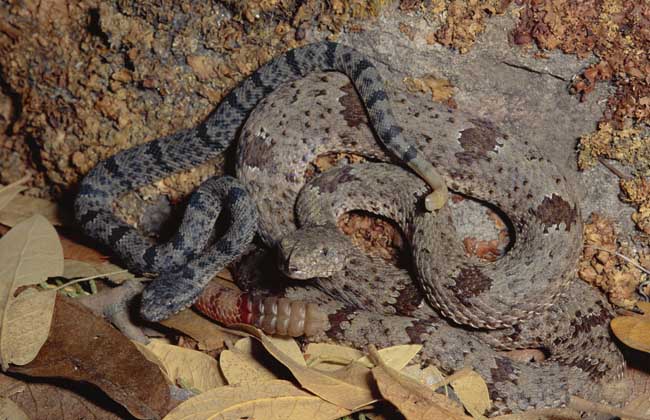
The rattlesnake is a solenoglyphous venomous snake of the family Viperidae, class Reptilia, generally about 1.5 to 2 m in body length, with a yellowish-green body, diamond-shaped dark brown markings on its back, and a series of keratinous rings at the tip of its tail, which are remnants left after repeated molts. When it encounters an enemy or engages in sudden activity, it rapidly shakes the tail rings, at 40 to 60 shakes per second, and can produce a loud sound for a long time, causing the enemy to dare not approach or to be frightened away; hence the name rattlesnake.
Rattlesnakes comprise two genera, the dwarf rattlesnakes and the true rattlesnakes. Dwarf rattlesnakes are small in body size and have 9 large scales on top of the head. True rattlesnakes vary in body size depending on the species, but the scales on top of the head are all very small. The most common in North America are the timber rattlesnake of the eastern and central United States, the prairie rattlesnake of several western U.S. states, and the eastern diamondback rattlesnake and western diamondback rattlesnake, the latter two being the largest of the rattlesnakes. Rattlesnakes are distributed in the arid regions from Canada to South America, with considerable variation in body length; for example, several smaller species in Mexico are only about 30 cm, while the eastern diamondback rattlesnake can reach about 2.5 m.
The typical feature of a rattlesnake is the rattle at the tail, which resembles a string of dry hollow beads. When shaken, the rattle rings rub against one another and vibrate the hollow chambers to produce a hissing sound that warns intruders. A newly hatched young rattlesnake has only one rattle ring at the tail, and the rattle rings gradually increase with each molt (except for the Santa Catalina Island rattlesnake, whose rattle loses one segment with each molt). The longer the string of rattle rings, the louder the sound produced, which also indicates that the rattlesnake is older. Young rattlesnakes that do not yet have rattle rings cannot produce a warning sound, so when they encounter intruders they attack without warning.
Rattlesnakes eat rodents and other small animals (such as rabbits and mice), and young snakes mainly feed on lizards. Rattlesnakes use venom to quickly subdue prey rather than constricting it; the venom can immediately paralyze or kill the prey. Rattlesnakes will track prey that has not been subdued by the venom and tries to escape, and their strike distance can reach two-thirds of their body length. Kingsnakes, roadrunners, pigs and hawks are all natural enemies of rattlesnakes.
Rattlesnakes are born with fangs capable of injecting venom and can control the amount injected. The venom of most rattlesnakes has the function of destroying blood tissue, heavily attacking platelets in the blood, causing the blood to be unable to clot and producing severe internal bleeding; but some instead greatly increase platelets, causing the blood in the main blood vessels to coagulate into a jelly-like state, obstructing blood flow and ultimately causing blood vessels to rupture due to blood blockage. A few, such as the venom of the small-scaled rattlesnake, also include a function that attacks the nervous system.
Like other snakes, rattlesnakes can tolerate neither heat nor cold, so species in tropical regions have become nocturnal, hiding during the day in various concealed places (such as burrows), and in winter gathering in rock crevices to hibernate. Most rattlesnakes mate in spring, and all species are ovoviviparous, usually giving birth to a dozen or so young in a litter. The young snakes are already able to fend for themselves after birth, so the mother snake does not stay by the young.