Detailed Explanation of Key Points and Methods of Oriental Rat Snake Breeding Techniques
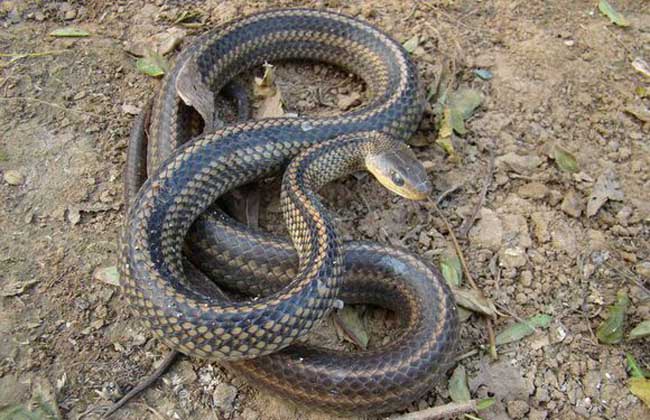
The Oriental rat snake (Zaocys dhumnades) is a relatively large non-venomous snake of the genus Zaocys in the family Colubridae. It grows fast, has strong adaptability, high disease resistance, and sells well on the market, making it very suitable for artificial breeding. Used as medicine, it has the effects of dispelling wind, dredging collaterals, and relieving spasms, and can treat conditions such as stubborn rheumatic arthralgia, numbness and contracture, and facial paralysis from stroke. It has very high breeding prospects. Let us take a look at the breeding techniques of the Oriental rat snake together below!
Male and Female Identification of the Oriental Rat Snake
Male and female Oriental rat snakes have similar body shapes. The male has a larger head, smaller ventral scales, and more subcaudal scales; in particular, the base of the tail is longer than that of the female, and it has a pair of "hemipenes" that are slightly swollen. The most accurate identification method is to turn the rear half of the Oriental rat snake belly-up, locate the cloacal opening, then use the thumb to press a few centimeters behind the cloacal opening, squeezing from back to front; a pair of "hemipenes" will protrude from the cloacal opening. The female's head is slightly smaller than the male's, with more ventral scales and fewer subcaudal scales, and the tail is shorter than the male's, with the tail suddenly becoming thinner after the cloacal opening; the cloacal opening is flat and concave. Using the same method of pressing a few centimeters behind the cloacal opening with the thumb and squeezing from back to front, no pair of "hemipenes" will protrude.
Selection of Breeding Oriental Rat Snakes
Female Oriental rat snakes usually lay eggs between July and August, laying 7 to 30 eggs each time, with an incubation period of 45 to 50 days. Females account for 51% of the male-to-female ratio, fertilized eggs account for 91.4% of the eggs laid, the natural hatching rate is 64.6%, and the natural survival rate is 30%. To improve breeding efficiency, select excellent breeding snakes that are over 3 years old, weigh more than 400 grams, have a strong physique, are free of injury and disease, grow and develop well, are lively and active, crawl flexibly, have a strong ability to coil up, move swiftly and powerfully, and have strong reproductive capacity. The ratio of female to male snakes for mating can be 5 to 8:1.
Mating and Egg Laying of the Oriental Rat Snake
The breeding period of the Oriental rat snake is from May to July each year. When the snakes are in heat, place breeding male snakes into the group of breeding female snakes according to the ratio and let them mate freely. To check whether a female snake is carrying eggs, gently pinch its neck with one hand, and with the other hand stroke from the female's abdomen to the cloacal opening. If it is pregnant, its abdomen will feel bumpy. The closer the bumpy area is to the cloacal opening, the closer the snake is to the egg-laying date. If the bumpy area is found to be only 2 to 3 cm from the cloacal opening, it indicates that the snake is about to give birth (generally it will lay eggs within 1 day), and the snake about to give birth should be placed in a snake box or egg-laying room to lay eggs. Female snakes have no fixed position for laying eggs. Once snake eggs are found, they should be collected promptly for incubation to prevent the eggs from being exposed to prolonged sunlight and wind and rain, which can cause uneven temperature and humidity and other factors that reduce the hatching rate of the snake eggs.
Artificial Incubation of the Oriental Rat Snake
For incubators for the Oriental rat snake, large-mouthed jars, tanks, barrels, or boxes are mostly used as containers. A layer of clean sandy soil about 30 cm thick is laid on the bottom of the container (sand-to-soil ratio of 3:1). The humidity should be such that it can be held into a ball by hand and breaks apart when released. Then press it firm, and place the fertilized snake eggs horizontally (they must not be stood upright) in rows on the sandy soil in the container. Add about 10 cm of sandy soil on top of the eggs. In high-cold regions, cotton can be placed over the incubator for insulation. Then place the incubator indoors and cover it to prevent mice, ants, mosquitoes, and other pests from harming the snake eggs. Also pay attention to keeping the effective incubation temperature above 28 to 30°C relatively stable. If it is below 20°C, the incubation period will be prolonged and the snake eggs may even fail to hatch young snakes. If the temperature is too high, although young snakes hatch earlier, the number of deformed young snakes and the mortality rate increase. Water should also be sprayed frequently to keep the absolute humidity of the sandy soil at around 15%. Turn the eggs once every 7 to 10 days, examine the eggs to check their embryonic development, and promptly pick out unfertilized eggs or eggs with dead embryos.