Is the Oriental ratsnake venomous? Understanding the toxicity of the Oriental ratsnake in one article
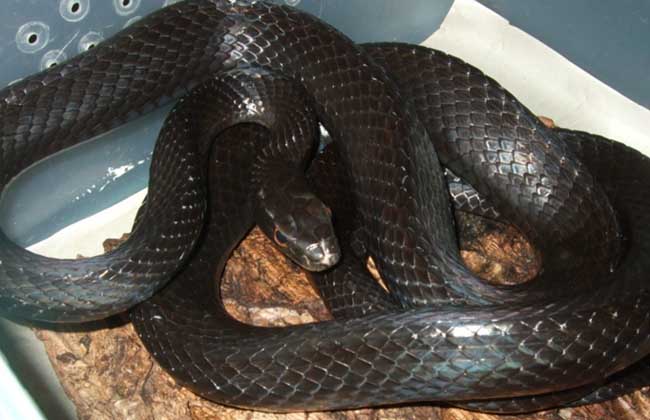
The Oriental ratsnake is a relatively large snake of the genus Ptyas in the family Colubridae, also known as the black snake, black wind snake, etc. It usually lives in hilly areas and is a stenophagous snake, feeding mainly on frogs, lizards, fish, rodents, etc. Because of its fast growth, strong adaptability, high disease resistance, and good market demand, it is very suitable for artificial breeding. Let us take a look below at whether the Oriental ratsnake is venomous!
Is the Oriental ratsnake venomous?
The Oriental ratsnake is not venomous. The Oriental ratsnake is a relatively large non-venomous snake with a total body length that can reach more than 2.5 m. It inhabits low and mid-mountain zones below 1600 m in altitude, often near farmland and ditches, and is sometimes also found in villages. It moves quickly, reacts agilely, and is gentle in nature, usually not biting people. Due to habitat destruction and large-scale hunting by humans, the number surviving in the wild has greatly decreased at present, and it should be protected.
What food does the Oriental ratsnake eat?
The Oriental ratsnake mainly lives in hilly areas and is a stenophagous snake, feeding on frogs (its main food), lizards, fish, rodents, etc. It has the habit of chasing and capturing prey, and mainly preys on live food. The Oriental ratsnake is usually not very interested in dead animals, but when food is scarce it also eats some dead food, which must have just died; it is not interested at all in spoiled and deteriorated matter. The Oriental ratsnake can swallow small animals several times larger than its head, such as large toads, but the swallowing speed is noticeably slower, sometimes taking as long as 15 to 25 minutes. Its food intake is not very large, and it is rare for it to swallow several frogs in a row at one time. Its digestive capacity is very strong, and it needs to be fed once every 4 to 6 days.
Common types of the Oriental ratsnake
1. Common Oriental ratsnake: The common Oriental ratsnake is a relatively large non-venomous snake of the genus Ptyas in the family Colubridae, with a total length that can reach more than 2 m. Its head is flat and round, and the boundary between the head and neck is not obvious. The internasal scales are wider than long, the prefrontal scales are large, the frontal scales are large at the front and small at the back, the supraocular scales are broad, and the nostrils are oval. The body scales are in 16 to 14 rows, the ventral scales are 186 to 205, the tail gradually becomes slender, and the body is grayish-brown with the edges of each scale dark brown. It is distributed in East China, South China, Southwest China, and Hunan, Hubei, Shanxi, Hebei, and other places.
2. Black net Oriental ratsnake: The black net Oriental ratsnake is a relatively large non-venomous snake of the genus Ptyas in the family Colubridae, with a total length that can reach 2.5 m. There is a yellow longitudinal stripe in the middle of the back, and there are two black longitudinal stripes on each side of the body, which disappear toward the rear of the body. It inhabits low and mid-mountain zones below 1600 m in altitude, often near farmland and ditches, and is distributed in India, Thailand, Vietnam, Malaysia, Indonesia, and Yunnan and other places in mainland China.
3. Black-lined Oriental ratsnake: The black-lined Oriental ratsnake is a relatively large non-venomous snake of the genus Ptyas in the family Colubridae, with a body length of 120 to 200 cm. Males are larger and females smaller. The top of the head is yellow-green, with two black longitudinal stripes on each side; in young individuals the stripes run the entire length of the body, and as they age they gradually disappear from the front part of the body. The ventral surface is light yellow, with black longitudinal stripes on both sides. It is mainly distributed in Sichuan, Yunnan, Tibet, and Guizhou in China as well as some countries in Southeast Asia.