Why Are Sloths So Slow? An Analysis of the Reasons Behind Sloths' Sluggish Movements
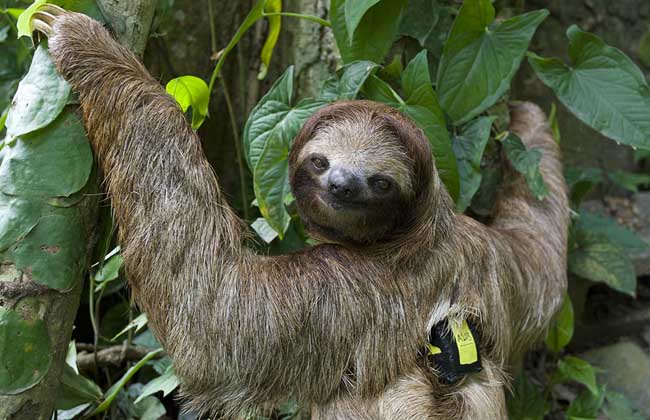
The sloth gets its name because it moves slowly and often hangs upside down from tree branches with its claws for hours without moving. It has a keen sense of smell, while its vision and hearing are not well developed. It feeds on leaves and fruits, and has become highly specialized for an arboreal life, having lost the ability to move on the ground. Its fur is grayish-brown all over, but appears green because algae grow on the hair. Let's take a look below at why sloths are so slow!
Why are sloths so slow?
Sloths move slowly in order to conserve energy. In fact, sloths move more slowly than any other mammal on Earth, and are famous for traveling no more than 38 meters a day. Yet their lazy nature allows them to make the most of the resources around them. Because sloths are herbivores, they have very little energy to use for moving quickly. Sloths feed on many species of trees, possibly including fruits, flower buds, and twigs and leaves, but none of these foods provides much nutrition. To make up for the lack of energy, they can only survive on a poor diet through adaptations such as moving slowly.
How slow is a sloth's movement?
The sloth is the only wild animal that has plants growing on its body. Although it has feet, it cannot walk, and relies on its forelimbs to drag its body forward, so to move a distance of 2 kilometers, it needs 1 month. It is also an animal that is incredibly lazy, too lazy to do anything, even too lazy to eat, too lazy to play. It can endure hunger for more than a month, and when it absolutely must move, its movements are also languid and extremely slow. Even when being chased or captured, it seems as if nothing is happening, crawling slowly, and its escape speed does not exceed 0.2 meters per second.
Why haven't sloths gone extinct?
First, sloths do a good job with protective coloration. They are already very close to the background color, and on top of that they are good at making use of green algae growing on their bodies, so from a distance they are very hard to spot. Their fur is also hard, so they have no problem defending against ordinary carnivores. Although their sharp claws have no attacking function, because they cling so tightly to tree trunks, eating them is quite difficult for any animal. In addition, sloth meat does not taste good, which is an evolutionary benefit that helps them survive. Generally, animals with conspicuous colors and no means of defense taste very bad, and predators will not expend their own energy eating unpleasant prey.