How long do sloths actually live?
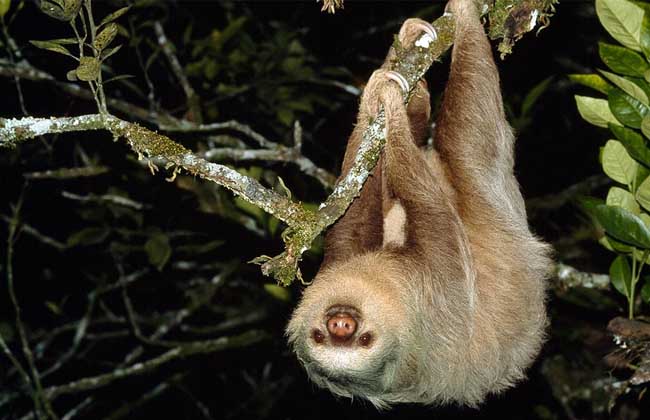
The sloth is the general name for animals of the suborder Folivora under the order Pilosa in the class Mammalia. They are mainly distributed in the tropical rainforests of Central and South America. Their fur is grayish-brown all over, and because algae grow on their fur, their appearance looks green. People often use a crawling turtle as a metaphor for moving slowly, but in fact sloths move even more slowly than turtles. Let us take a look below at how long sloths live!
How long do sloths live?
Sloths have become highly specialized for an arboreal life and have lost the ability to move on the ground. They usually hang upside down from tree branches. Their fur is fluffy and grows in a reversed direction, and it appears green because of attached algae, making them hard to spot in the forest. Most species breed in spring, and the gestation period varies by species, 4 to 6 months or 9 months, with 1 young per litter. Lifespans vary, and some species live up to 11 years.
What do sloths eat?
Sloths are strictly arboreal and purely herbivorous. They mainly eat leaves, tender buds, and fruit. The best food for sloths is low-calorie leaves, and eating a little takes several hours to digest. Once full, they hang upside down from branches and sleep lazily. It can be said that they make trees their home and rarely come down to the ground. They rely on hugging tree branches and climbing upward with their bodies upright, or hanging upside down and moving forward by alternating their four limbs. They can hang upside down for long periods, and even sleep in this posture.
How slowly do sloths move?
The sloth is the only wild animal that has plants growing on its body. Although it has feet, it cannot walk, and relies on its forelimbs to drag its body forward, so to move a distance of 2 kilometers, it needs 1 month. It is also an animal that is incredibly lazy and cannot be bothered to do anything, even too lazy to eat, too lazy to play, and can endure hunger for more than a month. When it absolutely must move, its movements are also lazy and extremely slow. Even when being chased or captured, it seems as if nothing is happening, crawling slowly, and its escape speed does not exceed 0.2 m/s.