What are the living habits of sloths? A full guide in one article
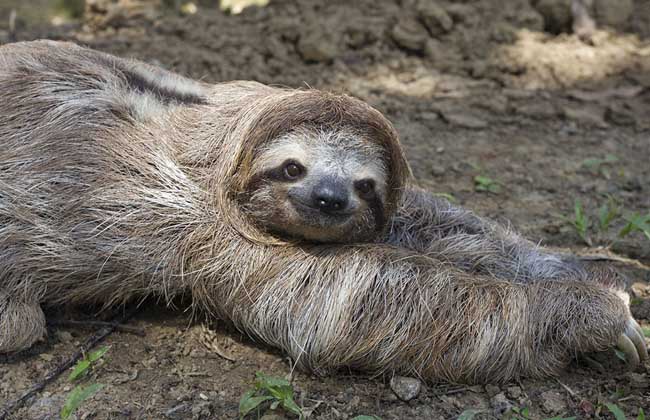
Sloths live in trees all year round, hooking their claws onto branches and hanging their bodies upside down, and move about in the trees. They have a keen sense of smell, while their vision and hearing are not very well developed. They feed on leaves and fruit, and their natural enemies are pythons and birds of prey. They are currently the only wild animal that has plants growing on its body. Their fur is grayish-brown but appears green because algae attach to the hair. Let us take a look below at the living habits of sloths!
The morphological characteristics of sloths
The sloth is the only wild animal that has plants growing on its body. Although it has feet, it cannot walk, and relies on its forelimbs to drag its body forward. Its fur is fluffy, long and thick; its head is short and round; its ears are small and hidden in the fur; its tail is short; its forelimbs have 3 fingers and its hind limbs have 3 toes, all with flexible, sharp claws; its forelimbs are longer than its hind limbs; its upper jaw has 5 pairs of teeth and its lower jaw has 4 pairs, 18 in total; its stomach is divided into several chambers; and it has 9 cervical vertebrae, the most among mammals. Its whole body is grayish-brown in fur color, and because algae attach to the hair, its exterior appears green.
The feeding habits of sloths
Sloths are strict tree dwellers and purely herbivorous, mainly eating leaves, tender buds and fruit. For sloths, the best food is low-calorie leaves, and eating a little takes several hours to digest. Once full, they hang upside down on branches and sleep lazily. It can be said that they make their home in trees and rarely go down to the ground. They climb upward by holding onto branches with their bodies upright, or hang upside down and move forward by alternating their limbs. They can hang upside down for a long time, and even sleep in this posture.
The reproductive habits of sloths
Most species of sloths breed in spring. Mating lasts only about 5 seconds, and it is estimated that mating is the only thing sloths do relatively quickly. The gestation period of sloths varies by species, usually 4 to 6 months or 9 months, with 1 young per litter. After birth, the baby sloth stays attached to its mother for 5 weeks.
The habitat environment of sloths
Sloths have become highly specialized for an arboreal life and have lost the ability to move on the ground. They usually hang upside down on branches, and their fluffy hair grows in the opposite direction, with algae attached to the hair making it green, so they are difficult to spot in the forest. The three-toed sloth is widely distributed, from Honduras in the north to northern Argentina in the south. The two-toed sloth has a slightly narrower distribution, from Nicaragua in the north to northern Brazil in the south.
The movement speed of sloths
The sloth is an unusually lazy mammal. It is too lazy to do anything, even too lazy to eat, too lazy to play, and even when being chased or captured by people it seems as if nothing is happening, crawling slowly. When facing danger, its escape speed does not exceed 0.2 m/s. People often compare slow movement to a turtle crawling, but in fact sloths crawl even more slowly than turtles.