What are the characteristics of a butterfly's living habits? This article gives you a comprehensive understanding
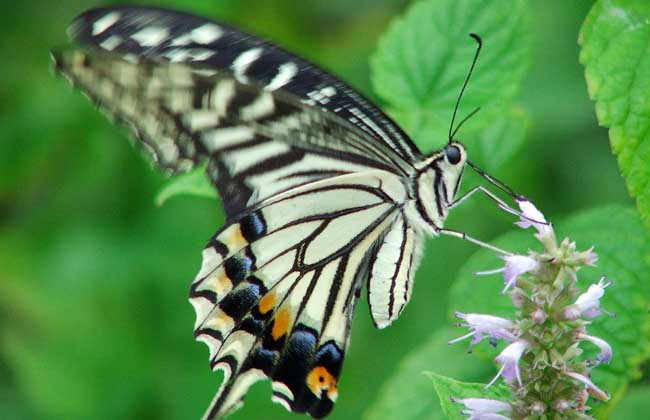
Butterflies are generally brightly colored, with many stripes on their bodies and rich colors, and various markings on their wings and bodies. The largest butterfly can reach a wingspan of about 28 to 30 cm, while the smallest is only about 0.7 cm. They are most numerous in the Amazon River basin of South America, followed by Southeast Asia. Let us take a look below at the living habits of butterflies!
Activity patterns of butterflies
From the perspective of activity patterns, among many gregarious species, the young larvae feed and rest in a coordinated way (more obvious in instars I and II), gathering together to feed or rest. Luehdorfia chinensis is one example. Some butterflies, such as the larvae of the small tortoiseshell (Aglais urticae), often gather in groups of dozens among nettle branches and leaves, spinning silk into a messy web and hiding within it like spiders, thereby defending against external enemies, while also feeding and resting at the same time, quite regularly. The resting places of butterfly larvae are generally very hidden, so it is not easy to find individual larvae in the wild.
Resting characteristics of butterflies
Some butterfly larvae often have the habit of joining leaves together to make a nest and hiding inside. The method of joining leaves differs by species: some join one leaf, some join several leaves, each with its own style or technique. The larvae of the banana skipper (Erionota torus) can fold and stick the edges of banana leaves into a nest and hide inside, while rice skippers often join several leaves together and live in the nest. Larvae with nest-dwelling habits or web-spinning gregarious habits all feed near their resting place and never go far. At the slightest disturbance, they immediately retreat into the nest to hide. This is completely different from the resting habits of general butterflies.
Mating and reproduction of butterflies
In general butterflies, males emerge earlier than females. After that, males fly everywhere, searching for newly emerged females based on the sex pheromones released by females and chasing them to mate. Before mating, there is a courtship process, in which the female's markings and colors and her pheromones play an important role. In addition, the structure of the external genitalia must match. If a female resting on a leaf has already mated, when a male approaches, she spreads all four wings flat and raises her abdomen high, refusing to fly. That is a sign that the female does not accept mating, so the male circles for a while and then flies away. Otherwise, they mate.
Feeding habits of butterflies
1. Larvae: The feeding targets of butterfly larvae differ by species. Most larvae prefer leaves. Some species, such as the pollen butterfly and the orange-tip butterfly, prefer flower buds. Some species bore into tender pods or young fruits, such as the pea blue (Lampides boeticus) boring into tender bean pods, and the gardenia blue boring into young gardenia fruits. In addition, among the Lycaenidae, a few species of larvae are carnivorous. For example, the coffee mealybug blue prefers coffee mealybugs, and the bamboo aphid blue feeds exclusively on bamboo aphids. Such carnivorous species are rare among butterflies and are beneficial insects.
2. Adults: Most butterflies suck nectar. As for butterflies that suck nectar, they not only suck nectar but also prefer the nectar of certain specific plants. For example, the blue swallowtail (Papilio protenor) prefers the nectar of Liliaceae plants, the cabbage white (Pieris rapae) prefers the nectar of Brassicaceae plants, and the fritillary prefers the nectar of Asteraceae plants, and so on. Some butterflies that do not suck nectar include the bamboo-eye butterfly, which sucks the sap of Ficus carica, and the pale purple nymphalid, which sucks the sour liquid of diseased oak and poplar trees. Some butterflies also suck the flesh of grapes, and butterflies are commonly seen feeding in grape fields.