What food does the red panda eat? Introduction to its main food types
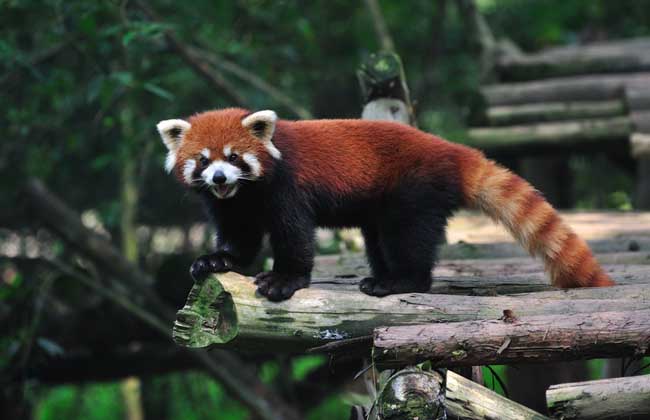
The red panda, also known as the red cat-bear, nine-section wolf, and golden dog, is a mammal of the order Carnivora, family Ailuridae, genus Ailurus. It looks like a cat but is larger and heavier than a cat, with a reddish-brown coat all over. It lives in mixed coniferous and broad-leaved forests or evergreen broad-leaved forests with bamboo groves at altitudes below 3000 m, and likes to bask in the sun on sunny cliffs or treetops. Let's take a look below at what food the red panda eats!
What food does the red panda eat?
The red panda likes to eat bamboo shoots, tender branches, and bamboo leaves of arrow bamboo, various wild fruits, leaves, moss, as well as prey such as small birds or bird eggs and other small animals and insects. It especially likes sweet-tasting food. Many grass-green droppings are commonly seen where it is active. Like the raccoon, it is quite fond of cleanliness and defecates at fixed locations. After eating, it has the habit of wiping its mouth and face with its paws or licking its mouth clean with its tongue.
The red panda's living habits
The red panda usually lives in large tree hollows, stone caves, and rock crevices. It comes out in the morning and evening to move about and forage, and during the day it mostly sleeps in caves or in the deep shade of large trees. When sleeping, it likes to curl its head into its limbs, hold its head with its forelimbs, and cover its body with its tail. Sometimes it lies high on tree branches with its two feet hanging down. It is good at climbing and can often climb onto high, thin branches to rest or avoid enemies. The soles of its feet are covered with thick, dense fur, which is also suitable for walking on wet mossy ground or rocks under the forest. When walking, its front feet turn inward and its gait is waddling, similar to a bear. It usually moves slowly and is relatively docile, rarely making sounds. Its hearing and vision are relatively dull, and its sense of smell is not especially keen either. It generally moves alone, in pairs, or in small groups, and has no hibernation habit. When it rains or snows, it mostly shelters from the rain and snow in rock crevices or in the deep shade of large trees.
The red panda's reproductive habits
The red panda generally comes into estrus between March and April in early spring. During the estrus period, both males and females often make unique courtship calls and frequently rub their external genitalia on stones or tree stumps. During this period, the female also discharges secretions with an odor. The gestation period is 117 to 122 days, and young are born from May to July, with 2 to 3 cubs per litter, occasionally 4. Because the red panda has relatively strong reproductive capacity, under natural conditions the proportion in the population is often that juveniles outnumber adults and the young outnumber the old.
When the red panda cub is first born, it is covered with fur, its coat color is pale, its eyes are closed, its head is grayish-white, and it has no facial markings. Its body length is about 20 cm, and its weight is about 100 to 150 g. Its tail is very long, about 5 cm, but the tail rings are not obvious. At about 21 to 30 days, it begins to open its eyes and can make squeaking sounds. Both its forelimbs and hindlimbs can move slowly, and its body color gradually darkens. The cub lives together with the mother for about one year, and often it is not until the mother is about to give birth the following year that she drives the cub away, and the cub begins to live independently.