What is the reason mules cannot reproduce?
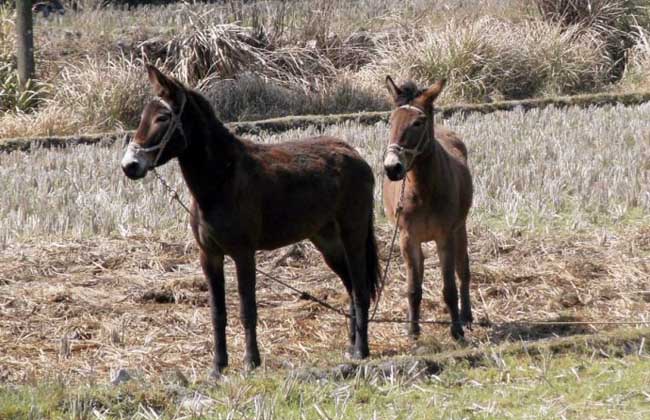
A mule is a hybrid of a horse and a donkey, and there are both males and females. Male mules and most female mules are infertile. The infertility is because their chromosomes do not pair up (63 chromosomes), so their germ cells cannot undergo normal division (that is, meiosis). Female mules have sexual function, and the uterus can carry an embryo, but the most difficult part is getting a female mule pregnant. Strictly speaking, the offspring produced by a male donkey and a female horse is called a horse mule, and the offspring produced by a male horse and a female donkey is called a donkey mule.
Whether it is a horse mule or a donkey mule, their chromosome number is not quite normal. This is because donkey chromosome 2 is homologous to horse chromosome 1, donkey 13 with horse 11, and donkey 14 with horse 13. Donkey 16 plus donkey 25 corresponds to horse 5, and the horse has 32 pairs of chromosomes, while the donkey has 31 pairs. Although horses and donkeys are relatively closely related, their gametes can not only combine with each other but also develop into complete individuals, yet the chromosome number in their offspring's cells becomes 32+31. No matter what, there is always one chromosome left alone.
Still, the mule is lucky, because if this were the chromosome number in the cells of a certain horse (if it were a horse, it would be called monosomic 2n-1), it would basically not be able to survive. For sexually reproducing diploid species, the survival ability of a pure haploid is even better than this state. Conversely, if this were the chromosome composition in the cells of a donkey, it would become trisomic, and the extra chromosome would certainly be present in three copies. A mule with 32+31 is not really a relationship of 31 pairs + 1. That is, during meiosis, it will not simply separate the 31 pairs of chromosomes from each other and then randomly assign the extra one. This is the trouble encountered by mules and other hybrid animals: during the process of chromosome separation, their chromosomes tend to separate randomly and assort freely. Because for trisomics that can survive, although their fertility is lower than normal, it is still quite high. Apart from that extra chromosome, all the others can pair normally and separate from each other.
For the unfortunate mule (taking a female mule as an example), what is the chance of producing a normal egg? For example, in an extreme case, the egg happens to contain 31 chromosomes from the donkey, or 32 chromosomes from the horse. Obviously, such a probability is quite low (comrades who are interested can calculate it). Of course, the actual situation does not need to be so extreme. After all, the mule itself can survive, which means that the egg can contain a harmonious combination of horse and donkey chromosomes.
In ancient Chinese books, the offspring produced by a male horse mating with a female mule is called ju, and the offspring produced by a male donkey mating with a female mule is called xu. A typical domestic example of a female mule giving birth to a foal is the report by Zong Enze and others at the Lanzhou Institute of Animal Husbandry, Chinese Academy of Agricultural Sciences, based on years of systematic research, totaling about 13 cases.
There are also quite a few foreign reports of mules giving birth to foals. In 1903, a case of a mule giving birth to a foal was reported in Estonia, Africa. In 1913, on the island of Cyprus, a female mule mated with a male donkey and gave birth to a male foal, and the following year it came into estrus again and was bred (still using a male donkey) and gave birth to a female foal. In 1923, in Morocco, a female mule mated with a riding-type Barb stallion and gave birth to a foal, whose appearance resembled its father——the Barb horse. In 1927, in Nebraska, USA, a female mule mated with a male donkey and gave birth to a foal. In 1939, in Arizona, USA, a female mule mated with a male donkey and gave birth to a foal, which looked exactly like its mother——a mule.