What does the five-paced snake eat? A detailed explanation of the five-paced snake's main food sources
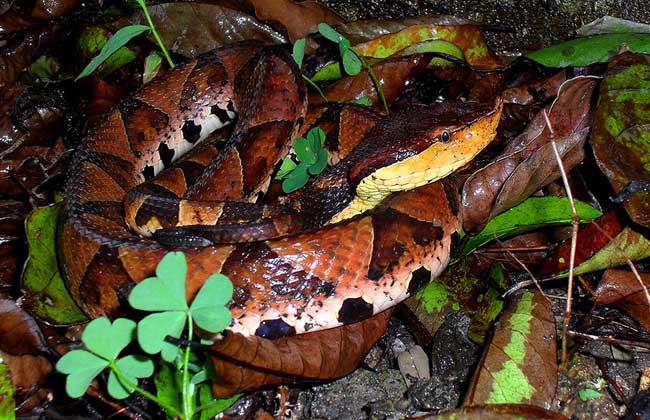
The five-paced snake is a venomous monotypic snake under the subfamily Crotalinae of the family Viperidae in the suborder Serpentes. The juvenile of the genus Deinagkistrodon has only one species, Deinagkistrodon acutus, and it is a quite famous snake species in Asia. It is widely distributed in China, with the largest reserves in the Wuyi Mountain area and the mountainous area of southern Anhui. Outside China, it is found only in northern Vietnam. Now let us take a look at what the five-paced snake eats!
What does the five-paced snake eat?
The five-paced snake is a euryphagous snake species with many types of feed, such as frogs, rodents, insects, and so on. Juvenile snakes have poor predatory ability, and their food mainly consists of larval Rana limnocharis, Quasipaa spinosa, and toads, as well as suckling mice of Wistar rats and Kunming mice. Generally, for 1-year-old juvenile snakes from 10 days after hatching to before the first hibernation, the food mainly consists of larval Rana limnocharis with an average body weight of about 1.6 grams, supplemented by suckling mice weighing about 2 grams. For 2-year-old juvenile snakes from waking after the first hibernation to before the second hibernation, the food mainly consists of adult Rana limnocharis, supplemented by small mice. For 3-year-old juvenile snakes from waking after the second hibernation to before the third hibernation, the food mainly consists of Kunming mice, supplemented by Rana limnocharis and frogs. The feed of adult snakes is mainly artificially bred Kunming mice, Wistar rats, frogs, toads, and so on.
How toxic is the five-paced snake?
The toxicity of the five-paced snake is greater than that of the cobra. The toxicity per unit of the five-paced snake's venom is not strong, but this does not prevent this snake species from in fact being quite dangerous. In the Shibi Township area of Chenxi, Hunan, people bitten by this snake basically all died, while people bitten by cobras could basically all be saved. According to survey data, dangerous incidents and even deaths caused by bites from Deinagkistrodon acutus are indeed relatively common in mainland China at least. On the one hand, this is because this snake species has a relatively large body, is fierce in temperament, has long venom fangs, and the bite wounds are relatively severe. On the other hand, it is also because this snake belongs to a snake species with a relatively large venom yield.
The living habits of the five-paced snake
1. Environment: The five-paced snake mainly inhabits evergreen and deciduous mixed forests at an altitude of 400-700 m. In summer, it likes to move around ditches in mountain valleys. Its requirements for habitat conditions are shade, ventilation, trees, and water. It also moves in tea gardens, farmland, and firewood piles. It can climb trees and can also enter human dwellings. In winter, it mostly overwinters in natural holes formed by tree roots or old rat holes.
2. Activity: The annual activity cycle of the five-paced snake is about 9 months from Awakening of Insects to Major Snow. The main factors affecting activity are temperature, humidity, and food. When the air temperature is 20-30 degrees C, it is most active. When the air temperature is as high as 35-38 degrees C, it mostly gathers toward the water's edge. At night, it is relatively sensitive to illumination with pine torches and has an attacking response to torches. When illuminated with a flashlight, it shows almost no obvious tendency to move toward warmth.
3. Reproduction: The secretion of the scent gland at the base of the tail of the female five-paced snake has a special odor and can attract male snakes. Before mating, there is a mate-chasing phenomenon. During mating, they intertwine with each other. Eggs are mostly laid in natural caves, and the cave passages are shallow, short, and dry. At a terraced field, the cave opening seen was 10 cm, and the cave passage was only 25 cm. The number of eggs laid varies. Young female snakes lay eggs early but in small numbers, while old female snakes lay eggs late but in large numbers, generally 12-18 eggs. The eggs are white, oblong, with soft eggshells that feel like paper when touched. The eggs weigh 16-18 grams and measure 42-45×25-30 mm. When laid, the eggs are mostly arranged upright in a circle and stuck together. Usually, laying is completed in 1-3 days, and the juvenile snakes hatch in about 24 days. At hatching, the body length is 19 cm. After 10 days, the first molting begins, and after 49 days, the second molting occurs.
4. Hibernation: The hibernation period is about 3 months from Major Snow to the Awakening of Insects of the following year. The overwintering caves are relatively deep. When there are many snakes, large and small snakes are together, and sometimes they also live mixed with pit vipers in the same cave. When the air temperature is 8 degrees C, it is equal to the snake's body surface temperature. When the air temperature is higher than 8 degrees C, the snake's body surface temperature is always slightly lower than the air temperature by 1 degree C. When the air temperature is lower than 8 degrees C, the snake's body surface temperature is slightly higher than the air temperature by 1 degree C. When the snake's body surface temperature is above 11 degrees C, it can bite people. For artificially raised juvenile snakes, when the air temperature is lower than 17 degrees C, they coil up and do not move. At 12 degrees C, when touched with tweezers, they show a state of opening their mouths to bite.