What kind of snake is the seven-step snake? A detailed look at this snake
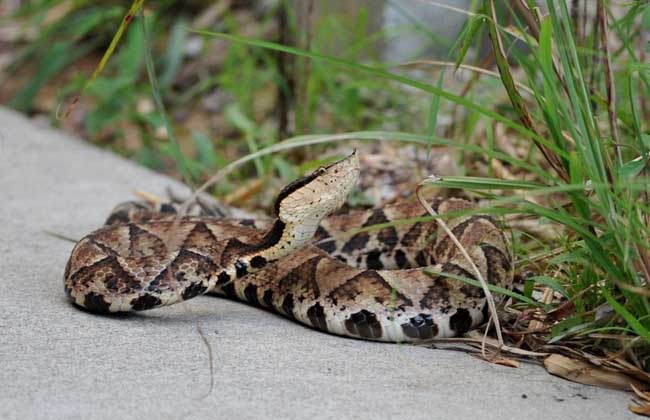
The five-step snake, whose scientific name is Deinagkistrodon acutus (sharp-nosed pit viper), is also known as the hundred-pace snake, five-step snake, qishe, shangu bie, baihua snake, Chinese pit viper and so on. It is a snake of the genus Deinagkistrodon in the family Viperidae, a rather famous venomous snake in Asia, and especially in Taiwan, China and southern China it has been a highly regarded snake since ancient times. It is widely distributed in China, with the largest reserves in the Wuyi Mountain area and the mountainous area of southern Anhui, and outside China it is found only in northern Vietnam.
The seven-step snake has a total length of 120-150 cm, and large individuals can reach more than 200 cm. The head is large and triangular, clearly distinct from the neck, with long tubular fangs. The tip of the snout forms an upturned protrusion from the pointed ends of the internasal scales and the rostral scale. Between the nostril and the eye there is an oval loreal pit. The dorsal scales have strong keels in 21-23 rows, the ventral scales number 157-171, and the subcaudal scales number 52-60; about 20 of the anterior ones are single or mixed with a few paired ones, while the posterior ones are in double rows, and the terminal scale is highly keratinized, forming a pointed hard structure called the "Buddha's fingernail".
The seven-step snake is brownish-black on the dorsal surface and earth-yellow on the sides of the head, the two colors sharply distinct. The body dorsum is brownish or slightly greenish, with 17-19 large grayish-white square blotches, and 3-5 on the tail. These blotches are formed by large triangular markings from the left and right sides meeting at the midline of the back, and occasionally they are arranged in an alternating pattern. The edges of the blotches are dark. The ventral surface is milky white, with irregularly arranged small black dots on the throat, and large black blotches in the center and on both sides of the belly.
The seven-step snake mainly inhabits evergreen and deciduous mixed forests at altitudes of 400-700 m. In summer it likes to be active around ditches in mountain valleys. Its habitat requirements are cool, ventilated places with trees and water. It is also active in tea gardens, farmlands and woodpiles, can climb trees, and can enter human dwellings. In winter it mostly overwinters in natural holes formed by tree roots or old rat holes.
The annual activity cycle of the seven-step snake lasts about 9 months, from Awakening of Insects to Major Snow. The main factors affecting its activity are temperature, humidity and food. It is most active when the temperature is 20-30°C, and when the temperature rises to 35-38°C it mostly gathers near water. At night it is relatively sensitive to the light of pine torches and reacts aggressively to torches, while when illuminated with a flashlight it shows almost no obvious tendency to move toward warmth.
One of the well-known names of the seven-step snake is the "hundred-pace snake", meaning that as long as a person has been bitten by the sharp-nosed pit viper, within a hundred paces of walking the venom will inevitably take effect and cause death, showing that the bite of the sharp-nosed pit viper is indeed extraordinarily venomous. In some places the sharp-nosed pit viper is even called the "five-step snake", further exaggerating the power of its toxin. In fact, the toxicity of the seven-step snake's venom per unit is not strong, but this does not prevent the species from in fact being quite dangerous (this snake is more venomous than the cobra; in the area of Shibi Township, Chenxi, Hunan, those bitten by this snake basically all died, while those bitten by cobras could basically all be saved). According to survey data, dangerous incidents and even deaths caused by the bite of the sharp-nosed pit viper are indeed relatively common, at least in mainland China.