How to grow potted Chinese hibiscus? Detailed care methods and tips
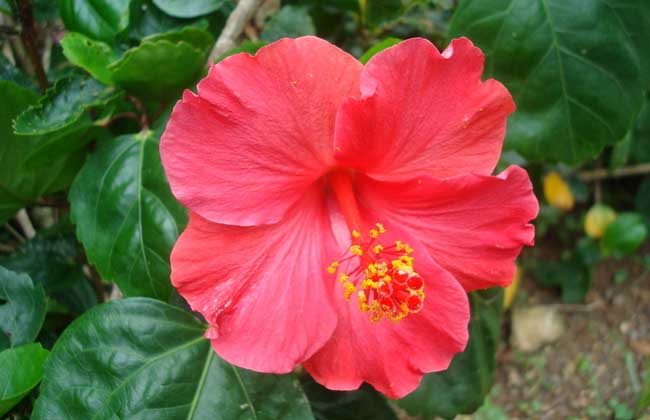
The Chinese hibiscus, scientific name Hibiscus rosa-sinensis, also known as red hibiscus, big red flower, zhuangyuan red and so on, is an evergreen shrub of the genus Hibiscus in the mallow family, native to China. It was already a popular ornamental plant in ancient times, with large and brilliantly colored flowers that bloom in all four seasons, mainly used for garden viewing. It is widely cultivated around the world, especially in tropical and subtropical regions. Let us take a look below at how to grow potted Chinese hibiscus!
Growth habits of the Chinese hibiscus
The Chinese hibiscus is a strongly sun-loving plant, fond of warmth and moisture, requiring ample sunlight, intolerant of shade, cold and drought. In the Yangtze River basin and areas to the north in China, it can only be grown in pots, and must overwinter in a greenhouse or other protected area with the temperature kept at 12-15°C. When the room temperature is below 5°C, the leaves turn yellow and drop; below 0°C, it suffers frost damage. It tolerates pruning well and has strong branching ability. It adapts to a fairly wide range of soils, but grows best in slightly acidic loam rich in organic matter with a pH of 6.5-7.
Propagation methods of the Chinese hibiscus
1. Cuttings: usually done from May to October, or in a greenhouse in winter, but the survival rate is highest during the plum rain season. The best cuttings are one-year-old semi-lignified ones, 10 cm long; remove the lower leaves, keep the top leaves, make the cut smooth, and insert into a sand bed, maintaining high air humidity with a room temperature of 18-21°C. Roots form 20-25 days after insertion. Treating the base of the cuttings with 0.3-0.4% indolebutyric acid for 1-2 seconds can shorten the rooting period. When the roots are 3-4 cm long, transplant into pots.
2. Grafting: usually done in spring and autumn, mostly used for hibiscus varieties that are difficult to root from cuttings or root slowly, especially double-petaled varieties with a low cutting survival rate. Either branch grafting or bud grafting can be used, with single-petaled hibiscus as the rootstock; grafted seedlings sprout branches and bloom the same year.
How to grow the Chinese hibiscus
1. Light: The Chinese hibiscus is a sun-loving species. In early May it should be moved outdoors to a spot with ample sunlight. If light is insufficient, the flower buds tend to drop and the flowers become smaller. Daily sunlight must not be less than 8 hours.
2. Fertilizing: During the growing season, the Chinese hibiscus has a high demand for fertilizer; apply a dilute liquid fertilizer once every 7-10 days.
3. Watering: During the growing season, the Chinese hibiscus needs sufficient water; it must not lack water, nor be waterlogged. Usually water once a day, and during the dog days of summer once in the morning and once in the evening. Sprinkle water on the ground regularly to increase humidity and lower temperature, preventing young leaves from drying and scorching and flowers from dropping early.
4. Overwintering: Move the Chinese hibiscus into the greenhouse after the weather turns cool at the end of October, keeping the temperature above 12°C. Care in late autumn should be cautious, with less fertilizing in the later period to avoid producing autumn shoots. Autumn shoots are tender in tissue and weak in cold resistance, and will suffer frost damage in cold weather.
5. Pruning: The Chinese hibiscus can be pruned and shaped around early spring before it is moved outdoors. Leave 2-3 buds at the base of each branch and cut off the entire upper part; pruning encourages new branches, making growth more vigorous and the plant shape more attractive. After pruning, since the above-ground part consumes less, water and fertilizer should be appropriately reduced.
6. Repotting: For potted Chinese hibiscus, use loose, fertile sandy loam. Every year in early spring before moving it outdoors in April, it should be repotted. When repotting, replace with fresh growing medium, cut off some overly dense and curled fibrous roots, apply sufficient base fertilizer, and add a little phosphate fertilizer at the bottom of the pot.
Pest and disease control of the Chinese hibiscus
1. Leaf spot disease
[Damage] It mostly occurs in late autumn when the weather turns cold, and is even more likely in northern regions when plants are not moved into storage promptly. The initial symptom is pale yellow and red-yellow spots appearing on the leaves; after the spots enlarge they become round or oval. Under relatively humid conditions, black granular bodies, namely the pathogen's pycnidia, may appear on the spots; in the later stage the leaves dry up and drop.
[Control] The key to control is doing a good job of cold protection; when strong winds and cooling occur after autumn, take protective measures. On this basis, timely spraying with 500-800 times diluted zineb or 1500 times diluted ammonium can achieve very good control results.
2. Stem rot
[Damage] It mostly occurs in the rainy season, and is severe under high temperature and rainy conditions. The pathogen mostly infects from the junction of the plant's roots and stem. In the early stage the symptoms are not very obvious; only the cortex at the affected site shrinks and appears slightly dark brown, but the subcutaneous tissue has already begun to rot and turn brown. After the lesion encircles the stem, the plant dries up and dies. Viewed from the leaf surface, in the early stage of the disease the leaves wilt, and yellow-brown necrotic spots appear at the edges and gradually spread inward; in the later stage the leaves dry up and drop.
[Control] The key to control is preventing long-term washing of the plant by heavy rain, and applying 200-500 times diluted thiophanate to the trunk about every 10 days before and after the rainy season. Experiments show that this method has very good control results.
3. Root-knot nematode disease
[Damage] Root-knot nematode disease is also a widespread and seriously damaging disease. Observed from the above-ground part, in the early stage the leaves grow weakly and red-brown necrotic spots appear at the edges, spreading inward; in the later stage the leaves dry up and drop. Observed from the underground part, variously sized nodular growths appear among the root system of the plant; in the early stage they are smooth and flesh-colored, and in the later stage rough and brown, containing pear-shaped female nematodes the size of a needle tip.
[Control] Control is relatively difficult. If there are few plants, the soil can be replaced; the soil must be exposed to the sun for a relatively long time, and the old soil should not be reused. For a larger number of plants, aldicarb granules can also be applied, planned at about 0.5 g buried per 5-cun pot.