When Does the Trumpet Tree Bloom? A Detailed Guide to Its Flowering Period
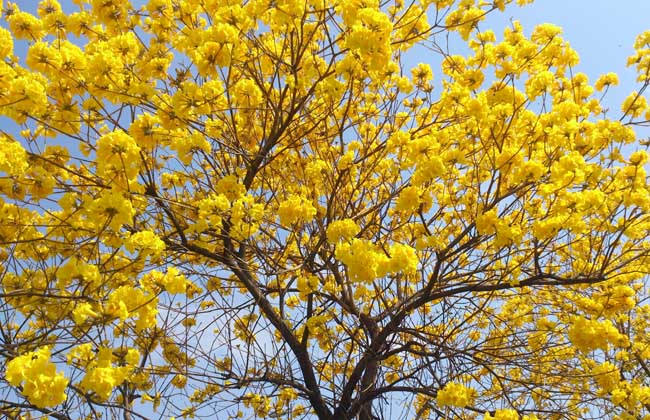
The trumpet tree, scientifically named Handroanthus chrysotrichus (yellow trumpet tree), also known as yellow poui, Brazilian trumpet tree, and ipê tree, is the national flower of Brazil. It is native to Mexico, Central America, South America, and other regions. Its flowers are bright golden yellow, and it is often used as an excellent street tree, and can also be planted in courtyards, on school campuses, in residential areas, and other places. Let us take a look below at when the trumpet tree blooms!
When does the trumpet tree bloom?
The trumpet tree blooms in spring, around March to April. The corolla is funnel-shaped, also resembling a wind chime, with crinkled petal edges and bright yellow flowers. During the flowering season there are many flowers and few leaves, making it quite beautiful. The fruit is a follicle, splitting open downward, with much downy hair to help disperse the seeds. The flowering period lasts only about ten days. The follicle, when splitting, has fruit pods that mostly curl back, splitting open downward; the seeds bear thin wings and have much downy hair to help disperse the seeds.
Propagation Methods of the Yellow Trumpet Tree
The yellow trumpet tree likes high temperatures, with an optimum growing temperature of 20-30°C. In winter it needs a warm, wind-sheltered place to overwinter. In the northern part of South China, winters are low in temperature and also rainy and humid, so attention must be paid to cold damage. The best soil for cultivation is sandy loam rich in organic matter. Good drainage and sunlight are needed, and in our country it is only suitable for cultivation in tropical and subtropical regions. It can be propagated by sowing, cuttings, or air layering, but sowing is the main method, with spring and autumn being the suitable periods. The best cultivation soil is soil rich in organic matter or sandy soil. It likes high temperatures, with an optimum growing temperature of 23-30°C.
Cultivation Techniques for the Yellow Trumpet Tree
1. Temperature and environment: The yellow trumpet tree grows best at 23-30°C and is not cold-tolerant. It also requires strong light during the seedling stage, especially when sowing and raising seedlings in a greenhouse environment, where it is very easy for insufficient light and ventilation to cause weak seedling growth and damping-off disease. Therefore, after the seeds germinate and the true leaves unfold, it is necessary to ensure that the shading rate of the growing environment does not exceed 50%, while maintaining sufficient ventilation.
2. Soil and fertilization: The nursery land for cultivating large yellow trumpet tree seedlings should be chosen in a place with loose, fertile soil and good irrigation and drainage, with planning done and drainage and irrigation ditches well prepared. Plant about 3,000 plants per mu; when planting, apply 250 grams of compound fertilizer or 1 kilogram of organic fertilizer per hole as a base fertilizer, and the base fertilizer should be thoroughly mixed with the soil before planting the seedlings. When planting seedlings, remove the seedling bag and plant firmly and press down.
3. Plant tying: The yellow trumpet tree grows quickly during the seedling stage, and its trunk is soft, so it is prone to lodging and easily produces sprouts, and the natural plant shape is often poor. To obtain an upright and straight plant shape, after planting, when the seedling height is 30-50 cm, a bamboo support about 2 m tall should be erected beside the seedling to guide the plant to grow upright, and the seedling should be tied once for every 50 cm of growth.
4. Pruning and shaping: During the growth period of the yellow trumpet tree, pruning and shaping should be carried out regularly to cut off low, branching side branches. After the leaves fall in winter, a uniform pruning and shaping should be carried out to cut off diseased branches, dead branches, and occasional side branches growing low down, so as to keep the trunk growing straight. When the trunk grows to 1.8-2 m tall, keep the branches at the top to form a crown. After 3-4 years of field cultivation, when the plant is more than 3 m tall and 4-6 cm in diameter, it can be released from the nursery for landscaping.
5. Pest and disease control: The yellow trumpet tree is often harmed by the coffee longhorn borer. Conduct a general survey of cashew trees 3 times each year. When an infested tree is found, immediately use a sharp knife to cut open the bark of the infested tree and remove the longhorn borer larvae inside. After the wound dries, mound soil to promote the growth of adventitious roots, so as to help the plant recover its growth vigor. When insect damage is found, a pesticide can be injected into the tunnel with a syringe to kill the larvae.