Detailed Explanation of the Key Cultivation Techniques for Sweetgum
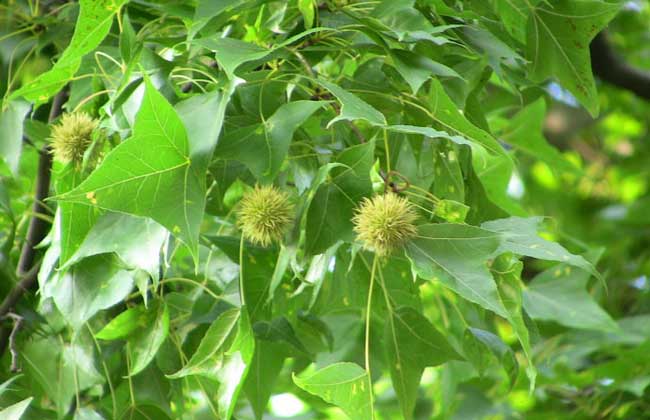
Sweetgum is a deciduous tree of the genus Liquidambar in the family Hamamelidaceae. It prefers a warm and humid climate, is light-loving, and tolerates drought and poor soil. It is produced in China in all provinces south of the Qinling Mountains and the Huaihe River. Its resin is used medicinally to detoxify and relieve pain, stop bleeding and promote tissue regeneration. Its roots, leaves and fruits are used as medicine to dispel wind and remove dampness, and to unblock collaterals and invigorate blood circulation. Its wood can be used to make furniture and packing cases for valuable goods. Let us now take a look at the cultivation techniques for sweetgum.
Growth Habits of Sweetgum
Sweetgum prefers a warm and humid climate, is light-loving, and young trees are slightly shade-tolerant. It tolerates drought and poor soil but not waterlogging. It mostly grows on flat land, near villages, and in secondary forests of low mountains, and grows well on moist, fertile and deep red-yellow loam. It has a deep root system, a thick and long taproot, and strong wind resistance, but does not tolerate transplanting or pruning. Its seeds have the habit of germinating the following year. It is not cold-tolerant, cannot overwinter in the open north of the Yellow River, and is not tolerant of saline-alkali soil or drought. On Hainan Island it often forms the dominant species of secondary forests. It is resistant to fire and has extremely strong sprouting ability.
Seed Propagation of Sweetgum
1. Seed collection: Select superior trees that have grown for more than 10 years, are free of pests and diseases, grow vigorously, and have straight trunks as mother trees for seed collection. When the color of the fruit changes from green to yellow-brown (slightly greenish) and before it has split open, it should be knocked down to facilitate collection. The collected fruits should be placed in the sun to dry, generally for 3 to 5 days. During drying, the fruits should be frequently turned with a wooden shovel. After the capsules split open, take out the seeds, then use a fine sieve to remove the impurities contained in them to obtain pure sweetgum seeds.
2. Nursery site selection: For the sweetgum nursery site, it is best to choose sandy loam with good traffic conditions, close to a water source, deep soil layers, loose soil, relatively fertile soil, and a pH value of 5.5 to 6.0. In order to reduce disease, it is best to choose a plot that was previously a paddy field for raising sweetgum seedlings. Soil that is too clayey or vegetable plots should not be chosen, as these soils contain more bacteria and can easily cause root rot in seedlings.
3. Sowing and seedling raising: Sweetgum seeds are small, and no treatment is needed before sowing. Sowing can be carried out in winter or in spring, but comparatively speaking, winter-sown seeds germinate earlier and more uniformly, while spring sowing is generally carried out in mid-March. Sowing can be done in 2 ways, namely broadcast sowing and drill sowing, with broadcast sowing generally used more often.
Seedling Stage Management of Sweetgum
1. Timely removal of the mulch: About 25 days after sowing, sweetgum seeds begin to germinate, and after 45 days the seedlings have basically emerged completely. The nursery germination rate is 12.3 to 57%, with an average of 35.6%. When the seedlings have basically emerged completely, the mulch should be removed in a timely manner. It is best to remove the mulch in two stages: remove 1/2 the first time, and remove the remaining part 5 days later. The action should be gentle to prevent pulling out the seedlings.
2. Thinning and filling in seedlings: After the mulch is removed, when the seedlings grow to 3 to 5 cm, thinning and filling in should be carried out promptly on cloudy days or light rainy days. Move out the denser seedlings with a bamboo stick, remove the soil, soak the roots in a 0.01% ABT No. 3 or ABT No. 6 rooting powder solution for 1 to 2 minutes, and then replant them in the seedbed where seedlings are missing. The spacing between plants and rows is generally 5×8 cm, and after planting, water thoroughly in a timely manner. After thinning, the density of sweetgum seedlings is controlled at about 100 plants per sq m.
3. Fertilization and irrigation/drainage: 40 days after the mulch is removed from the seedlings, a suitable nitrogen fertilizer can be selected for topdressing. The concentration of the first topdressing should be less than 0.1%, and the application amount is 22.5 kg per hectare. After that, according to the actual condition of the seedlings, topdress once about every 1 month, with the concentration controlled at 0.5 to 1.0%, and the application amount at 45 to 60 kg per hectare. When it rains, in order to prevent root rot in the seedlings, standing water in the nursery should be drained in a timely manner. During continuous drought weather, the nursery should be irrigated in a timely manner to meet the seedlings' water requirements for growth.
4. Loosening soil and weeding: During the seedling growth period, loosen the soil and weed in a timely manner. When the seedlings are small, weeds must be pulled by hand. When they grow to more than 30 cm, chemical weeding can be carried out with a 1/3000 concentration of Goal herbicide, with an amount of 15 ml per mu each time. When applying the herbicide, the sprayer nozzle should be aimed at the middle of the drill row spacing for spraying, and care should be taken not to spray the liquid onto tender leaves and young stems.
Cultivation Techniques for Sweetgum
1. Site selection and land preparation: Choose warm and humid valleys with deep soil, and the lower and middle parts of hillsides. In low mountain and hilly areas, shady slopes or semi-sunny slopes are preferable. Land preparation should be completed before winter. For gentle slopes, full reclamation plus hole-shaped land preparation is preferable. For steep mountain slopes, fish-scale pits or hole-shaped land preparation should be adopted, with hole specifications of 50×50×40 cm.
2. Planting of seedlings: Afforestation should be carried out in early to mid-March when the climate is relatively stable. The general spacing between plants and rows is (1.5 to 3.0)×(1.5 to 3.0) m, with 1110 to 4440 plants per hectare. Timber forests can be planted sparsely, while those mainly cultivated as fodder forests, raw material forests, or combined timber and seedling forests can be planted densely. In hilly and low mountain areas, mixed forests can be established, mixed with tree species such as Masson pine and Chinese fir. The mixing method is strip or block form, with sweetgum accounting for 30 to 40% of the mixture.
3. Weeding and fertilization: Newly established forests should be continuously weeded and loosened for 2 to 3 years, with tending carried out twice in May to June and September to October. In the first year, weeding is the main task, and in the second and third years, expanding the holes is the main task, with a hole diameter of 60 cm and a depth of 15 cm. Young forests should be fertilized in combination with tending from September to May of the following year, using organic fertilizer or compound fertilizer applied in strip trenches. For mature forests, fertilization is best carried out in winter.
4. Pruning and thinning: Starting from the second year after afforestation, prune branches below 1/3 of the base of the trees, as well as forked branches and competing branches, until the forest becomes closed. Pruning should be carried out during the tree dormancy period. Pruning cuts should be smooth, without damaging the bark or leaving stubs. When the stand canopy density reaches above 0.9 and suppressed trees account for 20 to 30% of the total trees, thinning should be carried out. The initial period is around 10 years, and the first thinning intensity is 25 to 35% of the total stand trees. After thinning, the canopy density should not be less than 0.7, and the thinning interval should not be less than 8 years. Thereafter, the thinning intensity is 20 to 30%, and final harvesting is carried out after 30 to 40 years.
5. Pest and disease control: Clear dead branches and fallen leaves from afforestation sites, eliminate sources of pests and diseases, establish mixed forests, improve the forest site ecological environment, remove diseased and pest-infested trees, and destroy pest habitats: fertilize scientifically and thin reasonably. For the control of the brown tent caterpillar, the following methods should be adopted:
① Manual control: Manually remove cocoons. Protect natural enemies: pick out parasitized pupae from cocoons collected in the field and put them back into the forest, or do not collect them. Poison rope method: mix 20% fenvalerate with machine oil at 1:8, soak paper rope for 0.5 hours, take it out and dry it, then tie it at breast height on the tree trunk. The control effect is above 90%. Light trapping of moths: set up insect traps in a concentrated manner in forest lands with heavier damage to trap and kill adults, with good results.
② Chemical control: Use 25% diflubenzuron III 3500-fold solution, or 20% fenvalerate 2000-fold solution, or 25% deltamethrin 2000-fold solution, or 40% omethoate 800-fold solution, and spray the tree canopy with a motorized sprayer in the evening. The control effects are all above 90%. Pyrethroid pesticide solutions can also be sprayed into the web nests, with a control effect of more than 95%.