When does the orange osmanthus bloom? A detailed guide to the orange osmanthus flowering period
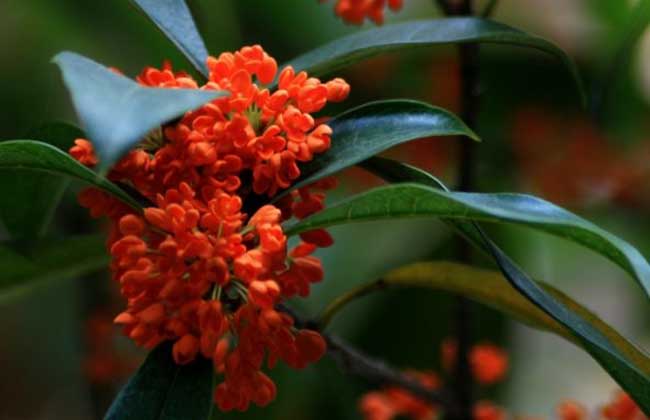
The orange osmanthus (Osmanthus fragrans), also known as muxi, guihua and so on, is an evergreen tree of the genus Osmanthus in the family Oleaceae. It is distributed in the Yangtze River basin and the northern subtropical deciduous and evergreen broad-leaved mixed forest zones to its south. It is dioecious, with oblong leaves and orange-red flowers that are very strongly fragrant, and a rounded spherical crown. It is commonly used as a landscape tree. Let us now take a look at when the orange osmanthus blooms!
When does the orange osmanthus bloom?
The flowering period of the orange osmanthus is from September to early October, and the fruiting period is March of the following year. The orange osmanthus is a precious variety among all osmanthus varieties, with red flowers, and its flowering time is mainly in October, slightly later than the golden osmanthus and the silver osmanthus. The cymes are clustered in the leaf axils or nearly broom-shaped, with many flowers in each axil, broadly ovate bracts, slender and weak pedicels, extremely fragrant flowers, a calyx about 1 mm long with slightly irregular lobes, and a corolla that is yellowish white, pale yellow, yellow or orange-red, with stamens borne in the middle of the corolla tube and very short filaments.
How many years does it take for a cultivated orange osmanthus to bloom?
The orange osmanthus variety is very special and currently cannot be obtained by sowing; it can only be grafted or propagated by cuttings, which determines its flowering time. A grafted orange osmanthus can generally bloom within one year, but most grafted orange osmanthus are used for potted plants and cannot be used as landscape trees. A cutting-propagated orange osmanthus can generally bloom at four years of age, and can be used both for potted plants and for landscape greening.
What should be done if the orange osmanthus does not bloom?
1. Placement: The orange osmanthus is a long-day plant and likes strong light, so a potted orange osmanthus must be placed in sunlight as much as possible. If there is insufficient light, during the growth and development period the potted orange osmanthus cannot get the sunlight it needs, which will cause the plant's leaves to grow leggy and in severe cases even cause leaf drop, affecting the differentiation and formation of flower buds.
2. Sufficient nutrients: Although potted orange osmanthus is not strict about soil, slightly acidic soil is best; it can be made from mountain soil or leaf mold, garden soil, river sand and so on. Fertilization is generally done once in spring when the buds sprout and new leaves emerge, with a quick-acting fertilizer mainly of nitrogen, and once before flowering in July with a fertilizer mainly of phosphorus and potassium. Repot and change the soil once every one and a half years, and apply an appropriate amount of cake fertilizer when repotting. Only in this way can the potting soil be prevented from becoming compacted, allowing its root system to extend freely, so that flowering will not be affected by insufficient nutrients.
3. Proper watering: The orange osmanthus has relatively high water requirements and most fears waterlogging. During the growing season, watering should follow the principle of "dry-wet alternation", and the pot soil moisture is best at 50% water content. If watered too much or if water accumulates in the pot for a long time, it will cause root rot and leaf drop, which will inevitably affect normal flowering. In general, after transplanting the orange osmanthus into new pot soil, water it thoroughly once, and wait about 10 days for the plant to recover growth and produce new leaves before watering normally. Water less before new shoots appear and on cloudy days, and water more in summer and autumn when the weather is dry.
4. Avoid smoke and dust: The orange osmanthus is the plant that most abhors smoke and dust, and is especially sensitive to coal smoke and the oil fumes discharged from kitchens. If a growing orange osmanthus is exposed to the above air pollution, it will grow poorly, with leaves becoming smaller and easily falling off, resulting in fewer or no flowers.
5. Shaping and pruning: The orange osmanthus has the characteristics of a well-developed root system and strong sprouting ability. Generally, an adult orange osmanthus tree sends out new shoots twice a year in spring and autumn. To maintain the physiological balance between reproductive growth and vegetative growth of the plant, pruning should be carried out in time. Pruning is best done after flowering in autumn or before sprouting in spring, cutting off dense branches, leggy branches, residual branches and diseased and pest-infested branches. During the growing season, cut off sprouting branches to help concentrate nutrients and produce abundant flowers.